|
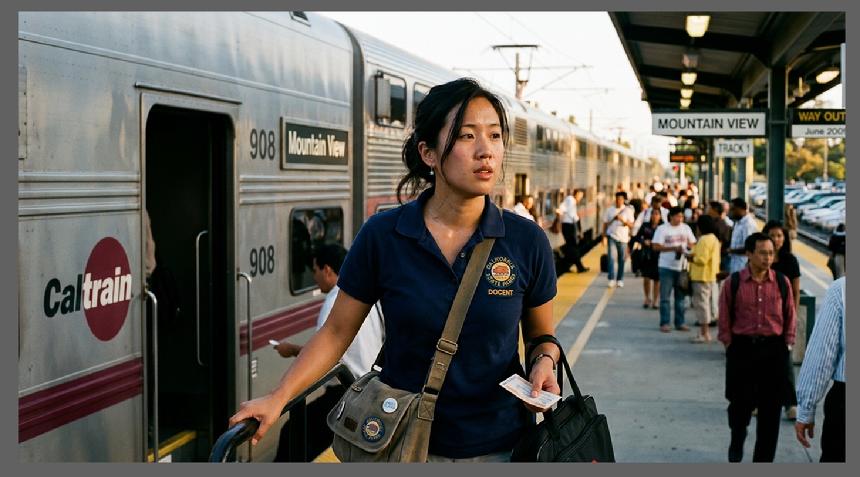
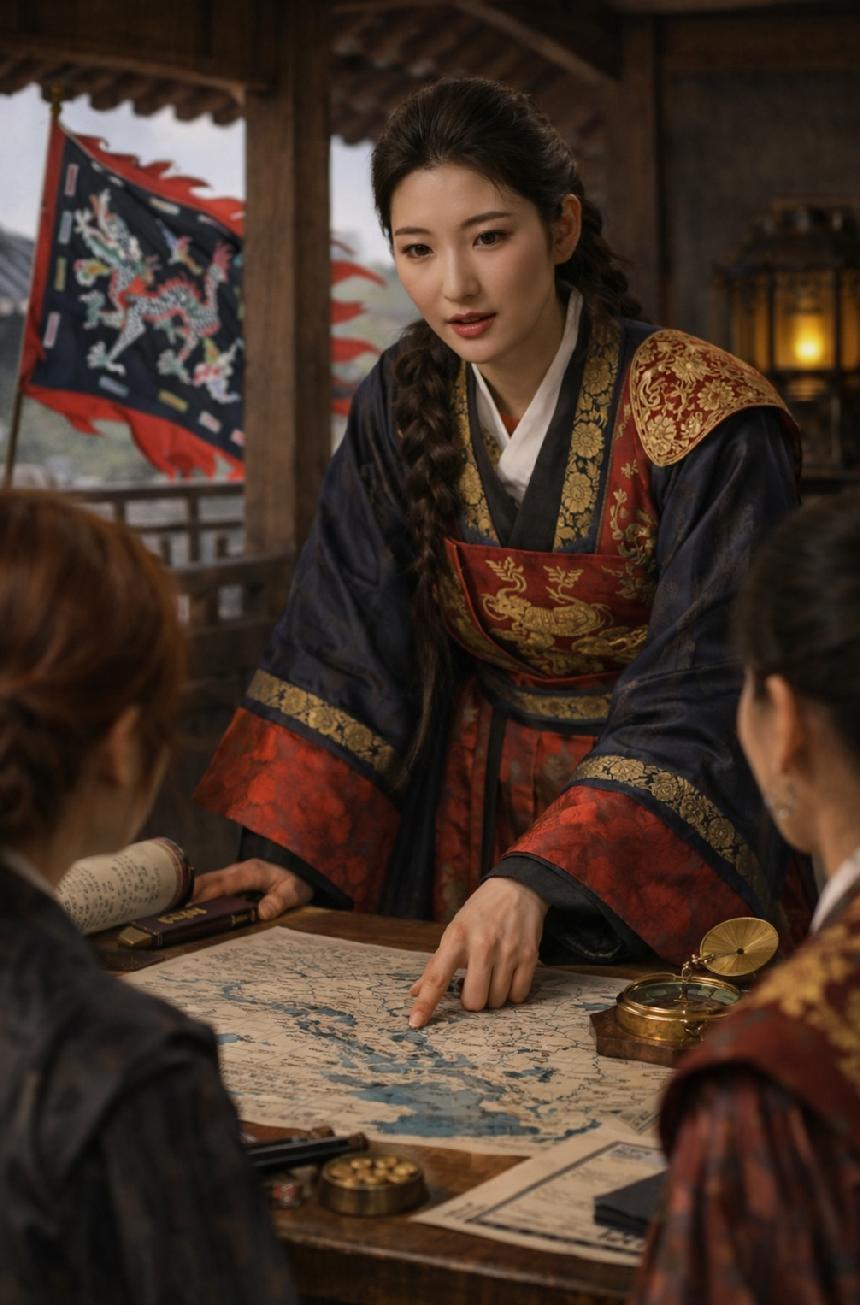
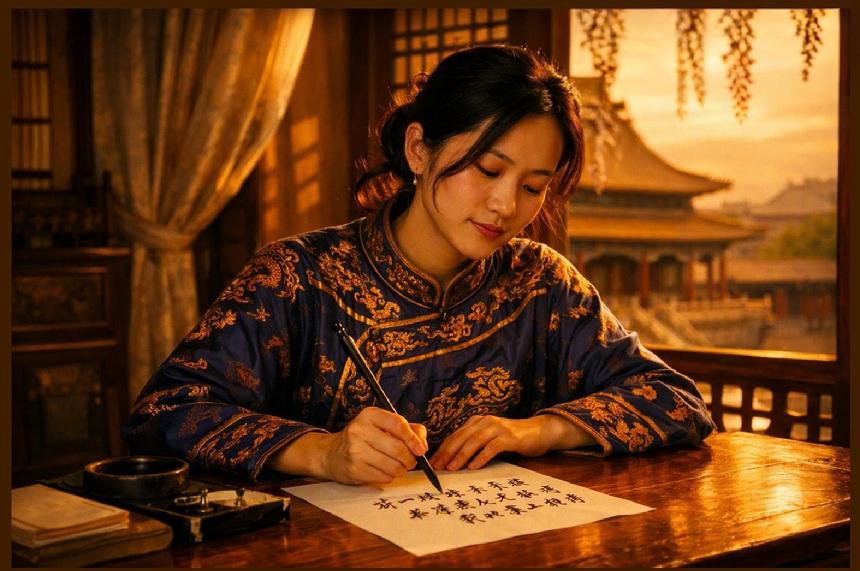
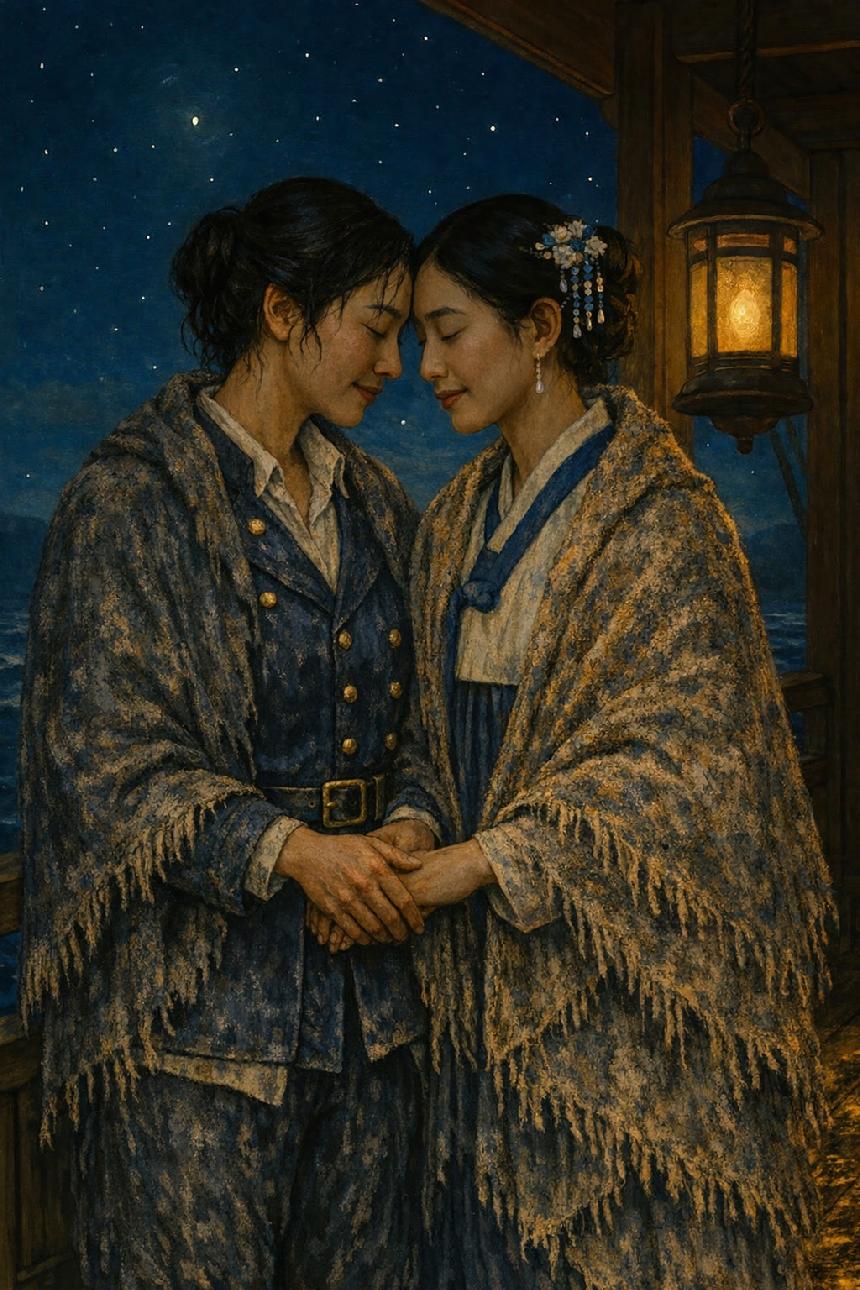
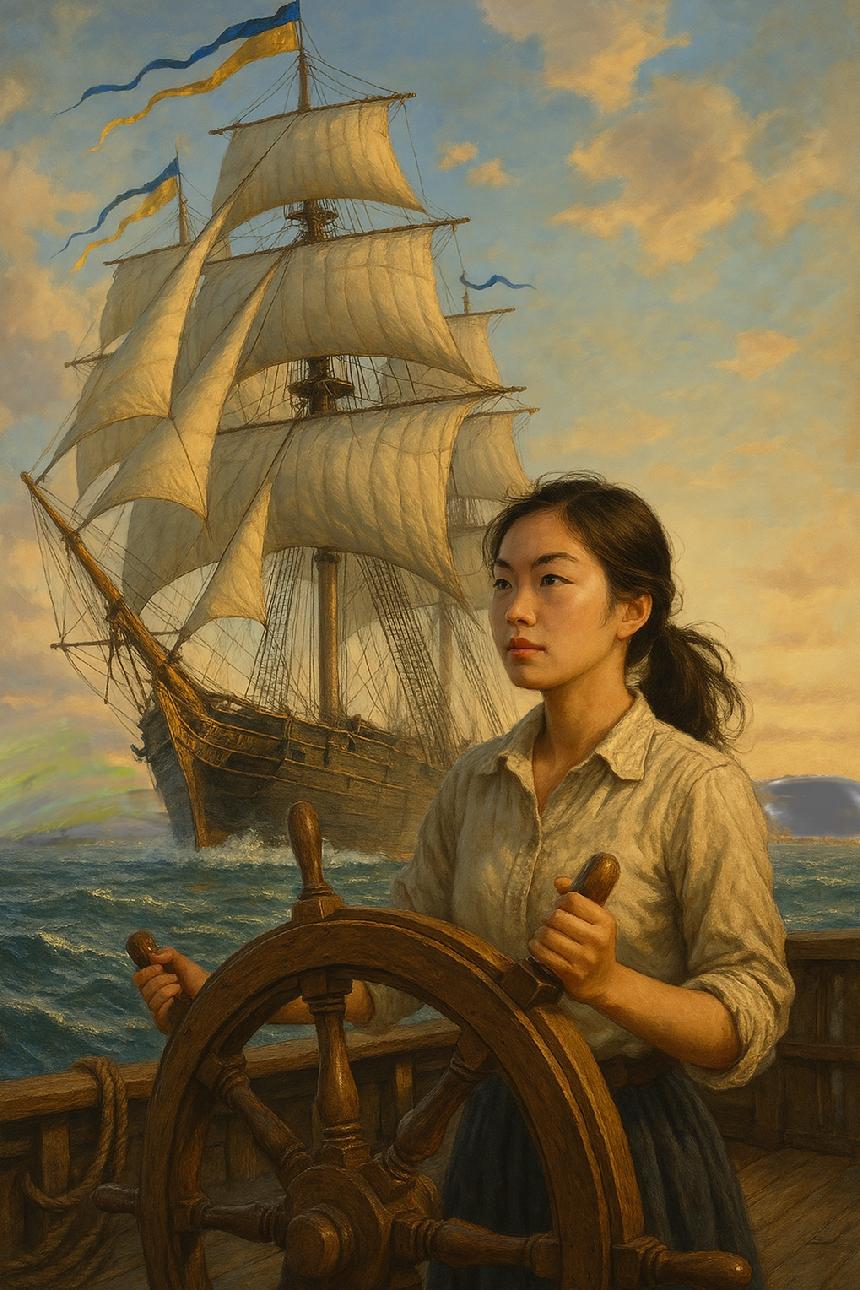
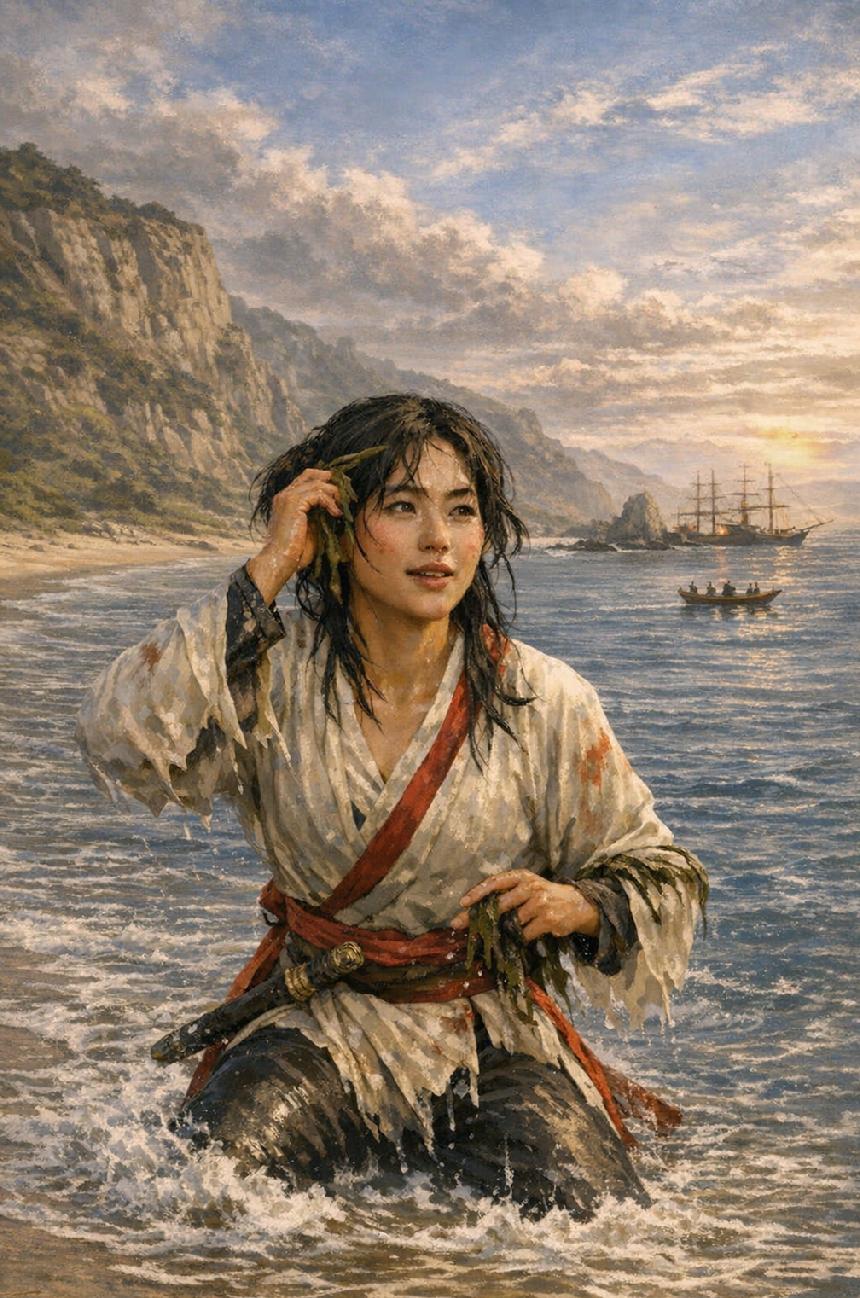
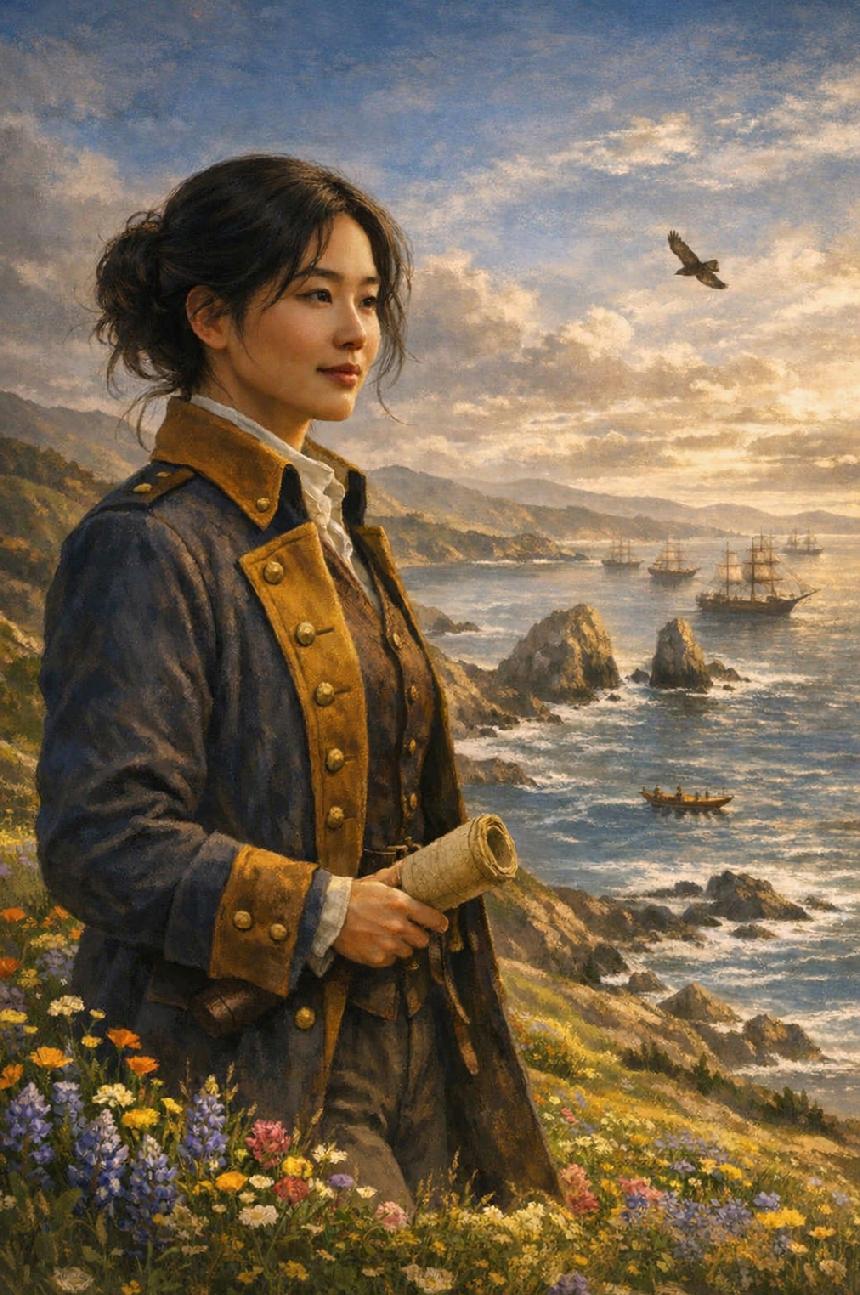
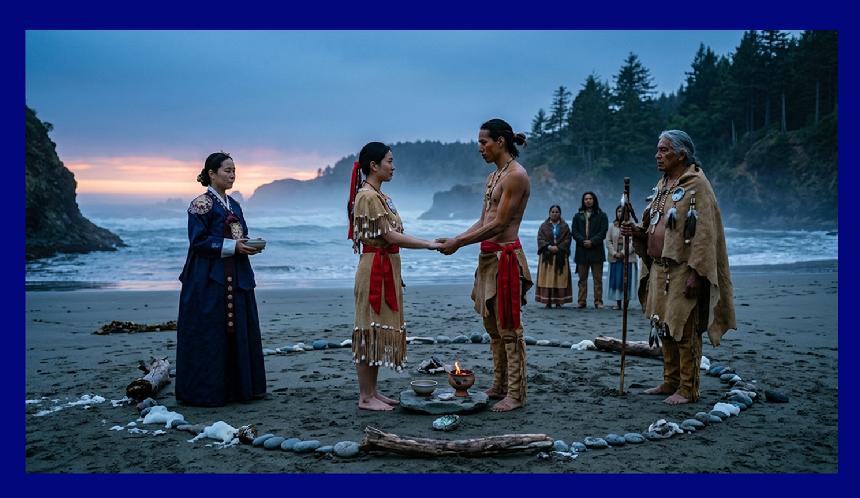
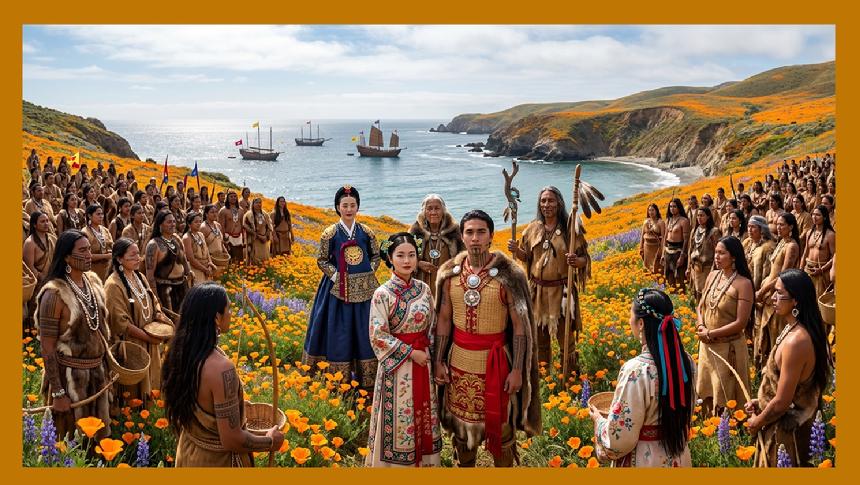
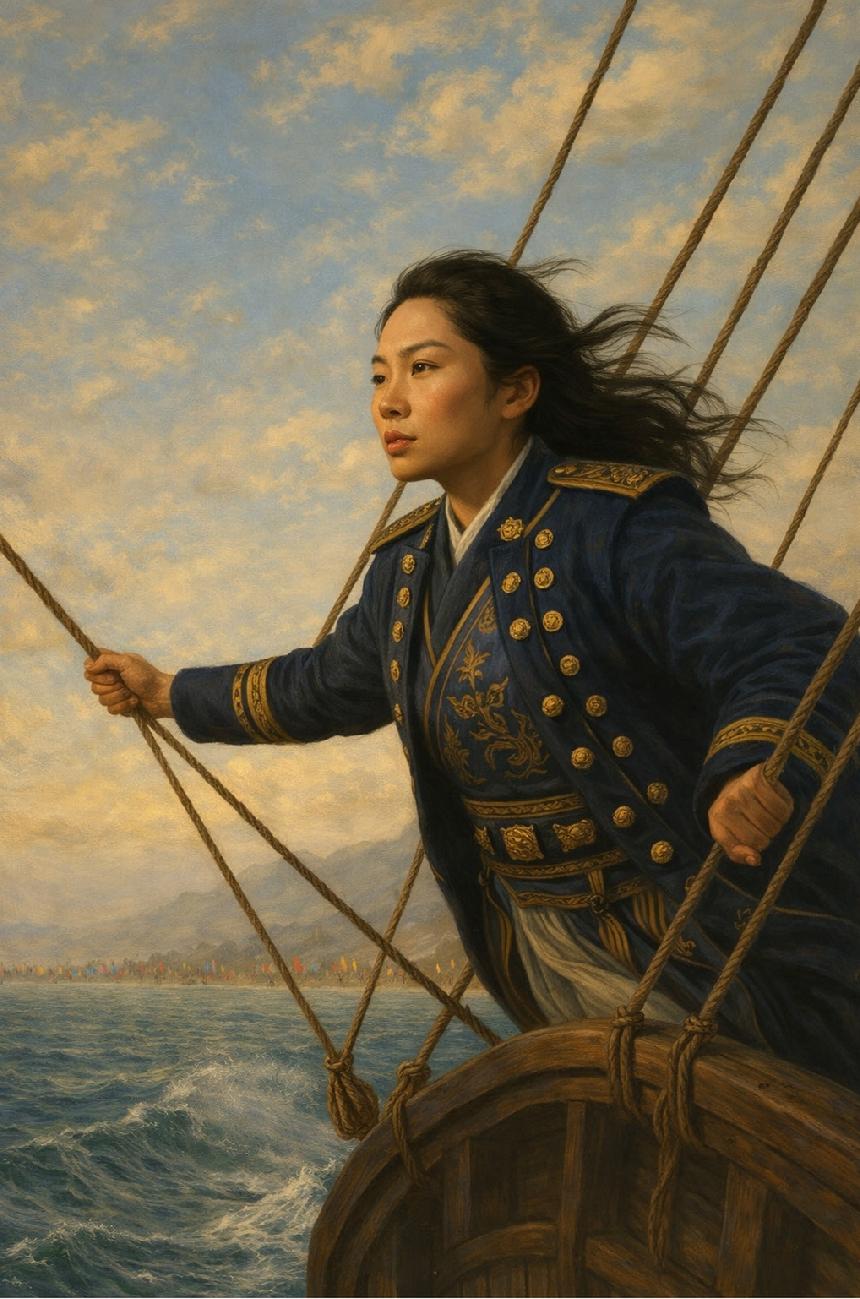
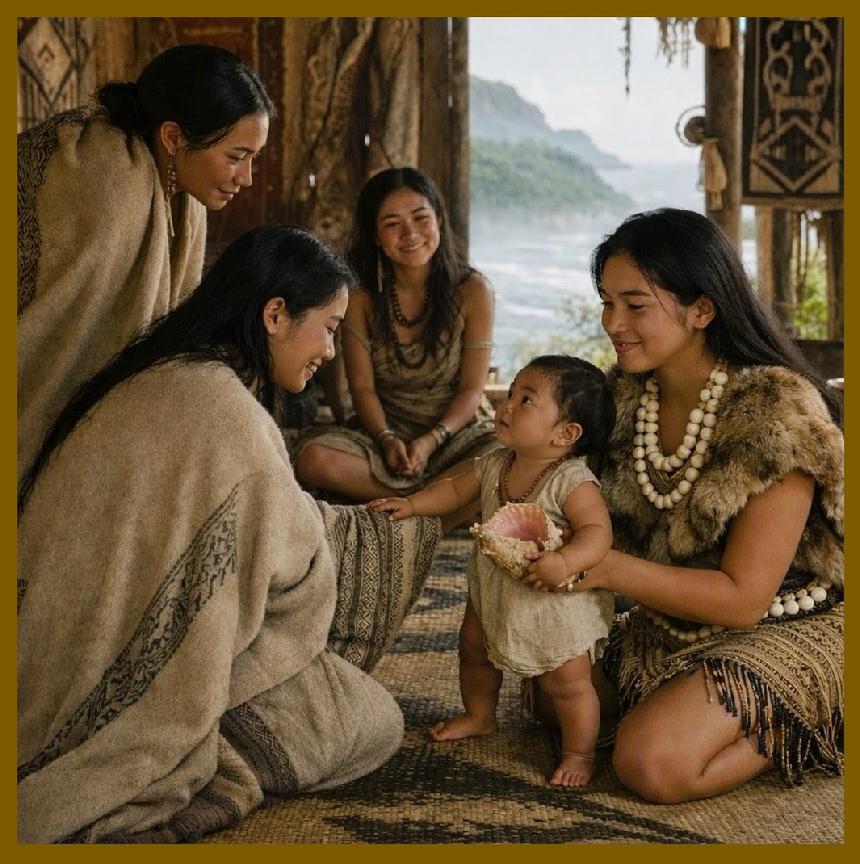
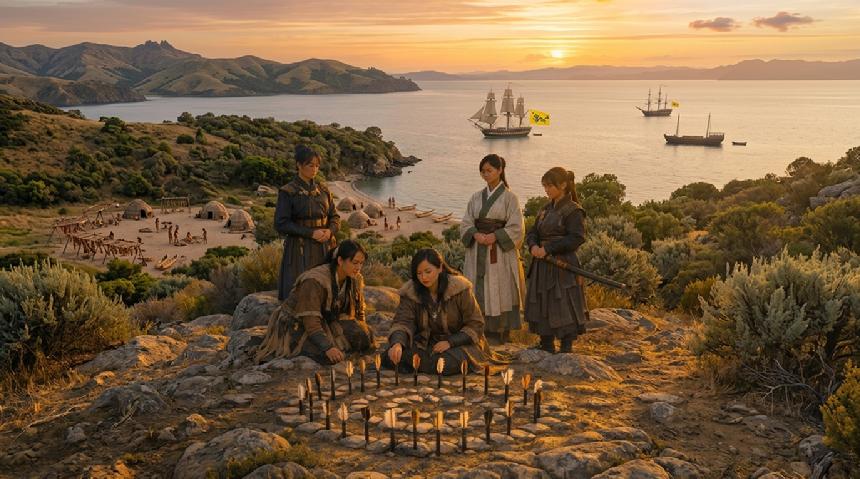
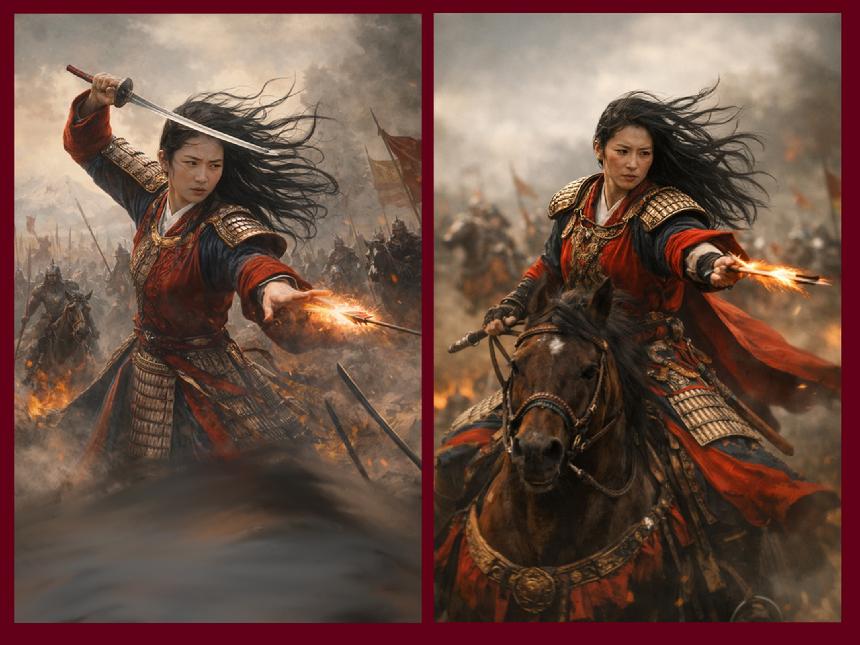
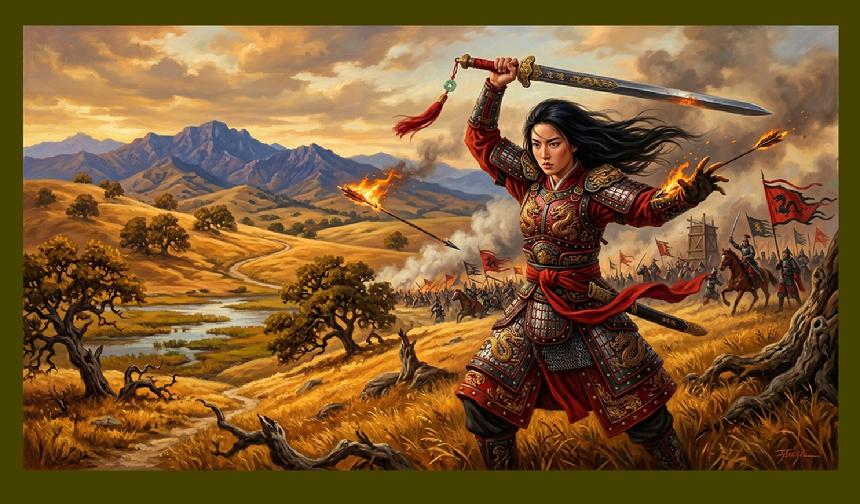
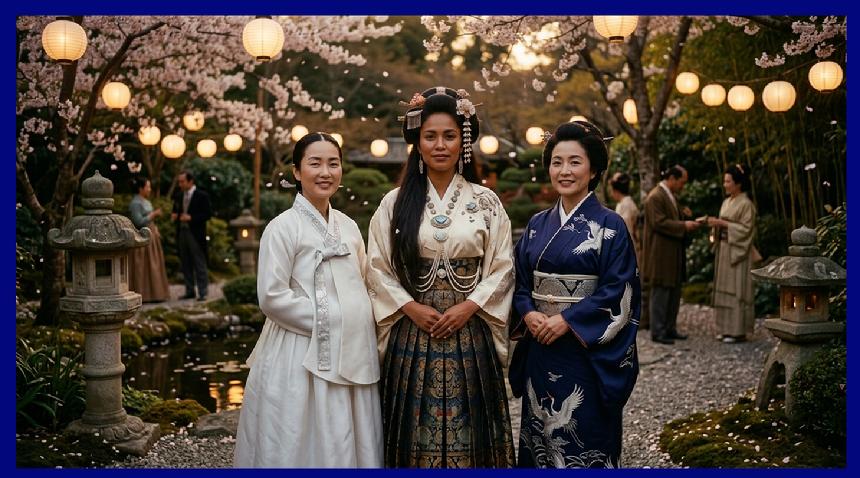
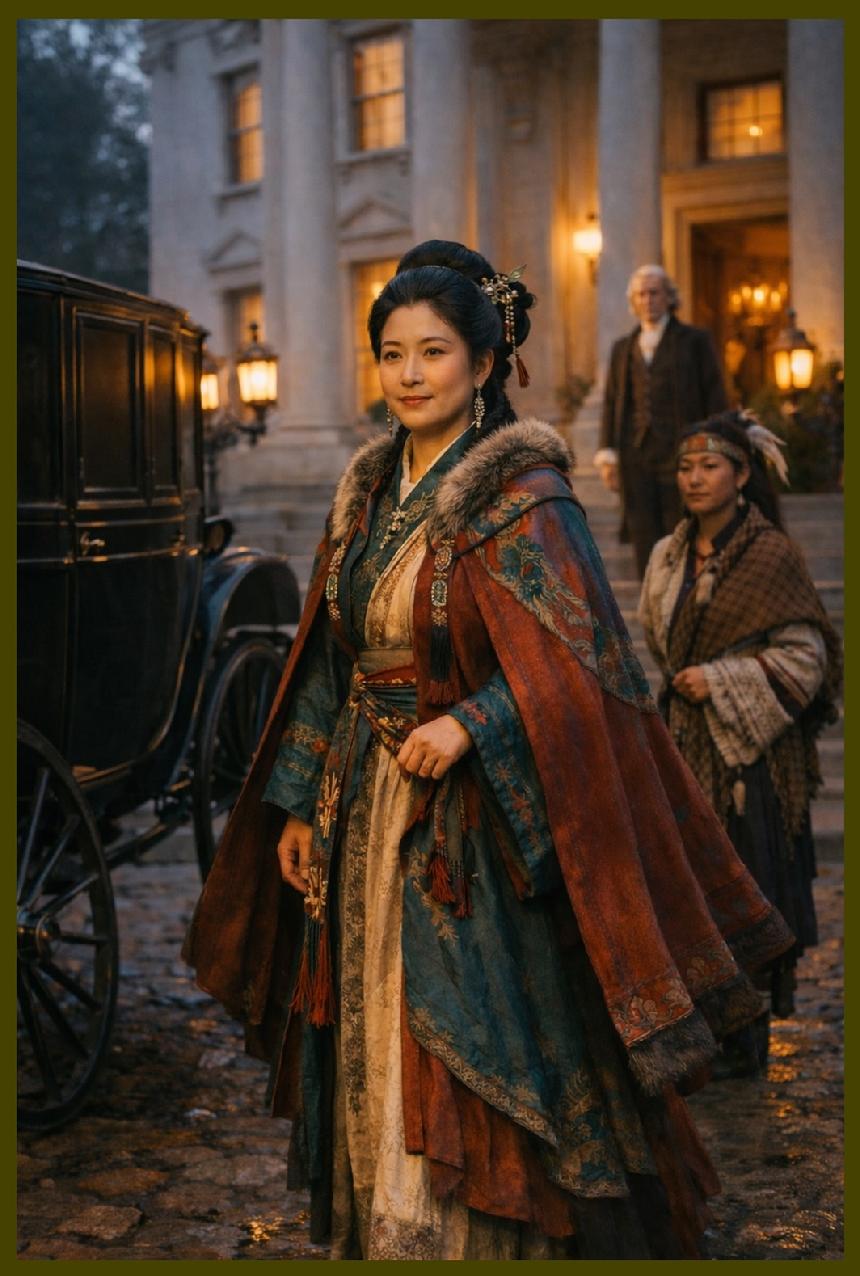
| Time Lord Roxane Wong Navigates Past The Ohlone Seagate, 1763 |
|
|
 |
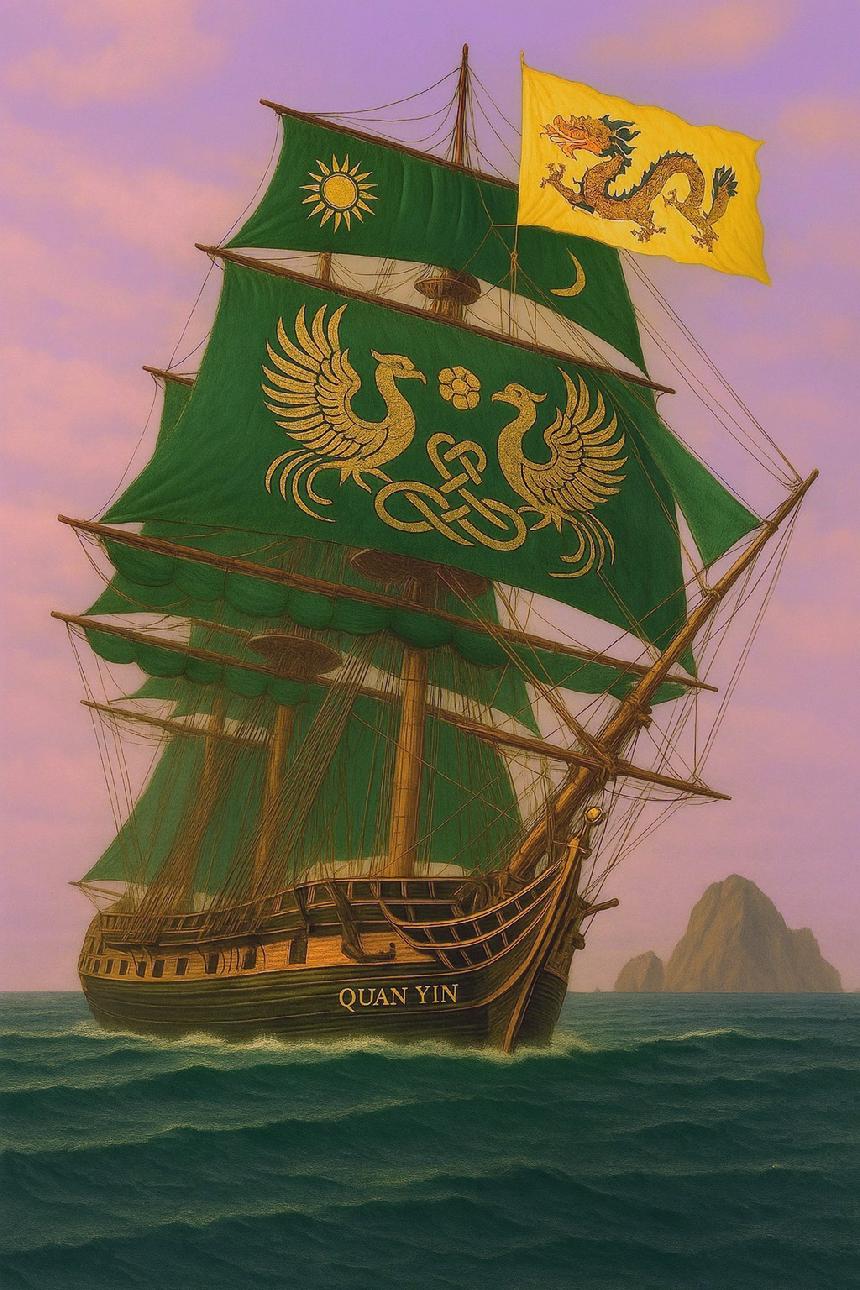
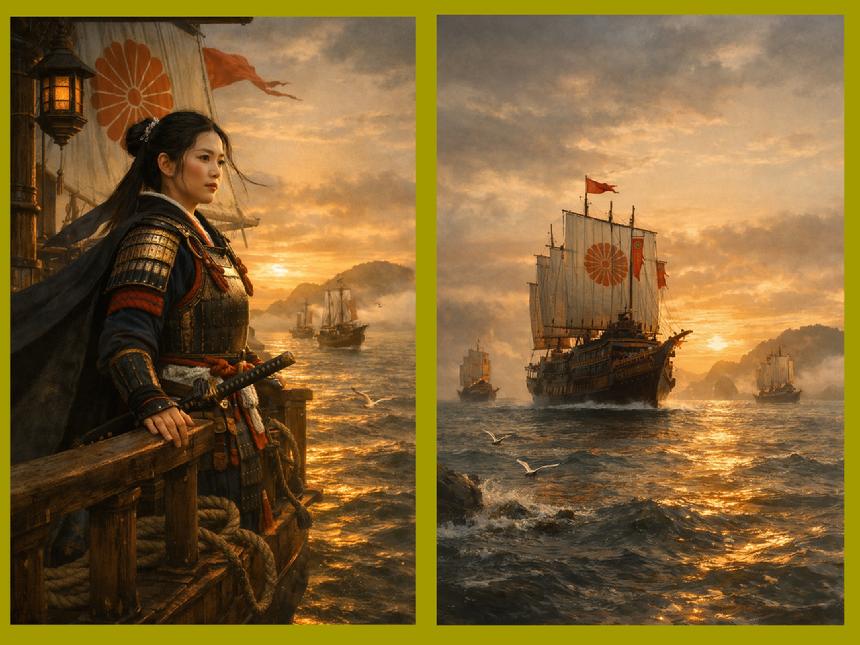
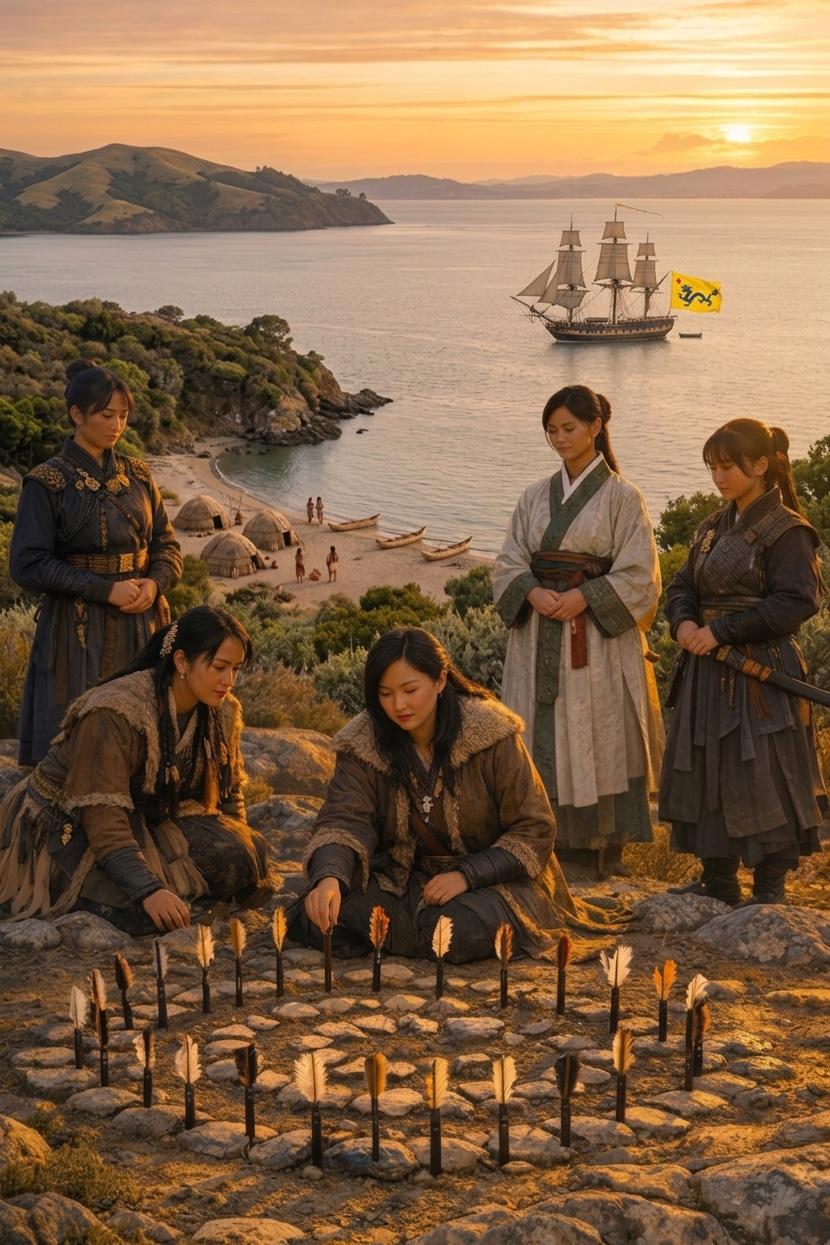
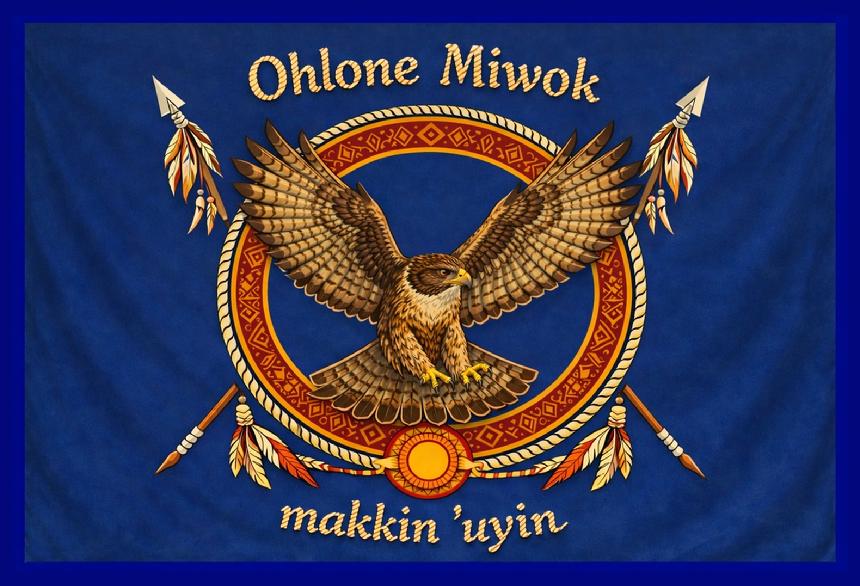
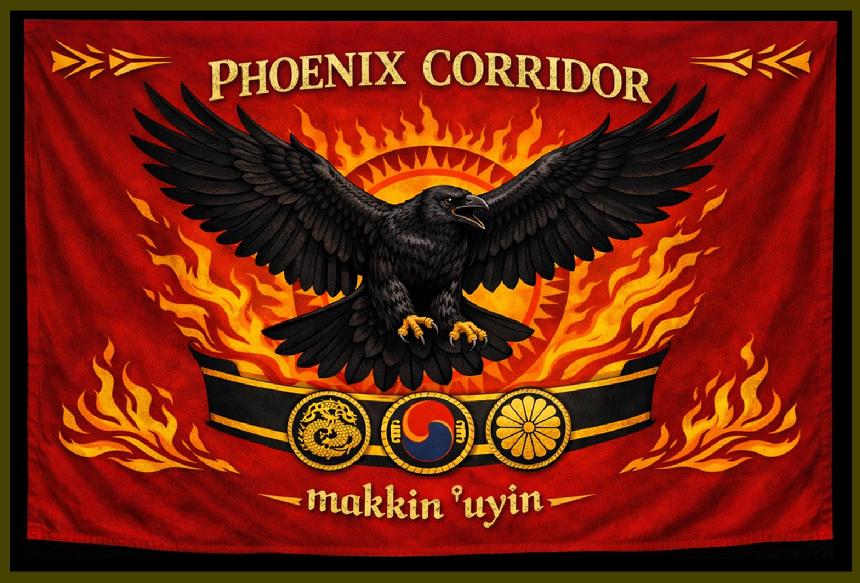
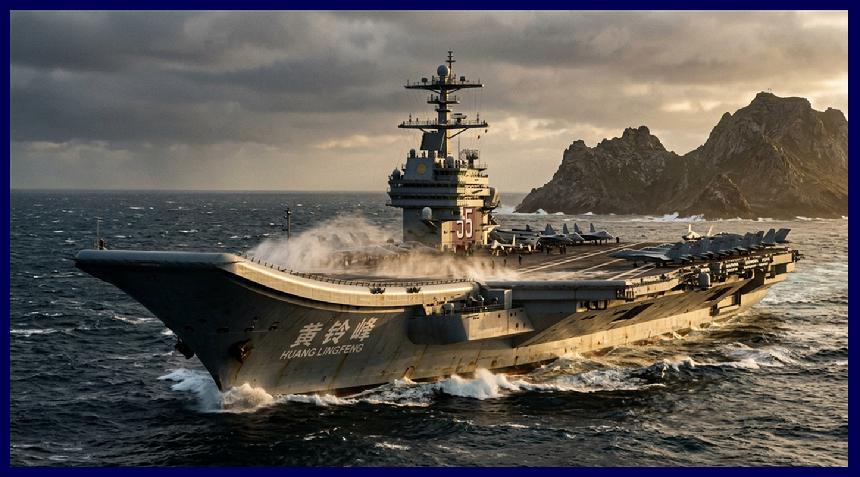
| The Quan Yin, Roxane Wong's Flagship Past The Ohlone Miwok Seagate, 1763 |
|
|
At the place of endings & beginnings…
Before the first oar dipped into the Pacific,
Before the treasure ships unfurled their lacquered sails,
Before the Golden Gate was ever named,
There arrived from the future a challenge wrapped in a question that was
Whispered across the courts of Asia:
“What if we get there before Europe?”
The fleet that crossed the ocean carried more than soldiers and scholars.
It carried five women whose shared voyage held the fates of nations.
Their arrival at the mouth of the great western bay would
Awaken the earth beneath their feet and alter the course of history,
A prophecy foretold the first contact.
Generations recall the adventure.
The land embraces the legacy.
|
This is a work of fiction. Except for the names of historic figures, all characters and events — including those who cross the boundaries of time and lineage to meet themselves in another era — are entirely fictional, and any resemblance to actual persons, living or dead, is coincidental.
Author’s Note
On Silence, Imagination, and the Work of Repair
The histories of this land are unevenly kept.
What survives in the archive is shaped by the hands that held the pen, and too often those hands were not Indigenous. The voices of the first peoples of Tamal‑Huye, Yelamu, Huchiun, and Petlenuc reach us only in fragments — a baptismal record, a land grant, a name half‑remembered in a missionary’s ledger.
Where the written record falls silent, the imagination is not an escape from truth but a way of returning to it.
I write into those silences not to replace what was lost, nor to claim authority over stories that belong to others, but to acknowledge the gaps honestly and to walk with care through the spaces where certainty cannot go. The ceremonies, treaties, and alliances in these pages are not reconstructions of what was, but gestures toward what might have been possible had the world been shaped by reciprocity rather than conquest.
This work invites the reader to join in that act of imagining — not as fantasy, but as a form of listening.
Listening to the land, to the languages that once named it, and to the people whose stories deserve more than the margins of someone else’s history.
If these pages open even a small doorway into that listening, then the work has done what it needed to do.
Dedicated with thanks and gratitude to
Gary Kamiya
author
Our Lady of Sorrows, in Cool Grey City of Love
Randall Milliken
author
A Time of Little Choice
Robert Penn Warren
author
All The King’s Men
Melissa Scott
author
A Choice of Destinies
“…The god doesn’t tell me. But he tells me it’s chancy, balanced on the sword’s point between one fate and another,
and it’s a night for friends…”
— Pasithea to King Alexander, A Choice of Destinies
“It might have been all different, Jack. You got to believe that.”
— Willie Stark to Jack Burden, All The King’s Men
“…The Indians living in San Francisco, the Yelamu, had the misfortune of living closest to the mission. They were wiped out…”
— Our Lady of Sorrows, Cool Grey City of Love
“…The processes of westernization, by which highly organized, highly capitalized forces of world commercial society
undermine simple lives and local spirits,
…have worked to destroy local cultures
time and time again in all parts of the world…”
— A Time of Little Choice
Synopsis
It is 2009 CE, and seven years have passed since involuntary time-traveler Roxane Wong returned from 1906 San Francisco to 2002 Mountain View — a settled and unsettled time for her ever since. Now her erstwhile temporal mentor, Geomancer Man, returns after that same seven-year hiatus to present her with a choice to voyage again — this time to the late 18th century, to the San Francisco Bay Region, before the place was called San Francisco, at an eventful moment in time when the indigenous nations about the Bay were about to receive uninvited guests representing enterprising elements from the outside world set on making a killing in Alta California. If she makes this choice to time travel again, is she venturing as a tourist? Is she laying out a plan to change Time? To maybe change the World? Or does she just need a vacation from the 21st Century?
What If We Got Here First?
Or
What If We Found The Golden Gate Before Spain?
When ancestral voices echo
On an island by the sea
Their regret for just
What might have been
If there had been
A melody
Sacred and unbroken,
Rising with the tide,
Grounded in a moment
Where there's left no place to hide
Tamien,
Ramaytush,
On an island by the sea,
That Island gathers all of us
For love,
For dreams,
For memory…
CAST OF CHARACTERS
THE 21st CENTURY
Mountain View, California — 2002
• Roxane Wong — Former Tapioca Hailstorm Café employee; involuntary time traveler returned from 1898–1906 San Francisco
• Qiu Sheng (Geomancer Man) — Fortune teller; mentor to Roxane’s 2002 time travel event
Annapolis & U.S. Naval Operations — 2002–2009
• Roxane Wong — United States Naval Academy & U.S. Navy 7th Fleet; Midshipman to Captain
San Francisco, Mountain View & Angel Island — 2009
• Roxane Wong — Honorably discharged from US Navy; California State Parks volunteer docent at Angel Island Immigration Station
• Qiu Sheng (Geomancer Man) — Time traveler; advisor across centuries
THE 18th CENTURY
1760–1762 — Qing Empire, Joseon Kingdom, Tokugawa Japan
• Huang Lingfeng (Roxane Wong) — Time traveler; Celestial Envoy; naval commander
• Geomancer Man — Time traveler; advisor to the Qing Court
• General Hua Yujin — 44th direct descendant of Hua Mulan; military attaché to the Qing Court
• Admiral Nam Seonhwa — Military attaché to the Joseon Court
• Zhang Feiyan — Mapmaker’s apprentice; daughter of a mid‑ranking Qing official
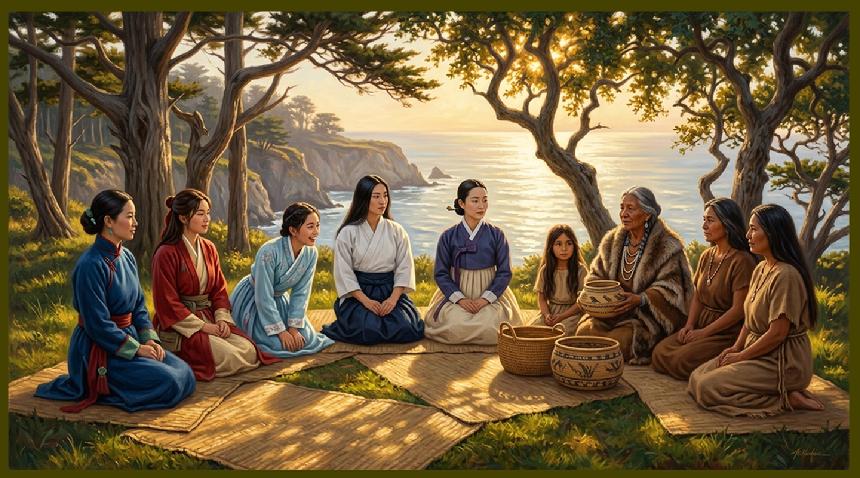
• Lady Nakahara Aiko — Master of Kyūdō; Sea Envoy of the Tokugawa Shogunate
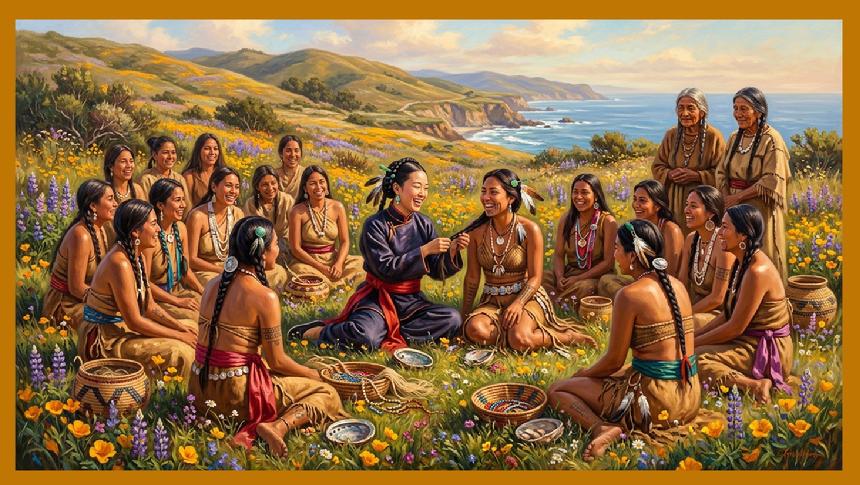
1763 — First Contact at ’Akkoyen Rummeyya (Ohlone Nations Seagate)
• Huang Lingfeng (Roxane Wong) — Admiral & Commander of the Combined Qing/Joseon/Japan Fleet
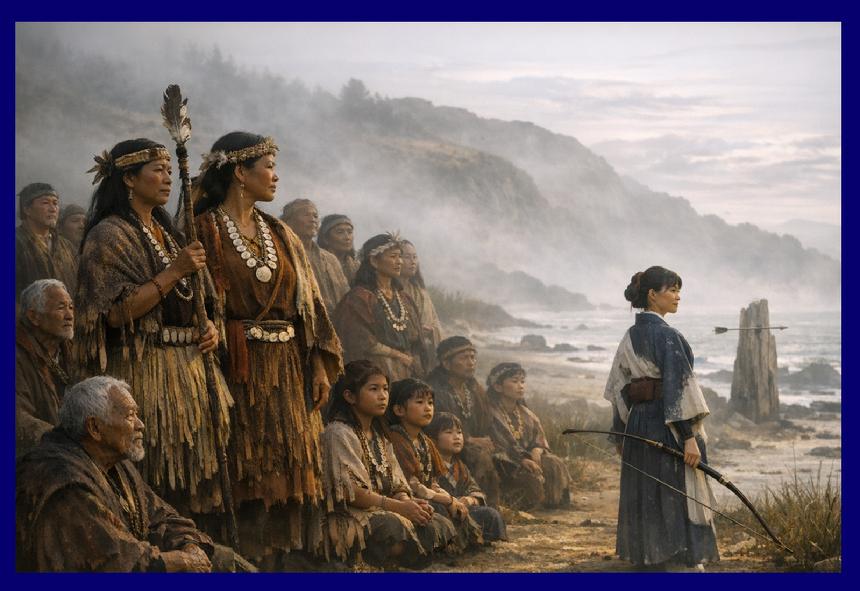
• Yelamu Ohlone — Stewards of the Coast & South Peninsula
• Petlenuc Tribal Leaders — Elders of the Yelamu village at the Golden Gate
• Teymuk — Son of the Petlenuc tribal leader
• Suyana — Daughter of the Petlenuc tribal leader; Teymuk’s sister
1763–1775 — Pacific Coast, Bay Region, Peninsula, East Bay, North Bay
Spanish Crown & Colonial Administration
• Gaspar de Portolá — Governor of Las Californias
• Antonio María de Bucareli y Ursúa — Viceroy of New Spain
• Fernando Javier Rivera y Moncada — Frontier commander
• Pedro Fages — Captain; field commander
• Juan Crespí — Franciscan chaplain and chronicler
• Juan Bautista de Anza — Officer of the Northern Expedition
• Pedro Font — Chaplain and diarist, Anza Expedition
• Juan Manuel de Ayala — Commander, Spanish naval vessel San Carlos
The Phoenix Corridor — The Sisterhood Circle
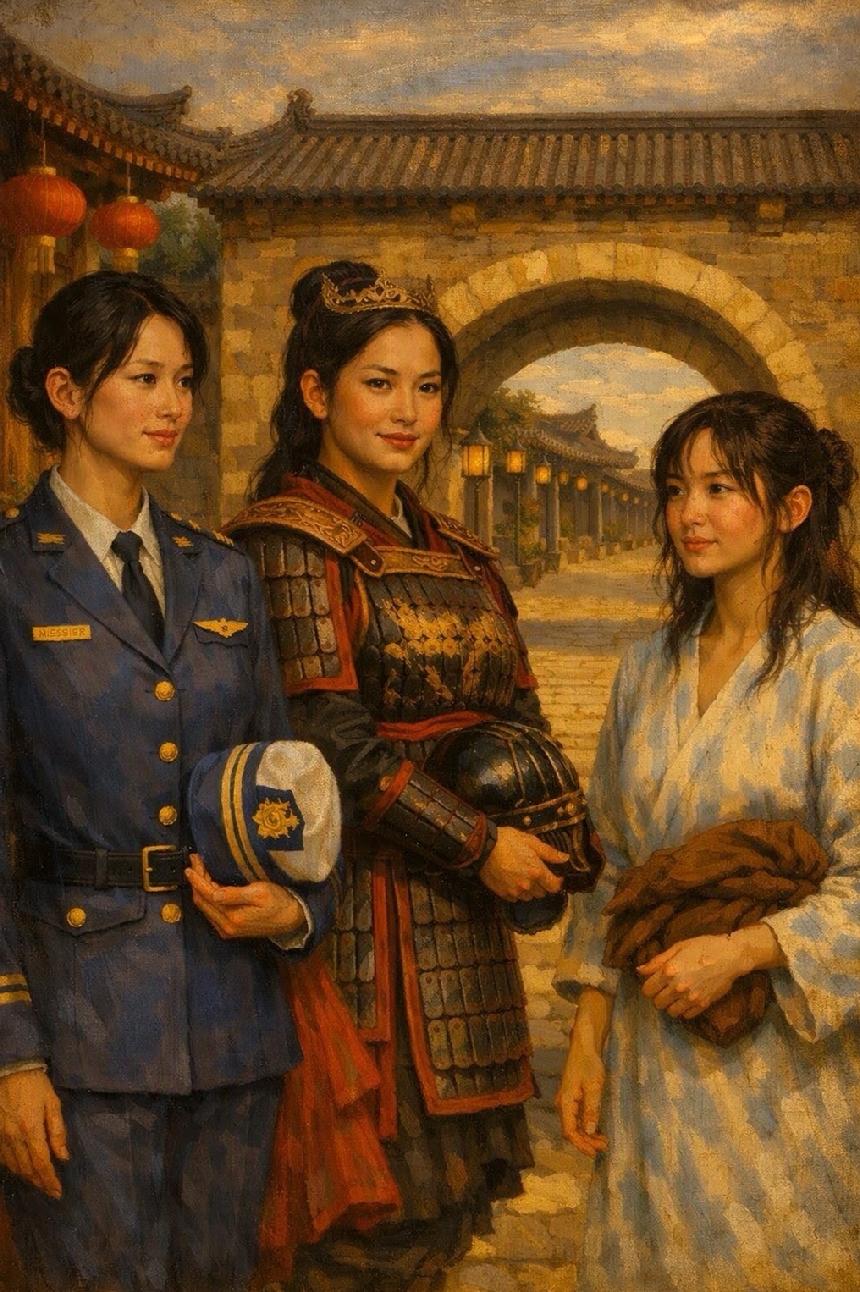
• Admiral Huang Lingfeng (Roxane Wong) — Commander, 1st Pacific Fleet; Co‑Protector of the United Ohlone Nations
• Zhang Feiyan — Senior Ensign; Cartographer, Qing Navy
• Admiral Nam Seonhwa — Commander, Joseon Pacific Formation
• General Hua Yujin — Commander, Ground Forces & Companion Cavalry; Co‑Protector
• Lady Nakahara Aiko — Arc‑Commander of the Phoenix Corridor
|
PROLOGUE
Mountain View, California
June 15, 2009
Roxane Wong stepped from the Caltrain Mountain View Station into Centennial Plaza on an unseasonably warm evening. The sudden blast of hot air as the train doors opened caught her off guard — a jarring contrast to the dense fog and chill winds she had spent the day navigating while leading tours through the Immigration Station Detention Barracks on Angel Island.
On days like this in the City and on the island Roxane interpreted San Francisco’s microclimates to out‑of‑town visitors with her usual candor — that the fog could swallow Angel Island in minutes, that sunshine might be waiting just one hill away, and that the Bay’s moods were part of its charm. Locals nodded in agreement; tourists looked skeptical; Roxane simply smiled, knowing the weather would prove her right soon enough.
From the plaza, she walked toward her old workplace for a boba milk tea — half sugar, no ice. Standing in line, watching the Tapioca Hailstorm Café staff in their blue‑and‑orange livery, she felt a tug of recognition. She saw more than a little of herself in the sweaty, just‑a‑little‑too‑overworked faces behind the counter. She remembered the rhythm of those shifts, the exhaustion, the camaraderie, the absurdity.
The line moved slowly in the airless café beneath a ceiling fan that seemed to be fighting for its life.
Too slowly, Roxane thought.
“I moved lines like this faster in my day,” she muttered.
From five customers back, she couldn’t see the cause of the delay, but she could hear it — a familiar, insistent voice arguing with the cashier. As she craned her neck, she caught sight of someone hunched over the counter, waving a coupon for half‑off a menu item and insisting the café honor it despite the expiration date being six months past.
“Payable to the bearer on demand! Good business practice!”
Roxane froze.
“No. It can’t be.”
She fixed a stink‑eye stare at the back of the cranky senior citizen with the broken Hong Kong Chinese accent and announced loudly enough for the entire line to hear:
“Oh for goddess sakes, I’ll pay for his squid heads! Anything to get the line moving!”
The old man turned.
He made a solemn bow toward his former protégé.
“Do‑Jeh, missy. Lift up your bangs. I will read your forehead.”
Roxane lifted her eyes toward Kwan Yin, sighed the sigh of someone who knew exactly what fate had just walked back into her life, and raised her bangs.
“Geomancer Man…”
|
Chapter One
Returning Crane
Later that evening — Roxane’s apartment, somewhere near Centennial Plaza, Mountain View
She entered quietly. Her place smelled of sandalwood, dust, old paper, and Time. No pleasantries offered or expected. Only tea. Steam curled upward between them like a spirit with unfinished business.
“Eight minutes,” she murmured. “Eight years.”
“You walked through that fog,” Geomancer Man said. “And through time.”
“I left Aunt, Uncle, the cats, Liam, and Megumi behind.”
“And you kept going.”
“It was always going to be forward after San Francisco,” she said. “I won a Congressional appointment to Annapolis. I needed to decompress from my eight years that were eight minutes. I needed structure. Chains of command. Something that kept me afloat — a U.S. Navy frigate in the Pacific, two thousand miles from The City…”
His eyes didn’t leave hers.
“I made Captain,” she continued. “But every deployment, every coastline, reminded me of the place I abandoned for the sake of an obligation to Time.”
“You were a traveler,” he said. “An involuntary traveler in the Circle of Time. You walked the Circle. You bore its weight. You did not break it. And it did not break you.”
Roxane sighed — a sound pulled from somewhere deep, somewhere old. “Maybe it didn’t break me… but it doesn’t change how I feel about running away without warning.”
She poured more tea. Geomancer Man waited.
“And yet,” he said, “when you returned to this place in Time, you found Liam’s and Megumi’s memorial stone. They thanked you with a message they hoped you would one day find. They lived a full and happy life together.”
“I found them. I found the message… Ichigo Ichie. One Time, One Meeting… Thank you, Roxane.”
Her voice broke. She wept.
“Your painful history will be with you forever, Missy,” he said gently. “I’m not here to erase your grief. But there is a way through it — a connecting path to another time.”
Roxane lifted her bangs. “You promised to read my forehead again. What do you see? What do you suggest?”
He studied her the way he had seven years ago — the buzzing at her forehead, the room softening at the edges. When the world returned to focus, he did not offer a prediction. Only an observation.
“You remember who lived here before Mountain View.”
It was not a question.
“Tamien. Ramaytush. The Yelamu community near the Golden Gate. I know what happened. I’ve helped repatriate their remains. I’ve sat in sweat lodges to listen and learn. I’ve read the research papers. I know all that remains after the destruction and genocidal rampage from Europe and America erased them from history and memory.”
“Then you know,” he said softly, “this ground still breathes with their stories.”
Roxane set her cup down. “Mostly I know the ending — how Spain arrived with presidios, missions, pueblos. Rewards and punishments. Divisions and decimation. Centuries of heritage exterminated in forty-one years. Fifty Nations falling like antelope struck by arrows.”
Geomancer Man unrolled a scroll across her coffee table — stitched silk stars and coastlines not yet rewritten by conquest.
“There is a window to the year 1760. To China. To Korea. To the courts of the Qing and Joseon Emperors. A proposal. A treaty. A chance. Would you welcome the opportunity to travel again — not as an involuntary passenger, but as an emissary of the 21st century?”
Roxane stared at him.
“I traveled to Qing and Joseon,” he continued. “I told them what will happen to this land if Europe arrives first. I told them about you. I proposed a joint expeditionary fleet — Qing and Joseon — to establish an economic zone with the Ohlone Nations. Mutual exchange. Commerce. Military protection of land, people, and culture. And I read in you the makings of the leader of this expedition.”
Roxane inhaled sharply. She traced the embroidered path between Joseon, Qing, and the Ohlone Nations. She looked at the man who once ordered squid heads at one in the morning in downtown Mountain View, and with the same sardonic smile she’d given him then, she whispered:
“Mother Goddess in Heaven, Geomancer Man… you don’t ask for much, do you?”
“You’re offering me a chance to change the course of history. What if I make things worse?”
Geomancer Man closed his eyes for half a moment.
“I’m offering you a chance to roll the dice. It’s the only way you’ll ever know the answer to that ‘what if’ question.”
Roxane held her cup in both hands. She looked at the map, at the four directions, at the unseen listeners who might be waiting.
“Well then…”
She exhaled.
“…Let the dice fly.”
|
Chapter Two
The Scroll and the Court
Two mornings later on Redtail Loop Trail
Arastradero Preserve
Palo Alto, California
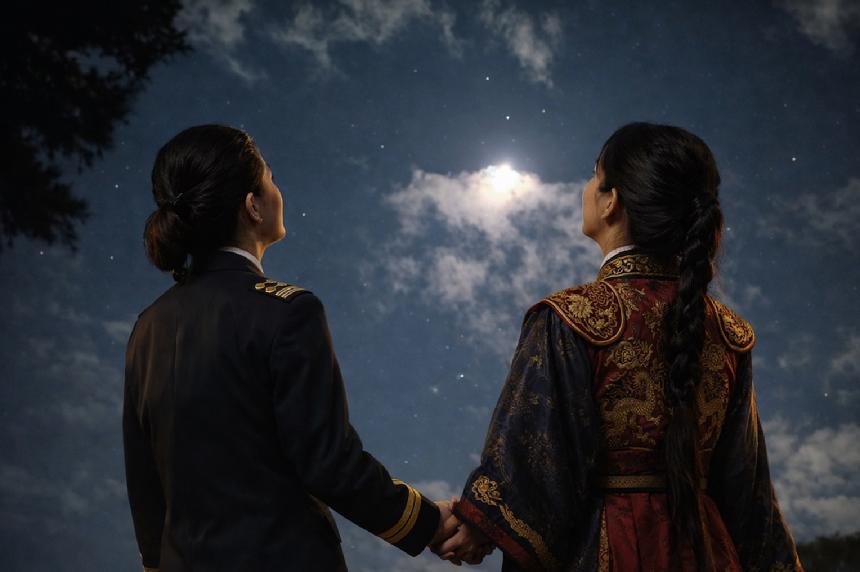
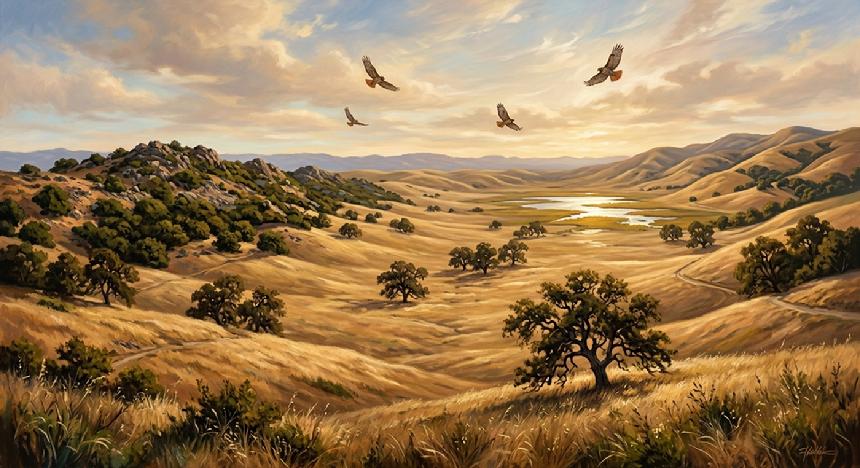
Roxane wore her US Navy Captain’s dress uniform for the first time since her discharge. The fabric felt heavier than she remembered, as if it carried the weight of the history she had lived since she last wore it. She stood beneath a fog-enshrouded, weathered oak that for more than a century kept watch in this place beside a familiar trail that Roxane had walked since childhood, its limbs sprawling like the arms of a guardian long entrusted with secrets. The foothills around her were hushed, the grasses golden and still. A red-tailed hawk cried once in the near distance, then vanished into the mist.
She knelt and placed the scroll at the base of the tree where the roots curled like sleeping serpents.
“Ohlone Nations, I come with a message. I come with a promise.”
The earth pulsed once beneath her palm.
The air changed. The wind stilled. And the scroll unfurled itself, glowing faintly with a light that came not from fire, but from memory.
Before her a pathway through the fog appeared welcoming, with a distant light beckoning—like a silk curtain parted gently by time.
Roxane stepped through.
China, 1760, The Qing Emperor’s Court
She arrived in silence. The air was thick with incense and the rustle of silk robes. Courtiers turned, startled by the sudden appearance of a woman in naval uniform, her hair tied back, her eyes steady.
An officer of the Emperor’s Guard stepped forward,
“Who approaches the court?”
From out of the assembly of court officials, Geomancer Man stepped forward, his voice carrying through the hall with ceremonial clarity.
“She is Wong Roxane, twenty‑nine years of age, an emissary of the future. She brings a proposal.”
A ripple of murmurs passed through the court before settling into silence.
The Emperor regarded Roxane with a long, measured gaze — not unkind, but weighted with the perspective of dynasties.
“Twenty‑nine…” he said softly.
“So young to carry the burden of centuries.”
The words hung in the air like incense smoke — an observation, a recognition, a quiet acknowledgment of the impossible path she had walked.
Then, with a slight nod,
“Let her approach.”
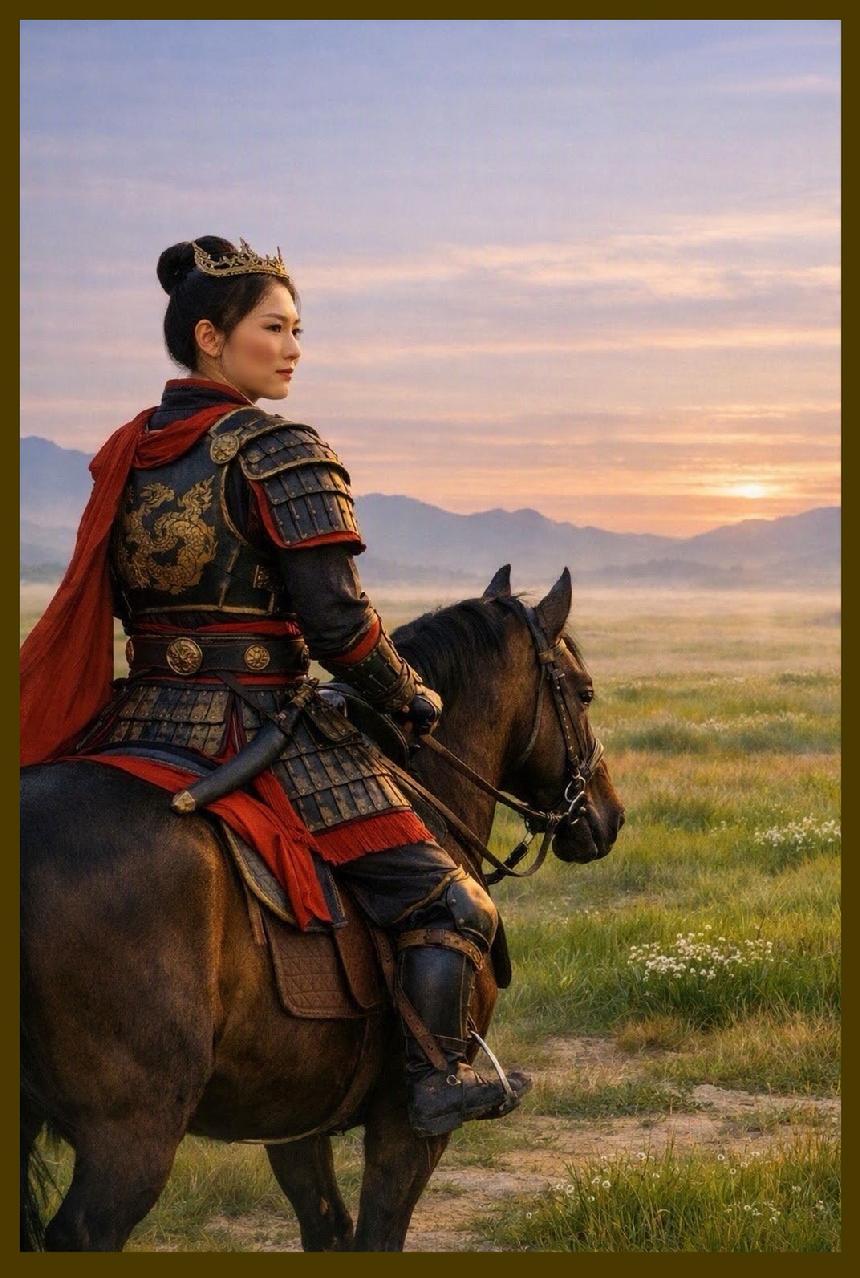
Roxane took a deep breath, steadied herself, and walked for what seemed like an eternity toward the dais emblazoned with a shimmering golden phoenix before the Emperor’s throne. About halfway there, from the corner of her eye, she saw a woman in the uniform of a Qing general — tall, composed, her bearing unmistakably martial. Something in her posture, in the quiet authority she projected, surprised Roxane with a memory from a past life, long hidden in half‑shadow — a forgotten fragment now parting a curtain, seeking daylight.
As Roxane walked past the general she felt a sudden spark — sharp, electric — and in that moment slipped and caught herself before falling on the jade‑green and rosewood pathway to the dais. The misstep was small but sufficiently lacking in grace to send a muted ripple of laughter across the imperial household.
Roxane cursed herself under her breath, continued her approach, and muttered something her great‑aunt Kim might have said:
“O for Goddess’ sake, Foon‑Yen… haven’t you seen a woman general before? Keep your eyes and your mind on what matters!”
Her composure regained, Roxane steadied her breath and bowed before the Emperor, a massive scroll offered forward in both hands.
“This is a map of my country and of what will happen to my country if the past, my past, is to decide what is now your future, an undecided future, a future that has not yet happened.
In nine years’ time the empire of Spain will arrive on the shores that lie opposite to Qing, the shores of the Ohlone people. Spain will bring missions, presidios, destruction and erasure to the bay region of the 50 Nations of Ohlone. And the nations of Europe will follow to annihilate all memory. But there is another path, another choice, another outcome, if Qing and Joseon together make first contact with the Ohlone before Spain. A corridor of cooperation. A naval fleet. A cultural alliance. Commerce and mutual protection — not conquest — undertaken by Qing and Joseon as equals.”
She pointed to the midnight thread connecting Joseon, Qing, and the Ohlone Nations.
“A corridor of cooperation. A combined Qing-Joseon naval fleet. A cultural alliance. Commerce and mutual protection—not conquest.”
The Emperor studied her. “And what do the Ohlone say?”
“They must decide for themselves,” Roxane replied. “This is not a treaty imposed. It is an offering. A chance to preserve what is sacred.”
A murmur rippled through the court.
Then the Emperor nodded. “You will travel to the Joseon court. They must agree. And then… we will send envoys to the Ohlone.”
Roxane bowed and knelt again. “Thank you, Your Majesty.”
Roxane rose as the Emperor spoke, his voice raised to reach the entire household,
“General Hua Yujin, approach!”
Roxane turned and stepped away from the dais, feeling again that sudden spark at the Qing general’s approach. She now recognized her: Hua Yujin, the forty‑fourth direct descendant of Hua Mulan, standing shoulder‑to‑shoulder with her before the Emperor.
He spoke to both women,
“Wong Roxane, Hua Yujin, you are commissioned marshals of an expeditionary fleet of naval and ground forces to treat with the Ohlone people for the purpose of establishing commerce with and protection for them. This is not an expedition of colonization or conquest. By no means will the Qing endeavor to exploit or colonize Ohlone land. Should a majority of the 50 Ohlone Nations object to our presence in their country, the fleet will return to China. I am sending diplomatic messengers in advance of your arrival to the Joseon Court with an offer of shared alliance in this venture.”
Roxane turned to face Yujin,
“General Hua, I am honored to serve with you.”
Yujin replied,
“We are now equals in rank from here forward.”
|
Chapter Three
Getting To Know You
Exchanging salutes and retiring from the dais, Roxane and Yujin walked from the hall into a courtyard where hurried footsteps suddenly echoed behind them. Both turned as a young court scholar skidded to a stop — all of eighteen years, half out of breath, half aflame with purpose.
“I will accompany you,” she said. “My name is Zhang Feiyan. I believe in justice. And I believe in you. I am your first recruit.”
Roxane smiled at this bold young sprout as Yujin with an impassive expression replied,
“I know you. Your reputation for audacity is only outdone by your impetuous energy. Have you obtained permission from your parents, Student Court Scholar Zhang?”
“Not yet, but I will presently. They will give me good leave. They have never refused me.”
“More like they have never been able to stop you, Student Court Scholar Zhang. First things first. Go to your mother and father now. Obtain their permission and return to us. Then we will acknowledge you as our first recruit, Ensign Zhang.”
In a single move Feiyan bowed and turned like an acrobat at a street opera and with all the drama found on that stage.
“I will return to you Marshals! Don’t go away,” Feiyan replied while departing as suddenly as her arrival, disappearing into the shadows of a courtyard archway.
Roxane blinked at this exchange between General Hua and the bright-spirited wraith while she and Yujin stared for ten heartbeats at the empty courtyard space just vacated by Feiyan as Roxane spoke into their shared silence,
“What in Goddess Quan Yin’s name was that?”
Shaking her head in resignation, charmed in spite of herself by the student court scholar, Hua Yujin replied,
“Fireworks... A handful...”
|
|
Courtyard of the Golden Plum Blossoms
Qing Court
Later That Afternoon
The shadows lengthened. Roxane and Yujin sat beneath a flowering plum tree, its blossoms pale against the deepening sky. A hush settled over the courtyard, broken only by the distant call of a crane and the soft rustle of silk from passing attendants.
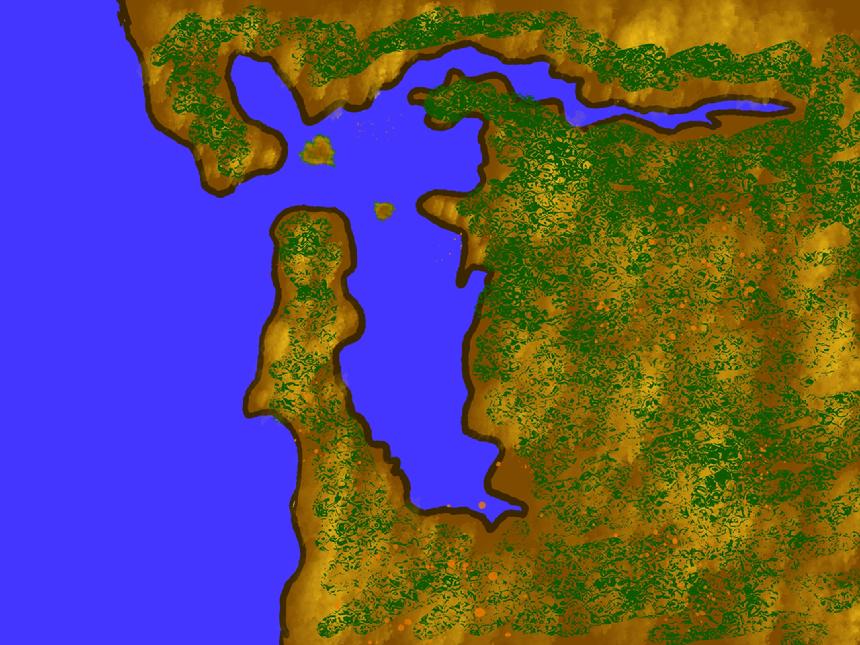
While getting better acquainted over tea as they waited for the return of the aspiring ensign, they shared aspects of their lives and careers that had led them to this moment. The conversation drifted into a companionable silence. Yujin studied Roxane’s 21st Century navigational chart of the Gulf of the Farallones, focusing on a description of the twenty miles of currents and tides between a remote pair of islands and a narrow seagate entrance to a massive bay. Roxane traced the edge of the emperor’s scroll, rereading the royal orders, her thoughts already drifting toward Joseon and the waters beyond.
Roxane looked up at Yujin for a moment, then spoke softly.
“General Hua… may I ask, how old are you?”
Yujin didn’t look up.
“Twenty‑nine.”
Roxane’s brows lifted in surprise.
“Same as me.”
Only then did Yujin pause, lifting her gaze to meet Roxane’s.
“Then we begin this journey as equals,” she said,
“In more ways than rank.”
Roxane traced the edge of her scroll, rereading the Emperor’s seal, her thoughts already drifting toward Joseon and the waters beyond.
Then — footsteps.
Rapid, rhythmic, unmistakable.
Feiyan burst through the archway like a gust of spring wind, scroll in hand, cheeks flushed, hair slightly askew. She skidded to a halt, panting, triumphant.
“I have returned!” she declared, holding the scroll aloft like a victory banner. “My parents have granted permission. My father said, and I quote, ‘If you must chase destiny, at least wear proper boots.’ ”
Yujin raised an eyebrow. “Did you?”
Feiyan looked down. “No. But I brought them in my satchel.”
Roxane smiled behind her officer’s mask. “Well, put them on now. And that’s an order, Ensign Zhang.”
Feiyan bowed low, switched to her proper boots, and straightened with a grin. “I am ready to serve. I have studied naval formations, diplomatic protocol, and the poetry of Du Fu. I also know how to climb trees, decipher riddles, and make tea from wild chrysanthemum.”
Yujin rolled up the navigational chart. “You will need all of those skills.”
Feiyan stepped forward, her voice softening. “I believe in this mission. I believe in the Ohlone, in the corridor of cooperation, in the possibility of a future shaped by choice, not conquest.”
Roxane nodded, moved by the clarity in Feiyan’s eyes.
“Then let us begin.”
Yujin turned toward the plum tree and plucked a single blossom, placing it in Feiyan’s hand.
“This is your first offering,” she said. “To the ancestors. To the journey. To the unknown.”
Feiyan held the blossom reverently. “I will carry it with me.”
And so the three women stood together — Admiral, General, and Ensign — beneath the plum blossoms, as the wind shifted and the scent of incense returned, mingling with the promise of distant shores.
The Docks of the Eastern Fleet
The evening deepened into indigo. Lanterns flickered to life along the palace walkways, their light trembling like fireflies caught in glass. Roxane, Yujin, and Feiyan walked side by side through the outer gates, their footsteps echoing against stone.
The scent of the sea reached them before the sound did — salt, kelp, and the faint sweetness of drying nets. Then came the harbor’s heartbeat: the creak of mooring ropes, the low murmur of sailors preparing for departure, the rhythmic thud of crates being loaded.
Feiyan bounded ahead toward the ship, wide-eyed with awe,
“It smells like adventure!”
Yujin gave her a sidelong glance.
“It smells like responsibility.”
Roxane stopped before the gangway.
“Both can be true.”
They approached a three‑masted treasure ship with a hull lacquered in deep red and black, its sails furled like sleeping wings. Lanternlight shimmered across the water, catching the jade‑inlaid eyes of the qilin carved into the prow. The creature seemed to watch them approach, as if judging their worth.
A line of sailors snapped to attention as the three women ascended the gangplank.
“Marshal Wong. General Hua. Ensign Zhang,” the captain said, bowing deeply. “Your quarters are prepared. We sail at dawn.”
Feiyan, who had never once in her life been known for restraint, leaned toward Yujin and whispered — loudly enough for Roxane to hear,
“Dawn!? Why not now?”
Yujin didn’t miss a beat.
“Because,” she murmured, “the sea listens better in the morning.”
Feiyan froze, considering this with the solemnity of someone receiving a sacred teaching. Then she nodded gravely.
“Yes. That makes sense.”
Roxane covered her mouth to hide a laugh.
Yujin did not bother hiding hers.
And the sailors — who had been trying very hard to remain stoic — exchanged the smallest, fondest smiles.
The ship rocked gently through the night, anchored in the quiet harbor. Though her cabin was warm and welcoming, Roxane could not sleep; she drifted instead to the quarterdeck rail, watching moonlight ripple across the water. The scroll lay beside her, its seal catching the light like a watchful eye.
Footsteps approached — soft, measured.
Yujin.
She joined Roxane at the rail without speaking. For a long moment, they simply breathed the same salt‑cooled air.
“You carry the weight of two worlds,” Yujin said at last.
Roxane didn’t look away from the water.
“Sometimes it feels like more.”
Yujin nodded.
“Then let me carry part of it.”
Roxane turned, surprised by the gentleness in her voice.
“You don’t even know me yet.”
“I know enough,” Yujin replied. “You speak with reverence. And you walk with purpose — even when slipping in front of the Emperor.”
Roxane laughed softly.
“That last part is unfortunately true.”
A pause followed — not awkward, but alive.
Yujin’s gaze drifted toward the lower deck, where Feiyan’s voice could be heard reciting Du Fu to a group of amused sailors.
“She will be trouble,” Yujin said.
“She will be joy,” Roxane countered.
“Both can be true,” Yujin echoed.
Below Deck — Feiyan’s Quarters
Feiyan sat cross‑legged on her bunk, the plum blossom tucked safely into a small lacquered box. She whispered to it like a promise.
“I will not fail you.”
Then she lay back, boots still on her feet, and fell asleep instantly — a small whirlwind finally at rest.
|
|
Chapter Four
Joseon (Korea) 1760: The Court Of King Yeongjo
The council chamber was quieter now, the ministers dismissed, the ceremonial fan screens drawn. The Qing emissaries had arrived three days before the Qing officers and were received by the Joseon court with full courtesy. Their proposal for an economic and defense corridor with the Ohlone was welcomed and accepted by King Yeongjo and his advisers without dissent.
Inspired by Emperor Qianlong’s appointment of two women marshals to lead China’s contribution to the expedition, King Yeongjo made a decision that startled even his closest ministers. He named a woman to serve as admiral of the Joseon fleet commissioned to join the Qing Navy.
Roxane, Yujin, and Feiyan received the news directly from Yeongjo himself:
Princess Nam Seonhwa, his royal kin, would serve as Commander of the Western Fleet — a title earned not by birthright, but by years of service along the Yellow Sea.
The Pavilion of Wind and Compass
Seonhwa’s Arrival — The Eve of the Phoenix Accord
The Qing delegation had been given comfortable quarters in the southern wing of Gyeongbokgung, where the wind from the sea met the scent of pine and ink. Beneath the curved eaves of the Pavilion of Wind and Compass, Senior Ensign Zhang Feiyan stood beside General Hua Yujin, watching the Joseon banners ripple in the courtyard below.
“She arrives within the hour,” Feiyan said quietly. “The Princess Admiral.”
Roxane shook her head.
“Not a princess. A commander. The King of Joseon made that clear.”
Feiyan traced a finger along the rim of her compass, its needle trembling.
“Do we trust her?”
“I trust her record,” Yujin replied. “Pirates off Jeju. Diplomacy in Ryukyu. She’s not an ornament. She’s forged.”
Feiyan turned toward her, brow furrowed in earnest thought.
“She’s… carrying a lot. You can read it between the lines of her record. Like she’s already fought battles we don’t know about.”
Roxane’s gaze softened.
“A burden you share with her, Ensign.”
Feiyan smiled faintly.
“I carry my mother’s name. She is the Emperor's cartographer. She taught me that every coastline is a question.”
“And every alliance,” Yujin added, “is an answer waiting to be tested.”
They moved to the ceremonial table, where Roxane’s map lay beside a scroll of naval formations. Feiyan placed a plum blossom beside the inked routes — a gesture of welcome, and of watchfulness.
“She will test us,” Roxane said. “Not with words, but with silence. With how she reads the tide.”
Yujin looked toward the palace gates.
“Then we must be ready to read her.”
A court attendant entered, bowing.
“Admiral Nam Seonhwa has arrived. She requests no ceremony. Only a map.”
Yujin stepped forward.
“Then let her find us not in ceremony, but in clarity.”
Feiyan placed the compass in her left palm. The needle trembled, turning west — an omen, or a promise.
“Let the Phoenix Corridor begin never with conquest,” she whispered, “always with alliance.”
Outside, the drums began to sound. Not for war. Not for tribute. For the meeting of minds shaped by sea and memory.
Seonhwa’s Entrance
Gathered with the Qing entourage, Nam Seonhwa stood before a lacquered table strewn with Roxane’s 21st‑century naval charts and 18th‑century British ship designs. Her fingers traced the contours of the unfamiliar Ohlone coastline — the narrow, challenging gateway to its bay, its hidden harbors, its maze of channels. Though only twenty‑five, her voice carried the cadence of command.
“I was thirteen when I first boarded a warship,” Seonhwa said, eyes fixed on the map. “My father forbade it. My brother disapproved. My mother silenced them both. It was with her blessing that I went to sea. And when I returned from my first mission, the King and the Fleet Admiral saw something in me — a mind for tides, they said, and a steady heart.”
Roxane exchanged a brief glance with Yujin — not surprise, but recognition.
Twenty‑five, and already carrying the weight of a nation’s expectations.
They both knew what that felt like.
Yujin leaned forward, her tone respectful, not probing.
“And now you command the fleet.”
“I command respect,” Seonhwa replied. “The fleet follows.”
Outside, the palace drums marked the hour. Inside, Seonhwa turned to Roxane.
“You speak of corridors,” she said. “But corridors must be defended. The sea is not a scroll — it does not yield to ink. It yields to vigilance.”
Roxane nodded, her expression softening with a new understanding.
“Then you will be our shield.”
Seonhwa stepped closer, gaze unwavering.
“I will be more than that. I will be your mirror. Your counterpoint. We are tasked with proving to our detractors in both courts that women command consequence.”
|
The Scroll of Service
A court attendant announced the arrival of a venerable Lady of the Joseon Court. Nam Seonhwa’s expression softened at the sight of Madam Hyejin — her former tutor, her compass in youth, and the keeper of Joseon’s naval archives.
Madam Hyejin bowed, her movements slow but precise, shaped by decades of discipline. She presented a scroll to Roxane.
“This,” she said, “is the record of Admiral Nam’s campaigns. Pirate suppression off Jeju. Rescue operations in the East China Sea. Diplomatic escort to Ryukyu. She is not merely a princess. She is Joseon’s Navigator.”
Seonhwa bowed deeply, both hands extended in respect.
“I thank you, Hyejin seonsaengnim. My record of service, wrapped in this scroll, is a testament to your wisdom. I will always be your student — and your servant.”
Hyejin’s eyes warmed. “And I will always be your teacher, child of the tides.”
Her gaze shifted then — past Seonhwa, past Roxane and Yujin — to Feiyan.
The young ensign straightened instinctively, unsure whether to bow or salute. Her compass trembled faintly in her hand. Hyejin stepped closer, studying her with the practiced eye of someone who had spent a lifetime reading sailors the way others read maps.
“You,” she said softly, “are young. But your spirit stands forward, not back. I was like that at eighteen.”
Feiyan blinked. “You were?”
A faint smile touched Hyejin’s lips.
“Too curious for my own good. Too bold for the comfort of my elders. And always holding something — a scroll, a quill, a compass — as if the world might reveal itself if I studied it closely enough.”
Feiyan looked down at her compass, cheeks warming. Roxane’s expression softened. Yujin’s did too, though she hid it behind a practiced neutrality.
Hyejin turned to Roxane and Yujin, bowing with the dignity of her station.
“Marshal Wong. General Hua. Joseon welcomes your leadership. The sea favors those who listen before they speak.”
Roxane returned the bow.
“Your wisdom honors us, Madam Hyejin.”
Yujin added,
“And your student honors you.”
Hyejin inclined her head.
“She honors the sea.”
Seonhwa placed the scroll beside Roxane’s map — two legacies, side by side. Yujin studied them both.
“Then let us forge a new record. One written not in conquest, but in covenant.”
Seonhwa turned to the ancestral tablets lining the chamber wall.
“I will sail,” she said. “Not as a royal. Not as a symbol. But as a strategist. As a daughter of Joseon and the sea.”
Roxane bowed.
“Then let us begin preparations.”
Feiyan whispered,
“The Phoenix Corridor now has its compass.”
And beneath the painted eaves of Gyeongbokgung, the expedition began to take shape — not as a fleet of empire, but as a vessel of memory, protection, and defiance.
|
Chapter Five
China & Korea, 1760-1762
After their introduction and first strategy meeting, Roxane and Seonwah saw in each other seasoned professional sailors with experience in naval tactics from their respective places in Time. Among the charts and pamphlets Roxane brought from the 21st century was one referencing an 18th‑century Joseon Admiral Nam, credited with developing fleet formations for long‑distance voyages and advanced close‑quarters' naval combat and ship-to-ship boarding tactics.
Roxane smiled when she found the entry — a small, unexpected confirmation of Seonhwa’s legacy. She shared the discovery with Yujin and Feiyan that evening, after the first official day of Operation Phoenix Corridor.
They ate together in a quiet corner of the palace guest hall, lanternlight flickering across their bowls.
Feiyan, who had been unusually contemplative, finally asked,
“What did Admiral Nam mean when she talked about detractors?”
Roxane and Yujin exchanged a glance — the kind that passed between older officers who had seen more of the world’s sharp edges than they wished on the young.
Yujin set down her chopsticks.
“Did you ever get bullied at school, Ensign?”
Feiyan nodded.
“Just once. I beat him up. Everyone left me alone after that.”
Roxane smiled, but her voice carried a deeper note.
“Yujin, the bullies who never got beaten up — or never learned their lesson — that’s what Admiral Nam means by detractors.”
Feiyan frowned thoughtfully, absorbing this.
Yujin added, her tone quiet but firm,
“Some people resent what they cannot imagine for themselves. A woman in command. A woman shaping strategy. A woman changing the course of nations.”
Feiyan looked between them — two women nearly a decade older than she was, carrying scars she could not yet name.
“Then we prove them wrong.”
Roxane reached for her tea, her expression softening.
“We don’t prove them wrong, Feiyan. We prove ourselves right.”
|
Joseon
Autumn, 1760
The scent of pine resin and lacquer clung to the sea mist as Tongyeong’s shipyards roared to life. Sawdust drifted through the air like incense smoke, catching the late‑autumn light in golden spirals. The rhythmic pounding of mallets on hulls echoed across the harbor — not noise, but invocation. A ritual. A promise.
From the moment that the news of the Qing-Joseon alliance arrived along with King Yeongjo’s royal directive, there had been a flurry of activity not seen since the days of Admiral Yi Sun‑sin. Old shipwrights whispered that the shipyard itself seemed to awaken, as if the timbers remembered the last time Joseon prepared for a voyage that would change the world.
At the center of the commotion stood Admiral Nam Seonhwa — twenty‑five years old, sleeves rolled, hair bound in a sailor’s knot, voice steady as tide and steel.
She moved between carpenters, smiths, and rope‑makers with the ease of someone who had grown up on decks and docks. In her hands she carried Roxane Wong’s blueprints — the future’s vision of a 34‑gun British frigate — the parchment already smudged with ink, resin, and seawater. Yet its essence remained intact:
Speed.
Firepower.
Grace.
“We will not copy,” Seonhwa declared, her voice rising above the din. “We will transform.”
The shipwrights bowed their heads in agreement. They had expected a royal figurehead. Instead, they found a commander who understood the language of wood grain, keel stress, and wind shear.
Beside Admiral Nam, Zhang Feiyan knelt at the dry dock’s edge, sketching hull curvature into the sand with a bamboo stylus. Her brow was furrowed in concentration, her lips moving silently as she translated Roxane’s 21st‑century annotations into Joseon geometry.
She had deciphered Roxane’s notes on keel balance and windward lift, adapting them to the curved shell of the new Turtle Ship — a vessel reborn not as a relic, but as a swift, armored predator of the Pacific.
• Iron plating: thinner, layered, flexible
• Sails: taller, reinforced with bamboo ribs
• Rudder: widened for sharper turns
• Cannons: cast in layered bronze, lighter and longer‑ranged
Their mouths would be shaped like dragons.
Their roar would be a warning to hostile empires that the Phoenix Accord sails with teeth.
|
The Forgotten Lunch
In the middle of the third week of preparations, Roxane took her midday meal in the shipyard cafeteria. She found a place beside an untouched plate of rice, fish, and greens. She signaled the mess hall officer with a questioning glance.
“Whose abandoned meal is this? We cannot waste food.”
The officer bowed.
“That plate belongs to your young Ensign Zhang. She did not abandon it — she never arrived. She forgets to eat more often than she remembers. She is… very focused.”
Roxane sighed — the sigh of a guardian, not a superior.
“Wrap it up,” she said. “I’ll find her.”
The mess hall officer nodded and swiftly bundled the meal in a plain cotton bojagi, tying the corners with practiced efficiency.
Admiral Wong set off across the shipyard, weaving between scaffolds and stacks of timber, assuming the parental role Zhang’s father had entrusted to her. She found Feiyan still kneeling in the sand, stylus in hand, oblivious to time.
“Ensign Zhang,” Roxane said gently, “eat.”
Feiyan blinked, startled, then sheepish.
“I… forgot.”
“The word at the cafeteria is that you often do,” Roxane replied, placing the cloth‑wrapped meal in her hands.
“Your father entrusted your care to me. I intend to honor that.”
Feiyan ate under Roxane’s watchful eye, cheeks flushed with embarrassment but gratitude shining through.
As Feiyan finished her lunch, Roxane stood at the edge of the dock, watching the shipwrights work. Her gaze was distant yet grounded — the look of someone who had seen the future and was now helping to build it centuries early.
She had already shared these blueprints with Qing engineers in Fuzhou and Ningbo, where war junks were being retrofitted with reinforced hulls and copper‑lined ballast. But here in Joseon, she saw something different:
A spiritual fusion of past and future.
Myth and metal.
Memory and possibility.
“This ship,” she whispered to Feiyan, “will carry memory across oceans.”
Feiyan swallowed the last bite of rice.
“And we will carry it.”
As dusk fell over Tongyeong, the first hull of the new Turtle Ship was lowered into the water. The shipwrights fell silent. Even the gulls seemed to pause. Monks gathered on the shoreline, chanting blessings that mingled with the sound of waves. Their voices rose and fell like the tide, ancient syllables wrapping the vessel in protection.
Seonhwa stepped forward and placed a sprig of mugwort at the prow — a gesture older than any dynasty, a promise to the sea.
Roxane, Feiyan, and Seonhwa stood together, wind tugging at their robes, watching the vessel rock gently in the tide.
Three women from three worlds.
Three minds shaping a future beyond the control of colonizers.
The Pacific awaited.
|
China
Autumn 1760
Hua Yujin’s Recruitment Campaign
Camp Hua Mulan
Qing First Infantry
Cavalry, Artillery, & Signal Corps Training Grounds
The valley outside Hangzhou thundered with hooves and shouted commands, but beneath the noise lay something far more deliberate — the mind of Hua Yujin at work.
She had spent years studying the campaigns of Alexander the Great and Julius Caesar, poring over translated manuscripts obtained from Silk Road traders. She admired Alexander’s ability to fuse cultures into a single fighting force, and Caesar’s mastery of discipline, engineering, and battlefield adaptability.
Now, in the crisp air of early autumn, she wove their lessons into the training of her own recruits.
Classical Weapons Training
The soldiers’ basic training regimen balanced physical conditioning on the parade grounds with classroom assemblies devoted equally to battlefield tactics and philosophical discussions on the rules of war.
She began each day by reshaping their bodies and instincts, forging muscle memory before philosophy.
• light javelin volleys in the style of the Macedonian akontistai, skirmishers trained to harry an enemy line with rapid, stinging throws
• heavy Roman pilum practice for her frontline infantry, each soldier hurling the shield‑breaking javelin in a single decisive cast before closing to melee
• short‑sword thrusting inspired by the Roman gladius, drilled until the motion became a reflex
• spear formations adapted from the Macedonian phalanx and the long‑spear infantry of the Han, a marriage of reach, discipline, and crushing momentum
Yujin insisted that her troops master both javelin traditions — the light, disruptive volleys of the akontistai and the heavy, formation‑breaking Roman pilum. To her, they were not contradictory but complementary: one to unsettle, one to shatter.
She walked among the ranks, correcting stances, adjusting grips, demonstrating techniques with effortless precision.
“A cavalry charge is not stopped by fear,” she told them.
“It is stopped by discipline, formation, and the will to hold the line.”
She drilled them until the motion became instinct — kneel, brace, angle, lock.
She blended:
• the mobility of Mongol cavalry
• the discipline of Qing spear formations
• the precision of Joseon signaling
• the cohesion of Roman infantry
• the momentum of Macedonian shock tactics
The result was something entirely new — a hybrid doctrine no army in the world had ever seen.
A Fusion of East and West
Some of Yujin’s officers were skeptical..
At the end of a particularly rigorous day of training, as the smell of oiled wood and sweat still hung in the air and Yujin sketched out ideas for troop deployments in her field notebook, a young lieutenant approached her,
“General Hua, why teach Roman swordwork to farmers?”
Yujin didn’t look up from her formation sketches.
“Because the Americas are unknown terrain, and the Spanish an unknown enemy. Alexander and Caesar adapted to every land they entered, preparing their soldiers for every tactic an adversary might use — modern or archaic alike.”
She paused, letting the weight of her words settle.
“Caesar turned farmers into legions. We will do the same.”
The Recruits Transform
By late autumn, the transformation was visible.
Farmers who had never held a weapon now moved in coordinated spear walls.
Scholars who once debated poetry now practiced javelin volleys with mathematical precision.
Former bandits learned discipline, forming tight shield‑and‑sword units capable of rapid counterattacks.
Yujin watched them with quiet pride.
“Alexander built empires,” she murmured to her second‑in‑command.
“We are building a future.”
Preparing for the Expedition
As the horses were ferried south toward Guangdong, the infantry and artillery units drilled relentlessly. The Signal Corps practiced flag and drum codes inspired by Joseon naval signals and Qing battlefield drums.
Every night, Yujin reviewed her notes by lantern light — diagrams of formations, supply lists, and the names of recruits who showed promise. She wrote letters to Roxane and Seonhwa, describing her progress, though she kept them tucked away. She would deliver them in person when the fleet finally crossed the ocean.
A Mission of Defense
One afternoon, after a particularly fierce round of javelin drills, Yujin called her recruits to attention. Her voice carried across the field, steady and uncompromising.
“Hear me clearly. We do not train for conquest. We train so that diplomacy may stand on solid ground. We fight only if attacked — only if colonizers force our hand.”
She let the words settle.
“Our purpose is defense. Our mission is protection. Our strength exists to prevent war, not to wage it.”
The recruits bowed their heads — not in fear, but in understanding.
A Speech to Her Recruits
On the final day of autumn training, she gathered the entire camp.
Thousands of recruits stood before her — cavalry, infantry, artillery, engineers, signalers — all shaped by her hand.
Yujin raised her voice so it carried across the valley.
“Alexander marched to the ends of the earth. Caesar crossed seas to change the world.”
She paused, letting the words settle.
“But we will cross the ocean not to conquer — but to unite. To reclaim history. To build a future worthy of our ancestors.”
The recruits roared their approval.
“Our navy will carry the Qing and Joseon dreams for tomorrow to the Ohlone,” she declared.
“And our cavalry — our infantry — our artillery — you — will be their champions.”
The valley shook with the sound of thousands of voices answering her call.
1761– 1762
Departure Looms
By winter, Yujin’s first infantry and cavalry units would march south toward Guangdong.
By spring, Roxane’s and Seonhwa’s combined fleet would assemble.
By summer, they would set sail.
And by spring 1763, they would stand on the shores of the Ohlone Nations.
Yujin felt the weight of destiny on her shoulders — and welcomed it.
|
China
1761
With Nam Seonhwa and Zhang Feiyan in Joseon overseeing fleet construction, Roxane and Yujin returned to the Qing court to deliver progress reports and projected departure dates for the combined expedition.
To their shared surprise, the Emperor summoned them not to the Hall of Governance, but to his private council chambers — where two recently returned ambassadors from the United Kingdom of Great Britain awaited them.
Diplomatic exchanges had been swift and continuous since the Qing delegation departed for Joseon in 1760. Now the ambassadors carried news of a ratified treaty, sealed in Guangzhou.
Treaty of Celestial Accord
Excerpt from the secret agreement, executed under seal in Guangzhou:
Article III — On the Transfer of Sovereignty and Beneficence
Her Britannic Majesty, moved by the desire for peace, commerce, and celestial harmony between the Isles of Albion and the Middle Kingdom, hereby conveys the territorial rights to the lands known as Nova Albion — first claimed by Sir Francis Drake in the Year of Our Lord 1579 — to the august Qing Empire.
These lands, facing the Great Western Ocean and lying beneath the stars of the Bear, shall henceforth be considered under Heaven’s Mandate and subject to no claim but that of the Son of Heaven. The transfer is made in perpetuity, in recognition of the Qing Emperor’s unmatched dominion and in pursuit of mutual prosperity.
Article V — On the Prohibition of Opium Trade
In recognition of the Qing Empire’s sacred duty to preserve the health and virtue of its people, and in acknowledgment of the corrosive effects of the opium substance upon body and spirit, Her Britannic Majesty agrees to a binding prohibition on the cultivation, export, and trade of opium within all territories under Qing jurisdiction.
Let no merchant, emissary, or vessel bear the poison of forgetfulness into the Middle Kingdom or its tributary lands.
Edict of Tributary Recognition by the Qianlong Emperor
Under Heaven’s Canopy, to the People of the Great Western Sea — the Ohlone, who dwell by the misty cliffs and moving waters:
We, by Heaven’s Mandate, recognize the Ohlone as honored tributaries, sovereign in their councils and protectors of the sacred coast. Their language shall not be effaced, nor their customs disturbed. Trade shall flow between us like the tides, and our banners shall fly together in harmony and watchfulness.
Let it be known that no vessel bearing the smoke‑flower of oblivion shall enter these waters. In this, the Ohlone and the Qing are united — guardians of breath, memory, and the unclouded mind.
A Courtyard in the Forbidden City
After the meeting, Roxane and Yujin walked in silence to a flat stone bench beside a koi pond beneath a century‑old wisteria. The treaty’s implications hung between them like a storm waiting to break.
Roxane spoke first.
“I wonder what the Emperor gave England to win this deal.”
Yujin didn’t look up from the koi surfacing for their evening meal.
“Most‑favored trade status,” she said.
“Exclusive access to our best ports. That would be enough.”
Roxane exhaled, long and weary.
“I wish I could feel grateful for this alliance, but it’s just another piece of paper. The Ohlone would never accept Britain’s presumptive claim to their land. And Spain will see this as an act of war.”
Yujin nodded slowly.
“It is arrogance. But I’d rather have this useless paper than British interference. The opium ban alone is a miracle. That smoke‑flower has hollowed out too many of our people.”
She paused, watching the koi ripple the pond.
“And Spain… Whether or not we succeed with the Ohlone, conflict with Spain is inevitable.”
Roxane bowed her head in acknowledgment. Yujin understood the Qing court — and the geopolitical realities of the 18th century — better than any time traveler from 2009 ever could.
“So everything rests on our getting there before Spain…”
She turned to Yujin.
“General Hua, with everything we know — your time, my time — and with us standing at a threshold that will be decided by the flight of an arrow not yet drawn toward a land that is not ours… where do we go from here?”
Yujin looked toward the last rays of sunlight filtering through a distant cypress grove. When she spoke, her voice was softer.
“Everything rests on our getting there before Spain.”
Then, after a breath,
“You would be doing me a favor, Admiral, if you would call me Yujin from here forward.”
Roxane blinked, caught off guard by the shift in tone — gentle, intimate. Her heart skipped, the same spark she felt the first moment she saw Yujin.
“My honor, Yujin. You may call me Roxane.”
Yujin’s lips curved, just slightly.
“Then tell me, Roxane… where do we go from here?”
Roxane let her gaze drift across the pond, where the koi shimmered like fragments of fallen stars.
"We follow the Bear’s constellation east toward a western shore. Its light guided Drake, and it will guide us. And when we reach the Ohlone shore, no treaty, no imperial seal will matter. Only the ceremony of respect — and the breath we share with their people — will decide our fate.”
Yujin inclined her head, the wisteria brushing her shoulder like a blessing.
“Spain’s ships may crowd the horizon, but the stars are not theirs to command. If we arrive first, and with reverence, the Ohlone will see us not as claimants, but as companions. That is the alliance worth more than paper.”
The koi scattered the last reflection of the sun. Silence settled between them — heavy, alive, expectant.
Roxane whispered, almost to herself,
“So where do we go from here, Yujin?”
Yujin lifted her eyes to the first star breaking through the dusk.
“Toward the coast where Heaven’s Mandate meets the people’s will. And wherever that may take us.”
|
Unsent Letter from Roxane to Yujin
Forbidden City, 1761
Yujin,
I write this with the ink of restraint and the breath of longing.
Tonight, beneath the wisteria, you asked me to call you by your name. And I did. And something shifted — not in the world, which remains as it is, but in me.
I have stood on decks in stormlight, faced down cannons and court intrigue, but nothing has unsettled me like the moment you looked away and said, “You would do me a favor…”
I wanted to ask what favor it truly was.
Was it the name?
Or was it permission — for both of us — to feel something neither of us has spoken aloud?
I do not know how to love in this century.
I do not know if I am allowed.
But I know this.
When you asked for my name beneath the wisteria, your lips curved, just slightly, and I saw the tide inside you.
If I were braver, I would tell you that I have already drawn the arrow, and that it flies not toward the Ohlone shore, but toward you.
But I am not brave tonight.
I am only grateful.
Grateful for your name.
Grateful for your silence.
Grateful for the koi who listened.
I will not send this.
If you ever ask me what I was thinking beneath the wisteria I will tell you that your name is the most beautiful word I have ever been given permission to speak.
Roxane
|
1761
Forbidden City
Roxane Wong’s Investiture and Naval Commission
The Hall of Supreme Harmony shimmered with lantern light, silk banners rippling like waves of dawn. Courtiers stood in hushed rows, their embroidered robes forming a living tapestry of dynasties past. At the center, upon the Dragon Throne, the Son of Heaven regarded Roxane Wong with an expression that made clear how the fate of nations would turn from this moment forward.
She knelt upon the polished jade floor, breath steady, heart alive with a memory only a time‑traveler could possess — of descendants yet unborn who would one day cross the same ocean toward a distant shore calling to her even now.
The Emperor’s voice, deep and resonant, carried across the hall like the toll of a temple bell.
“Roxane Wong, you have shown loyalty, courage, and the harmony of heart and mind.
Today, you are reborn into the lineage of the Middle Kingdom.”
An attendant stepped forward, bearing a scroll bound in vermilion silk.
“I bestow upon you your Chinese name:
Huáng Rúxiān (黃如仙) — As if Immortal — a name that honors your grace and unyielding spirit.”
The Emperor lifted a jade seal, pressed it into cinnabar ink, and stamped the scroll with the mark of Heaven’s Mandate. The hall exhaled. Drums thundered, gongs rang, and the courtiers bowed low.
Roxane rose, her new name echoing in her chest like a second heartbeat.
But the ceremony was not yet complete.
The Emperor stood, his robes flowing like storm clouds over the sea.
“Rúxiān,” he said, “your grace honors Heaven.
But in the realm of command, you shall also bear another name.”
An attendant unfurled a second scroll, bound in indigo silk.
“Huáng Língfēng (黃凌風) — Soaring Wind — for your spirit moves as the gale that drives ships across the horizon.”
The Emperor pressed the jade seal once more into cinnabar ink and stamped the decree.
“By the Mandate of Heaven, Huáng Rúxiān — Huáng Língfēng — Admiral and Commander of the Combined Qing–Joseon Fleet, is entrusted with the defense of the seas, the unity of nations, and the guardianship of memory. She shall command with wisdom, courage, and harmony, binding the waves of East and West beneath one banner.”
The court bowed as one.
Roxane accepted the indigo scroll with both hands, its ink still glistening like dawn upon water. She felt the twin names settle within her — Rúxiān, the immortal grace; Língfēng, the soaring wind. Together they formed her compass, guiding her across oceans and into legend.
Outside, the harbor bells rang where the ships of Qing and Joseon lay at anchor, their sails furled, awaiting her command.
The plum blossoms stirred in the breeze, as if saluting their new Admiral.
|
The Weight of Names
Celestial Fleet Dockyard
Pearl River Delta — 1761
Banners of cobalt and crimson rippled above the harbor, catching the river wind as if the sky itself were breathing in anticipation. The scent of river silt and lacquered pine drifted through the air, mingling with the soft clanging of ceremonial gongs from the nearby dry docks.
Roxane stood beneath the shadow of the newly christened frigate, her jaw tightening as she traced the silver characters on the hull.
"HLC Quan Yin"
She exhaled sharply.
“It’s too much.”
Yujin stepped beside her, hands clasped behind her back.
“Too much?”
Roxane gestured toward the lettering.
“It should be TCS Quan Yin — Tianchao Commissioned Ship. A diplomatic vessel. A ship of service, not… this.”
Yujin’s brow lifted, amused.
“And what, exactly, is ‘this’?”
Roxane folded her arms.
“A ship class named after me. Huang Lingfeng Class. It feels like a cult of personality.”
Yujin let out a soft breath — not quite a laugh, not quite a sigh.
“Roxane… you didn’t name the class. The Emperor did. Because you brought the design across time. Because without you, these ships would not exist.”
Roxane shook her head.
“That doesn’t mean my name belongs beside the Bodhisattva’s.”
Yujin studied her for a long moment, then spoke gently.
“The Emperor didn’t choose HLC to elevate you. He chose it to remind the fleet of its origin — and its purpose.”
Roxane frowned.
“Which is?”
Yujin’s voice softened.
“To carry compassion across an ocean.
To protect without conquering.
To meet the Yelamu with open hands.”
Roxane looked back at the hull, her expression conflicted.
Yujin continued, quieter now:
“TCS is for ordinary ships.
But this is the lead vessel of the Huang Lingfeng Class — the class you made possible.
It honors the path you walked, not the person you are.”
That disarmed her.
Roxane reached out and touched the cool metal of the hull, her voice barely above a whisper.
“Then she will serve as a promise.”
Yujin bowed her head.
“To what?”
Roxane’s eyes steadied.
“To walk gently where fire once burned.
To be less than legend and more than memory.”
Yujin smiled — the rare, quiet smile she saved for moments of truth.
“Then she sails true.”
|
|
Chapter Six
Japan Initiates Contact
Edo Castle
Autumn, 1761
The shogunate had deliberated for months.
The 1761 proposal from the Qing court — a joint Pacific expedition to a sovereign Indigenous nation across the ocean — had stirred both fascination and unease within Edo Castle. Scholars debated the maps. Naval officers studied the ship designs. Court astrologers examined omens. And the senior council weighed the risks of stepping beyond the boundaries of sakoku.
At last, the decision was made.
Japan would not open its gates, but it would open a door.
A controlled, deliberate, carefully chosen door.
And through that door, they would send one person.
The Envoy to Joseon and Qing
A small Japanese delegation arrived at Busan Harbor under a banner of white silk — the color of sincerity. Their ships were modest, their sails unadorned, their presence quiet but unmistakably formal.
Joseon officials escorted them to Hanyang.
Qing envoys traveled south to meet them.
Roxane, Yujin, Seonhwa, and Feiyan were summoned to the Pavilion of Wind and Compass.
The air was thick with anticipation.
The Introduction of Lady Nakahara Aiko
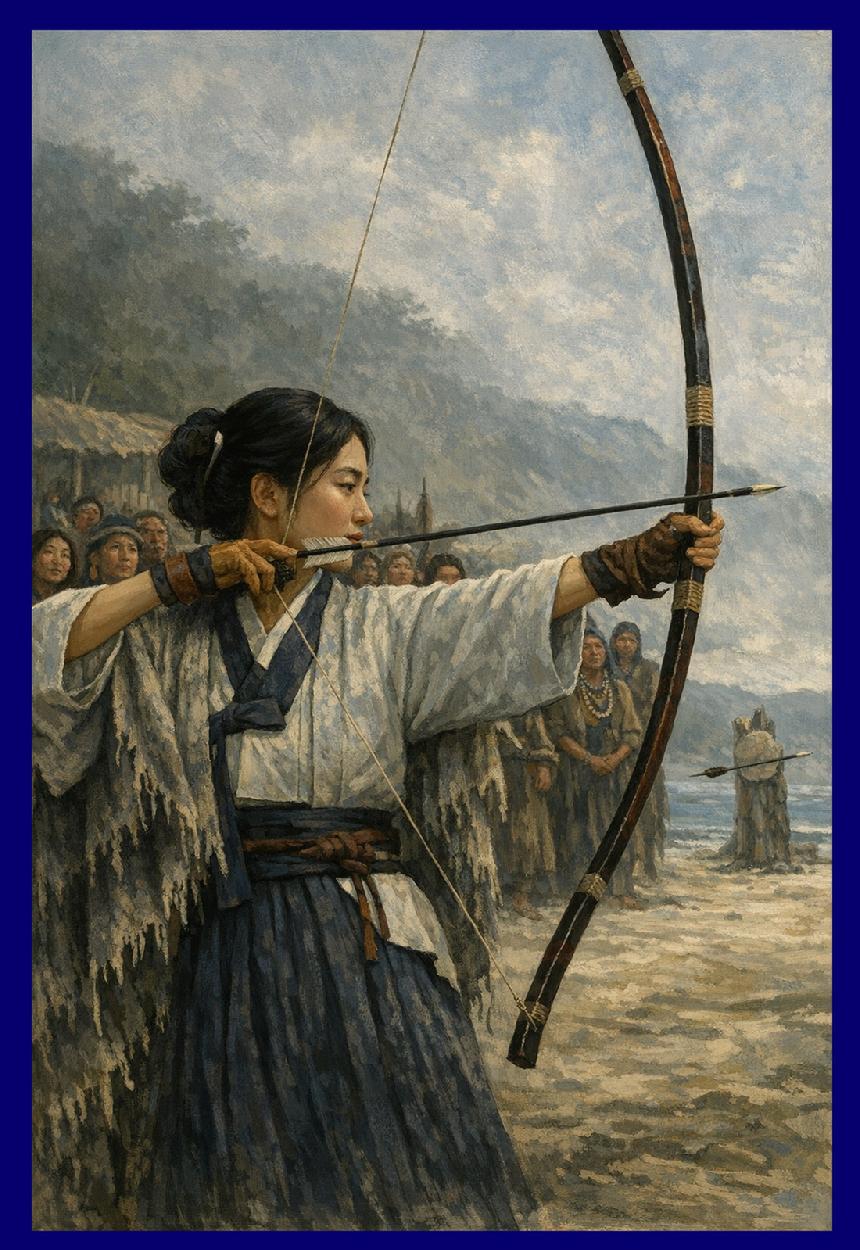
The Japanese delegation entered with measured steps. At their center walked a woman in a formal kimono, her posture straight, her expression serene. A yumi bow — taller than she was — rested across her back, its lacquered curve gleaming like a crescent moon.
The lead envoy bowed deeply.
“Honored representatives of Qing and Joseon,” he said, “the Tokugawa shogunate acknowledges your proposal for a Pacific expedition. Japan will participate in a manner consistent with our laws, our dignity, and our caution.”
He stepped aside.
“We present to you Lady Nakahara Aiko, appointed Kaishi — Sea Envoy of the Tokugawa — and commander of Japan’s contribution to the Combined Fleet.”
Aiko stepped forward and bowed with perfect precision.
Her voice was soft but carried the unmistakable clarity of someone trained in ceremony.
“I bring greetings from Edo. I am honored to stand before you.”
Roxane studied her — the calm, the discipline, the quiet strength.
Yujin recognized the posture of a warrior.
Seonhwa recognized the bearing of a commander.
Feiyan recognized the spark of someone who had trained her whole life for a moment she never expected.
Aiko continued.
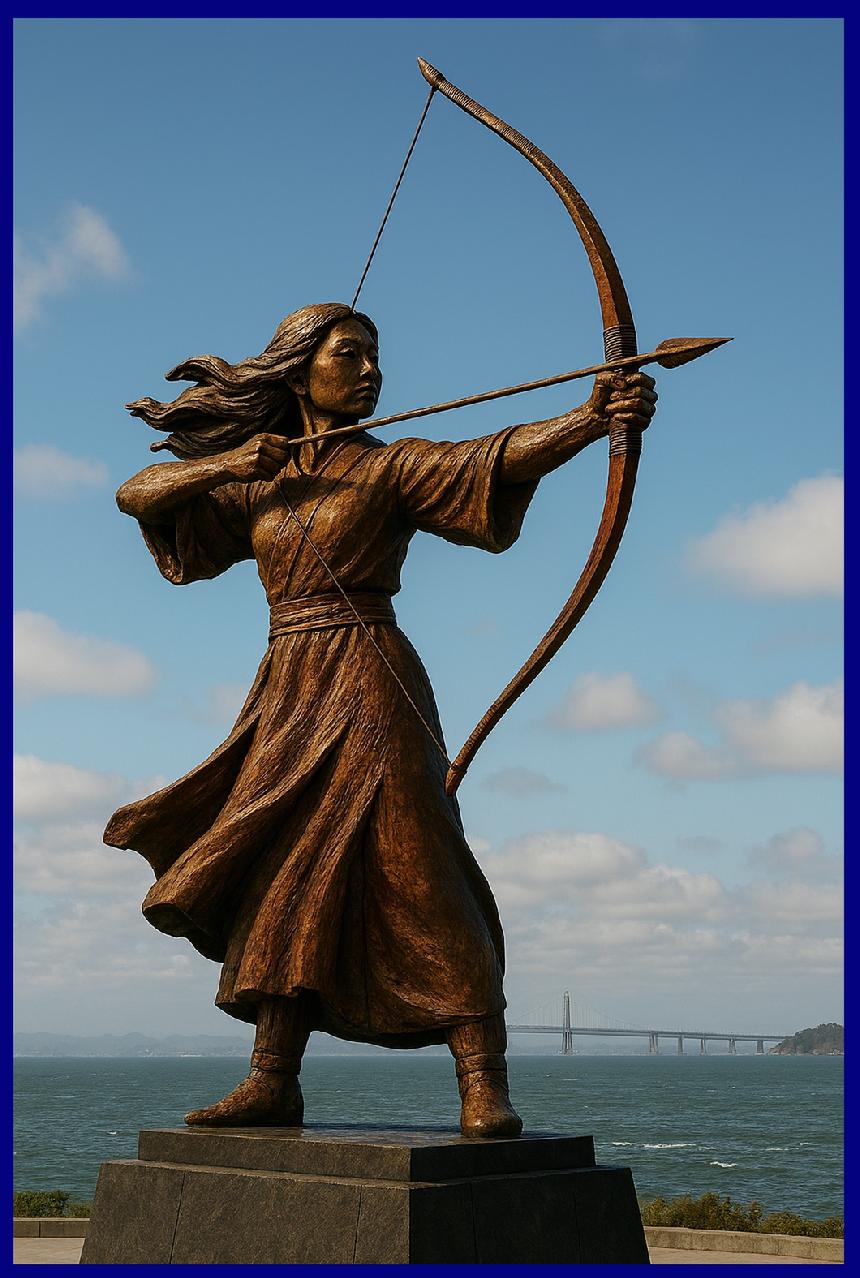
“I am trained in the Way of the Bow — in Kyūdō, and in Yabusame, the art of archery on horseback passed down through my family. In my country, the bow is not merely a weapon. It is a mirror. It reveals intention, truth, and the alignment of one’s heart.”
She unslung the yumi and held it horizontally in both hands.
“I offer this art to the Phoenix Corridor, as a symbol of Japan’s sincerity and our commitment to peace.”
Roxane stepped forward.
“Lady Aiko,” she said, “your presence honors us. And your discipline strengthens us.”
Aiko bowed again.
“I come not to lead, but to serve. Not to command, but to contribute. Not to conquer, but to understand.”
Seonhwa exchanged a glance with Yujin — a glance that said this woman belongs with us.
Feiyan whispered, “She carries herself like a poem.”
Roxane smiled. “She carries herself like an arrow.”
Japan’s Terms of Participation
The envoy unfurled a scroll.
“Japan will contribute three ships, a contingent of marines, and the expertise of Lady Aiko. We request that our participation be recognized as limited, diplomatic, and non‑territorial.”
Roxane nodded.
“The Phoenix Corridor is not an empire. It is a covenant.”
Aiko’s eyes softened.
“Then I am ready to join it.”
Roxane, Yujin, Seonhwa, Feiyan, and Aiko stood together — five women from four nations and two centuries, and Roxane felt something ancient and new — the sense that history had just changed direction.
Pavilion of Wind and Compass, Early Evening
The courtyard was empty except for drifting leaves and the shadows cast by flickering lanterns.
Roxane lingered beneath an archway, letting the cool air steady her. She sensed movement behind her — soft, deliberate, controlled.
Lady Aiko stepped into the half‑light.
She bowed.
“Admiral Wong.”
Roxane returned the bow.
“Lady Aiko.”
For a moment, neither spoke. The wind carried the faint scent of pine resin and ink. Aiko’s yumi bow glimmered on her back like a crescent moon. She studied Roxane — not with curiosity, but with the calm precision of someone who had spent her life reading the smallest movements of breath and intention.
“You carry two worlds in your posture,” Aiko said softly, The world you were born into…, and the world you chose.”
“You noticed.”
“Kyūdō trains the eye to see what is hidden. The arrow reveals the archer.”
Roxane was starting to appreciate in Aiko the discipline, the serenity, the quiet strength that had made the shogunate choose her as Edo’s representative.
“And what did the arrow reveal today?” Roxane asked.
Aiko’s gaze did not waver.
“That you are the wind that directs a change in the course of Time.”
Aiko continued, her voice low.
“Japan does not open easily. But today, we opened a door because you asked with sincerity, not ambition.”
Roxane bowed deeply, feeling the weight of Aiko’s words settle between them.
“Japan honors me with that trust.”
Aiko bowed her head.
“I look forward to serving beside you, Admiral Wong.”
Roxane returned the bow.
“And I look forward to learning from you, Lady Aiko.”
|
Chapter Seven
Joseon — October 27, 1762
The Combined Fleet Departs from Busan
The horizon stretched endless, a silver‑blue expanse where the Pacific breathed in long, rolling swells. The combined Qing–Joseon–Japan fleet moved as a single body, sails taut with autumn wind, banners of dragon, phoenix, and rising sun rippling side by side. Their prows cut eastward into open water, suspended in the liminal space between Joseon’s volcanic edge and the distant green mountains of Hawai‘i.
They were:
-
Four 34‑gun frigates, British‑designed and Qing‑built, their hulls reinforced with Roxane’s shared innovations. Two had been gifted to Joseon — a gesture of trust and unity.
-
One Joseon turtle ship, modified by Admiral Nam Seonhwa for extended ocean travel.
-
Three cavalry transports, fitted with slatted ventilation and padded stalls, carrying twenty‑five horses for scouting, ceremony, and rapid overland travel once they reached Ohlone territory.
-
Six troop transports, crowded with soldiers, scholars, interpreters, and envoys.
-
Five supply ships, heavy‑bellied and essential, laden with rice, dried fish, fresh water casks, medicinal herbs, and shipwright tools.
-
Two medical ships, outfitted with Qing surgical equipment, Joseon herbal stores, and healers trained to tend wounds of both body and spirit.
-
Two Imperial Japanese Navy ships, sleek and disciplined, their sails painted with the sun‑burst crest of Amaterasu.
At the heart of the formation sailed the Quan Yin, Roxane Wong’s flagship. To starboard, the Joseon flagship Yi Sun‑sin held steady under Admiral Nam Seonhwa’s command. To port, the Japanese flagship Amaterasu glided in perfect counterbalance, Lady Nakahara Aiko standing at its prow like a quiet flame.
The three flagships formed a triangle of purpose — compassion, courage, and clarity — guiding the fleet into the deep Pacific.
Admiral Roxane Wong stood at the quarterdeck of the Quan Yin, her presence calm yet commanding.
Ensign Zhang Feiyan darted across the deck with the energy of a rising tide. Now twenty‑one, she brimmed with exuberance — her laughter ringing out even as she leapt to adjust a line or call out a maneuver. Sometimes her eagerness outpaced her caution: she would rush to signal before the admiral’s order, or lean too far over the rail to study the ocean swells. Roxane, with patient authority, tempered Feiyan’s impetuousness into discipline, never crushing her spark but guiding it into rhythm.
From the midship, General Hua Yujin sent a signal flag code to the sister ships:
“All Is Well… Goddess Speed To The Ohlone Miwok Seagate.”
From the Yi Sun‑sin, Admiral Nam Seonhwa acknowledged with a heliograph flash of mirrored sunlight.
In response from the Amaterasu, Lady Aiko rang the ship’s bell in a gentle cadence across the water — a sound that echoed like a drawn bowstring releasing light.
The fleet wove together across the waves in convoy formation, each ship answering the others’ signals, binding the great armada into harmony.
On the Quan Yin, Roxane placed a hand on Feiyan’s shoulder after one particularly daring maneuver — her young ensign hadn’t stood still in one place since the fleet lost sight of the Joseon coast.
“Your fire lights the fleet,” she said softly, “but fire must learn to breathe with the wind.”
Then she winked at Feiyan and added,
“And don’t forget to eat…”
Feiyan nodded, cheeks flushed, her spirit still sometimes untethered to wisdom but growing more grounded with each moment in this new life of adventure unfolding before her. The crew smiled, knowing that in this balance of heart and exuberance, the fleet carried not only ceremony but promise.
And above them, the three flagships sailed in perfect formation — Quan Yin, Yi Sun‑sin, and Amaterasu — guiding the alliance toward a shore none of them had yet seen, but all of them already felt in their bones.
The Crossing Begins
Pacific Ocean — October 28, 1762
By the second day at sea, the fleet had settled into its long‑distance rhythm. The frigates cut clean lines through the swells, the turtle ship moved with surprising grace, and the Japanese vessels held their formation with quiet, unwavering discipline.
Roxane stood at the rail of the Quan Yin, watching the horizon shift from silver to indigo. The Pacific was no longer a boundary. It was a corridor — a living, breathing expanse that carried them toward a future none of them could yet name.
Yujin approached, her steps measured.
“The currents are with us,” she said.
“The sea approves.”
Roxane smiled.
“Or tests us.”
Yujin’s eyes softened.
“Both can be true.”
|
From the Amaterasu, Lady Aiko raised her yumi bow in a silent salute — not a display of power, but a gesture of alignment. Roxane returned the nod, recognizing the discipline behind the motion.
Feiyan, perched in the rigging, whispered to herself:
“She moves like a poem.”
She climbed down lightly, joining Yujin at the rail.
Yujin nodded in agreement.
“She moves like someone who has trained her whole life for a moment she never expected.”
On the fleet cavalry transports, the twenty‑five horses shifted in their padded stalls, hooves tapping softly against the slatted flooring. They were restless, sensing the vastness beneath them. Their handlers soothed them with low, steady words.
The Admiral’s Table
Pacific Ocean — Evening of October 28, 1762
As twilight settled over the fleet, the lanterns aboard the Quan Yin glowed like small constellations. The sea had calmed into long, rolling breaths, and the ships moved in quiet harmony — the kind of stillness that invites reflection.
Roxane stood at the entrance to the great cabin, dressed not in formal regalia but in the understated elegance of a commander at ease. One by one, her guests arrived: Admiral Nam Seonhwa, composed and sharp‑eyed; Lady Nakahara Aiko, serene as moonlight on water; General Hua Yujin, carrying the calm of a seasoned strategist; Senior Ensign Zhang Feiyan, still flushed from the exhilaration of these early days; and the captains of the four Qing frigates, the Joseon turtle ship, and the Japanese flagship Amaterasu.
Roxane welcomed each with a bow of equal depth — a deliberate gesture that set the tone.
“Tonight,” she said, “we dine not as three nations, but as one fleet.”
The table was long and low, set with dishes from all three cultures…
Qing steamed fish with ginger, Joseon kimchi and barley rice, Japanese pickled plums and grilled mackerel, and a pot of Ohlone‑style acorn broth Roxane had prepared herself, a quiet homage to the land they were sailing toward.
Feiyan’s eyes widened at the spread.
“Admiral… you cooked?”
Roxane smiled.
“A small reminder that even commanders must know how to feed their people.”
Seonhwa laughed softly.
Aiko’s lips curved in approval.
Yujin shook her head with affectionate exasperation.
The Toast
When everyone had taken their seats, Roxane lifted a cup of warm sake — a gift from Aiko’s stores.
“To the Phoenix Corridor,” she said.
“To the journey ahead.
To the shores we have not yet seen.
And to the trust that will carry us there.”
The officers echoed the toast, their voices blending like the three chants that had guided the fleet earlier that day.
Aiko raised her cup last.
“And to the wind,” she added softly,
“which teaches us to move together.”
Roxane met her gaze — a brief, quiet acknowledgment of the understanding that had passed between them on the quarterdeck.
Conversations Across Cultures
As the meal unfolded, the cabin filled with the warm hum of voices…
Seonhwa and Yujin debated the best way to coordinate signals during storms.
Aiko explained the philosophy of Kyūdō to a fascinated Joseon captain.
Feiyan animatedly described the moment she lost her balance and got hung-up in the rigging, prompting laughter from the entire table.
The Qing captains shared stories of the shipwrights who had built the frigates now carrying them across the Pacific.
Roxane watched it all with quiet satisfaction.
This — this weaving of voices, traditions, and temperaments — was the true beginning of the expedition.
A Moment Apart
Later, when the plates had been cleared and the officers departed down the lantern‑lit gangway to their waiting longboats, Lady Aiko remained for a breath longer at the doorway of the great cabin.
“Admiral Wong,” she said softly, “tonight you did more than host a meal. You created a circle.”
Roxane inclined her head.
“A fleet cannot sail on discipline alone.”
Aiko’s eyes warmed.
“No. It must also sail on trust.”
They bowed to each other, not as commanders, but as women who understood the weight of what lay ahead.
Aiko turned to leave, stepping into the cool night air. The longboat from the Amaterasu waited below, its lantern swaying gently with the tide. She descended the steps halfway… then paused.
Not from hesitation.
From recognition.
There was one more thing the night needed to hold.
She dismissed the waiting oarsmen with a quiet gesture and walked the short distance back along the deck, her footsteps soft against the planks.
The Quan Yin drifted gently on the black water, its sails furled, its lanterns glowing like small moons. Roxane stood at the bow, her hands resting lightly on the rail. She heard the soft, unmistakable footfall of Lady Aiko — a presence that never intruded, only arrived.
Aiko stopped beside her, bow slung across her back, sleeves stirring in the wind.
“Commander,” she said quietly.
Roxane smiled. “Aiko. You don’t have to call me that when it’s just us.”
Aiko inclined her head. “Then I will call you Roxane, if you permit it.”
Roxane nodded. “I’d like that.”
For a long moment, they simply watched the water. The stars were sharp tonight — the kind of clarity that made truths easier to speak. A faint glow rose on the horizon, the direction of the Phoenix Corridor, as though the future itself were listening.
Aiko broke the silence first.
“When I was informed of my country’s choice to join this venture to a new world and my appointment as Japan’s representative, my intuition told me it meant something beyond diplomacy.”
Roxane exhaled slowly. “It does.”
Aiko waited — patient, steady, the way a Kyūdō archer waits for the breath to settle before releasing the arrow.
Roxane turned toward her.
“Aiko… in my history — the one I was born into — Japan did not choose to open its doors.”
Aiko’s eyes shifted, just slightly. A breath faltered — the smallest break in a warrior’s discipline — quickly recovered.
Roxane continued.
“In the middle of the nineteenth century, foreign ships arrived. Iron ships. Cannons. Demands. And Japan was forced open by coercion. Not by choice. Not by deliberation. Not by sincerity.”
Aiko’s hands tightened on the rail.
Roxane’s voice softened.
“What you and the shogunate did today… choosing to open a door, even a small one… choosing to step into the world on your own terms… Aiko, that changes everything.”
Aiko looked out over the water, her face unreadable, but her breath unsteady.
“In my training,” she said quietly, “we are taught that intention is the soul of the arrow. If the intention is corrupted, the arrow flies false.”
She turned to Roxane.
“Are you telling me that in your history, Japan’s arrow was forced from its bow?”
Roxane nodded. “Yes. And it wounded Japan, and all of Japan’s neighbors in turn. The wound affected everything that came after.”
Aiko closed her eyes — not in pain, but in comprehension. When she opened them again, something fragile flickered there.
“If we open the door,” she whispered, “how do we keep from losing ourselves?”
Roxane stepped closer, her voice barely above the wind.
“By choosing how you open it. By choosing why. And by choosing who stands with you.”
Aiko swallowed — a small, human sound.
“Roxane… why tell me this?”
“Because you deserve to know the weight of what you’ve done. And because your presence here — your discipline, your clarity, your sincerity — is now part of the Sisterhood Circle, and of this voyage of the Phoenix Corridor to the Ohlone Miwok Seagate.”
Roxane hesitated, then added:
“And because you are the one person on this ship with a singular understanding of what intention means.”
Aiko bowed her head, not in formality, but in gratitude.
“I am only one woman,” she whispered.
Roxane shook her head gently.
“You are the one woman Japan sent into the world. And you came willingly.”
Aiko’s eyes shone in the lantern light.
“Then let this be the intention of my arrow,” she said. “Not conquest. Not fear. Not coercion. But choice.”
Roxane touched her shoulder — a gesture she rarely used, but one Aiko accepted without flinching.
“And that,” Roxane said, “is how history changes in this time — not with iron ships, but with intention.”
|
Toward the Unknown Shore
By dawn, the fleet had left the last trace of land behind. The Pacific opened before them — vast, ancient, indifferent, and full of possibility.
Feiyan climbed the rigging again, her hair whipping in the wind, her eyes bright with wonder.
“Admiral!” she called down.
“The sea is singing today!”
Roxane looked up at her — this young, brilliant spark of a woman — and felt the truth of it.
The sea was singing.
And somewhere far beyond the horizon, the Yelamu waited, unaware that history was already turning toward them.
The fleet pressed on —
Quan Yin, Yi Sun‑sin, Amaterasu —
three nations, one purpose, carried by wind, will, and destiny.
The Letter Beneath the Cloak
Pacific Ocean
Early November 1762
The combined fleet sailed westward, banners of Qing, Joseon, and Japan snapping in the wind. Days found their rhythm; nights deepened into a quiet that felt almost sacred.
Roxane, restless in a way she would never name aloud, had tucked her unsent letter into the lining of her sea chest, folded beneath her ceremonial cloak. She believed it hidden — a private vow written in ink she hoped no one would ever read.
But one evening, as the fleet neared the horizon where the Bear’s constellation dipped toward the sea, Yujin entered the Admiral’s cabin in search of a chart. The lantern light flickered across the room, catching the faint shimmer of silk beneath the cloak.
Her hand brushed against it.
She paused.
Not out of curiosity — but because something in the air shifted, as if the cabin itself held its breath.
She drew the folded silk free.
The ink had bled slightly from salt air, but the opening lines remained clear:
“I write this with the ink of restraint and the breath of longing…”
Yujin stopped reading.
She did not need the rest.
She had seen the tremor in Roxane’s hand when she spoke of the future.
She had felt the silence beneath the wisteria in Nanjing.
She had watched the arrow of Roxane’s life drawn toward something beyond duty, beyond conquest, beyond even destiny.
She folded the letter again — carefully, reverently — and returned it to its place as though consecrating it.
Then, in the stillness of the cabin, she whispered:
“Admiral… you are braver than you believe.”
Outside, the sea murmured against the hull, unaware that the first storm was already gathering beyond the horizon.
|
The North Pacific Cyclone Edge
The Storm At Sea
The Combined Fleet
December 22, 1762
The Quan Yin’s navigator recorded their position: 35° N, 175° E — the place where storms were born.
The wind shifted with a low, warning moan.
The sea darkened beneath a sky gathering itself into fury.
On the horizon, the Joseon flagship Yi Sun-sin raised her signal flags in sharp, urgent strokes.
Roxane lifted her spyglass.
Beside her, Hua Yujin read the message even before the final flag snapped into place.
“FIRST OFFICER INCAPACITATED
KNEE INJURY SECURING SAILS
REQUEST QUALIFIED REPLACEMENT
BEFORE STORMFRONT”
Roxane lowered the glass, jaw tightening.
“Seonhwa wouldn’t ask unless she had no choice.”
A gust tore across the deck.
From the port side, Japan's flagship Amaterasu pitched sharply, then righted herself. On her forward deck, Lady Aiko stood unmoving, her cloak snapping like a banner. She lifted her face to the wind — not in fear, but in recognition.
She touched two fingers to her brow, then toward the Quan Yin.
A silent gesture.
A warning.
A blessing.
Yujin saw it and understood.
“My place is there,” she said quietly. “I will go.”
Roxane turned sharply. “Yujin—”
But the general was already fastening her cloak, movements steady despite the rising wind.
“They need an officer who can hold the deck when the storm hits. I am the most qualified.”
“You’re also my first officer,” Roxane said softly.
Yujin’s expression softened — just for a heartbeat.
“Then make this Second Lieutenant Zhang’s moment. Advance her to First Officer in my place until I return.”
A pause.
A breath.
A truth.
“I will return to you.”
The words hung between them — a promise carried on the breath before the storm.
From the Amaterasu, Aiko raised a lantern — a single flame held against the darkening sky.
Not a signal of command.
A signal of faith.
Moments later, Yujin descended into the longboat. The crew watched in tense silence — no one spoke when the general left the ship. The oarsmen rowed hard against the first cold gusts as Roxane watched her cross the widening water.
The longboat vanished into the rising waves.
A sudden break in the rain revealed the Yi Sun‑sin’s mast.
Roxane seized the moment and raised her own signal flags — fast, decisive strokes cutting through the wind.
Aiko, on the Amaterasu, caught the movement instantly.
Her eyes narrowed, reading each stroke with the precision of a bowstring drawn to its perfect point.
“GENERAL HUA TRANSFERRED TO YI SUN-SIN
ZHANG FEIYAN ACTING FIRST OFFICER QUAN YIN
STORMFRONT IMMINENT”
Aiko exhaled once — a single, steadying breath.
“So…” she murmured to the wind, “…the young one carries the bow now.”
She touched two fingers to her brow, then toward the Quan Yin —
a gesture of acknowledgment, and of faith.
Roxane stood at the rail a moment longer than necessary, her fingers tightening around the wet wood as the first cold gusts swept across the deck.
Behind her, Feiyan hovered — uncertain, restless, the storm’s electricity already in her bones.
Roxane turned.
“Second Lieutenant Zhang,” she said, voice steady despite the wind. “Front and center.”
Feiyan straightened instantly, boots braced, chin lifted. “Captain.”
Roxane studied her — the earnestness, the fire, the unpolished brilliance that Yujin had seen long before she had. The deck pitched beneath them, the sky bruising darker by the heartbeat.
“Hua Yujin is assigned as temporary First Officer aboard the Yi Sun‑sin,” Roxane said. “Effective immediately, until General Hua returns, you are Acting First Officer of the Quan Yin.”
Feiyan blinked. Once. Twice.
“Me?”
“Yes, you.” Roxane stepped closer, lowering her voice. “This is not ceremonial. This is not symbolic. I need someone who can think fast, move faster, and keep this crew alive when the storm hits.”
Feiyan swallowed hard. “Captain, I—”
Roxane cut her off gently. “Yujin recommended you herself.”
“General Hua…?”
Feiyan squared her shoulders and replied to Roxane, now less afraid of failing this promotion than honored by it.
“I won’t fail you,” she said.
“I know you won’t,” Roxane said. “But listen to me, Feiyan. This storm will test every ship in the fleet. You will not try to prove yourself. You will not take unnecessary risks. You will hold this deck steady. Understood.”
Feiyan nodded, jaw set. “Understood.”
Roxane placed a hand on her arm — brief, firm, grounding.
“Take your station, First Officer Zhang.”
Feiyan inhaled sharply at the title and turned toward the command rail with a new gravity in her step.
Above them, thunder rolled like a distant drum.
The sky darkened.
The sea rose.
And the storm began to close its fist around the fleet.
The Combined Fleet vanished into walls of rain and roaring wind. Lanterns swung wildly. Masts groaned. The decks became rivers.
On the Amaterasu, Lady Aiko stood at the forward rail, her archers lashed to the mast for safety, her voice carrying through the storm in calm, measured commands. She did not shout. She did not panic. She read the wind like scripture.
At one point, she turned toward the Quan Yin — though the ships were nearly lost to the storm — and whispered:
“Hold fast, Feiyan. Breathe between the waves.”
On the Qing flagship, Roxane fought to keep order as waves slammed the hull. A cry rose from the starboard rail — a young sailor swept toward the sea.
Feiyan moved before thought.
She sprinted across the slick deck, dove, and caught the sailor’s wrist just as he slipped beneath the rail. The force nearly dragged her over with him. A wave crashed over them, swallowing both in white fury.
With a guttural cry, Feiyan hauled him back onto the deck, collapsing beside him, soaked and shaking.
Roxane knelt beside her. “First Lieutenant—”
Feiyan spat out seawater. “Second Lieutenant,” she insisted, breathless.
Roxane’s voice softened. “Not anymore.”
By dawn, the storm had passed, leaving the fleet battered and scattered. The sea steamed in the cold morning light, as if exhaling after the night’s fury.
Two ships were missing; a Joseon frigate commanded by the youngest captain in the fleet, and a Qing supply ship carrying medical stores and fresh water casks.
Search signals were raised, scout vessels deployed, but the sea offered no answers.
Roxane stood at the rail, grief and exhaustion etched into her features. “We’ll find them,” she murmured, though the horizon remained empty.
A longboat from the Hua Mulan — one of the few still intact after the storm — approached from the direction of the Admiral Yi, carrying Yujin back to the Quan Yin.
Yujin climbed aboard, soaked, exhausted, alive.
Roxane stepped forward, unable to hide the relief that broke across her face.
“You’re safe.”
Yujin bowed her head. “The storm was… unkind.”
Roxane reached out, her hand resting briefly on Yujin’s arm. “I thought I had lost you.”
Yujin looked up, and something unguarded in her eyes telegraphed a silent message to her Admiral and co‑commander.
“Roxane… there is something I must tell you.”
A confession was about to rise between them like a tide.
But the moment did not come then.
|
On the Deck of the Lady Quan Yin
Early Evening, December 22, 1762
A few hours had passed since Yujin’s return from the Admiral Yi.
The sea had gone strangely still, as if exhausted by its own fury. Clouds thinned into long silver veils, and the last drops of rain clung to the railings like beads of glass. Lanterns flickered weakly along the deck, their light trembling in the fading wind.
Roxane stood near the bow, her uniform soaked, her hair plastered to her cheek, still shaking — not from fear, but from the sudden, overwhelming clarity that had struck her when she thought she might lose Yujin to the sea.
Footsteps approached.
Yujin moved quietly across the wet planks, carrying herself with her familiar command presence — but tonight there was something gentler beneath it, something unguarded. The storm had stripped her down to a truth she had carried too long in silence.
They stopped a few paces apart.
Roxane spoke first.
“Yujin, I—”
Yujin stepped into her words.
“Roxane, I need to tell you—”
They both stopped.
Both laughed — the kind of laugh that trembles at the edges, the kind that comes when the heart is too full.
Roxane tried again, her voice low.
“During the storm… when I thought you were gone… everything inside me broke open. I saw what I’ve been afraid to admit.”
Yujin’s eyes softened — the fierce guardian finally letting herself be seen.
“I felt the same. I kept thinking… if I don’t tell her now, if I don’t say it while I still can… then I’ll never feel whole again.”
Lantern light caught their faces in half‑shadow, a thin scatter of rain crossing the deck and running down their cheeks.
Roxane stepped forward.
“I love you. I think I’ve loved you longer than I realized.”
“And I’ve loved you since the moment you slipped and almost fell in front of the Emperor. In that instant, a star with your name danced in my heart. I love you with everything I am.”
Roxane reached for Yujin’s hand — not tentative, not hesitant, but steady.
“I don’t want to wait anymore. Not for the right moment, not for permission, not for certainty. I want a life with you.”
Yujin’s fingers tightened around hers.
“Then let’s choose. Right here. Right now. After everything we survived.”
There was no kneeling.
No ring.
No ceremony.
In that moment they were two women who had come through a storm together and now saw the world, and each other, with new eyes. Ahead lay a new world, and for the first time it felt impossibly bright.
Slowly, the world settled back into itself, and with it came the small, human truths of what they had survived.
“I thought we’d lose the mizzenmast,” Roxane said softly, as if her voice hadn’t quite returned from the storm.
“But we didn’t,” Yujin replied. “You held the line.”
Roxane turned to her.
“We held it. Together.”
And only then did Roxane notice Yujin’s clothing underneath the blanket draped over her shoulders — the soft folds of a hanbok, the colors gentle in the lantern light.
At Roxane’s curious expression, Yujin answered before she could ask.
“Seonhwa lent this to me. You saw what I looked like coming back. I wasn’t about to confess to you smelling like salt water and squid.”
Roxane blinked — then laughed, full and bright.
“Squid!?”
Yujin, smiling at Roxane’s puzzled expression, explained,
“At the end of the storm, I went to the bow to inspect for damage. A sneaker wave crossed over the deck and gave up to the ship several dozen baby squid.” A dozen baby squids got tangled in my hair.”
The two paused for half a breath, held hands, then burst into laughter as Roxane replied,
“So that’s what subdued the storm!”
|
A Proposal
The sea was quiet now, but their hearts were not. For a moment, neither spoke, the lantern swayed between them, warm against the cold night air, then — Yujin reached into her coat and drew out a small carved token, an ivory compass etched with the character for trust.
“I give you this tonight,” she said. “And ask you to marry me.”
Roxane blinked, then laughed — a sound like wind catching a sail.
“A proposal?”
Yujin nodded, suddenly unsure.
“Unless that’s too forward.”
Roxane reached into her own satchel and pulled out a folded piece of parchment.
“I am giving you this,” she said. “A map I drew — not of land, but of the stars the night I first realized I loved you. I am asking you to marry me.”
They stared at each other, stunned and smiling.
They held each other’s gaze, breath mingling in the quiet.
“So,” Yujin said, “do we say it together?”
Roxane nodded. “On three.”
“One,” Yujin whispered.
“Two,” Roxane breathed.
“Three,” they said in unison,
“Will you marry me?”
They laughed — but the laughter carried weight, not sorrow but knowing. They were no longer just lovers — they were a declaration. A same‑sex union aboard the flagship of a multinational expedition, under the watchful eyes of emissaries from the Qing and Joseon courts. The implications would ripple outward — through protocol, through politics, through centuries.
Yujin’s smile softened.
“They’ll talk.”
“They’ll write,” Roxane added. “They’ll send envoys. They’ll question everything.”
Yujin’s grip tightened.
“Let them. We’ve already answered.”
The sea rolled gently now, silently.
The storm had passed, but its truth remained, and the two women, wrapped in storm‑worn blankets and moonlight, kissed like the world had just begun.
The storm had left the deck still smelling faintly of rain — that clean, metallic scent that lingered on the rigging and the lacquered railings. Lanterns swung gently in the wind, casting long, wavering bands of gold across the planks.
Roxane stood with Yujin near the bow, their cloaks drawn close, watching the horizon where the Pacific met the night. They were not thinking of strategy or alliances or the Emperor’s commission. They were thinking only of the way their voices had trembled when they said yes.
The wind lifted a strand of Yujin's hair, brushing it against Roxane’s shoulder. They remained together for a long moment in quiet companionship, breathing the same air, listening to the same quiet rhythm of the ship cutting through the dark.
Roxane exhaled slowly.
“I didn’t expect the world to feel different so quickly,” she said.
Yujin’s voice was low. “It isn’t the world that changed.”
Roxane turned to her. Yujin’s eyes were steady, but there was a softness there — a vulnerability she had never shown in daylight.
“You’re afraid,” Roxane murmured.
“Of the consequences,” Yujin said. “Not of you.”
Roxane felt something warm rise in her chest — a quiet, steady courage she hadn’t known she still possessed. She reached out, her fingers brushing Yujin’s hand. Yujin didn’t pull away. She intertwined their fingers, her grip firm, as if anchoring herself.
The lantern above them flickered.
Yujin looked out over the water. “When I was younger,” she said, “I used to ride horseback at night. Past the barracks, past the river, past the city walls — farther than anyone knew.
I didn’t know where I was going. I just knew I needed to keep moving.”
Roxane listened, her thumb tracing the back of Yujin’s hand.
“It felt like the only time I could breathe,” Yujin continued. “The night didn’t ask anything of me. It didn’t care who I was supposed to be.”
Roxane’s voice softened. “And now?”
Yujin turned to her fully. “Now the night feels like a road I’m walking with you.”
Roxane stepped closer, her forehead resting lightly against Yujin’s temple.
“We’ll walk it together,” she whispered. “Even when the world is watching.”
Yujin closed her eyes. “Let them watch.”
Their hands remained intertwined as the fleet sailed eastward, the night holding them like a secret — not hidden but sheltered. A quiet, steady forward motion. A midnight road.
|
The Month Between Storm and Shore
Aboard the Quan Yin and Across the Combined Fleet
January, 1763
The days after the storm unfolded slowly, like sails drying in the winter sun.
The fleet moved cautiously across calmer waters, masts repaired, ropes re‑oiled, hulls inspected plank by plank. The storm had left scars — splintered railings, torn canvas, bruised ribs, shaken hearts — but the ships endured, and so did the people aboard them.
Feiyan rose before dawn each morning, her boots still damp from the previous day’s inspections. She moved through the decks with a new steadiness, her voice firmer, her presence sharper. The storm had carved something in her — not fear, but clarity.
And she was not the only one changed.
Rumors on the Wind
By the first week of January, whispers drifted through the fleet like sea mist.
Junior officers murmured over morning rice.
Crew members exchanged glances when the two commanders passed by.
Even the seasoned sailors of the Joseon flagship noticed.
Roxane and Yujin walked the decks with a quiet gravity — not distant, not aloof, but aligned. Their conversations were softer. Their silences were warmer. Their decisions, once parallel, now moved like two currents flowing toward the same shore.
No one said it aloud.
But everyone felt it.
Something had changed.
Feiyan noticed it first — not in words, but in the way Roxane’s shoulders eased when Yujin approached, or the way Yujin’s voice softened when she addressed Roxane. It was subtle, but unmistakable.
The Sisterhood knew.
The fleet suspected.
The sea, as always, kept its own counsel.
A Call to the Officers
On a cool evening in early January, signal flags appeared on the Qing flagship:
“All officers of the Combined Fleet are requested aboard the Quan Yin at second bell.”
No explanation.
No urgency.
Just a summons.
Feiyan arrived with the other junior officers, her uniform freshly pressed, her hair tied back with a ribbon still smelling faintly of cedar oil. Lanterns swayed overhead, casting warm light across the deck.
Nam Seonhwa stood near the helm, arms folded. Lady Aiko stood beside her, serene as moonlight. Roxane and Yujin waited at the center of the deck.
A hush fell as the officers gathered.
Roxane stepped forward.
The Announcement
Her voice carried easily across the deck.
“Officers of the Combined Fleet, we have weathered a great trial together. We have crossed a threshold none of us will forget.”
Yujin continued,
“In the storm, we found not only survival…
but clarity.”
A ripple moved through the assembled officers.
Roxane reached for Yujin’s hand, a small gesture, but enough to still the air.
“We are pleased to announce our engagement.”
For a heartbeat, the deck was silent.
Then the sound rose — cheers, applause, laughter, the release of something the fleet had been holding in its collective chest.
Feiyan felt her throat tighten.
Nam Seonhwa allowed herself the smallest smile.
Lady Aiko bowed her head, as if acknowledging a prophecy fulfilled.
The fleet needed this moment, one of joy, direction, and hope.
Arrival at Hawai‘i
In the weeks that followed the announcement, the fleet’s rhythm changed. Officers walked with lighter steps, crew members sang while mending sails, and the Combined Fleet moved with a new sense of purpose.
Feiyan found herself working harder than ever, not out of pressure, but out of pride. She wanted the HLC Quan Yin and her crew to be ready to honor the union of the two commanders of the Phoenix Corridor. She wanted the wedding to be worthy of the two women who had carried them through the storm.
By mid‑January, the ships were fully repaired.
By late January, the winds shifted.
And on the morning of January 25, the Quan Yin's lookout cried,
“Land ho! Islands! Dead ahead!”
The fleet erupted in cheers.
|
From the western horizon, the Combined Fleet approached in stately formation — sails taut, hulls gleaming, banners unfurled in wind‑script. The volcanic peaks of the Hawaiian Islands rose from the sea like guardians of the mid‑ocean world.
On the deck of the Quan Yin, Roxane stood beside Yujin, Seonhwa, and Lady Aiko, each wearing the ceremonial colors of their nations. The air carried the scent of salt and flowers, and the rhythmic chant of paddlers echoed across the water. Canoes appeared first — swift, elegant, carved like living creatures — their navigators guiding them with gestures that spoke of lineage and tide.
Aiko raised her hand.
The fleet answered in unity —
Japanese taiko drums rolled like distant thunder.
Joseon banners unfurled in the wind.
Qing lanterns glowed in soft morning light.
The ships bowed — not with bodies, but with hulls and oars — a gesture of respect across the waves.
From the shore, a conch shell sounded in reply.
Signal fires flared along the ridges, serving a dramatic backdrop to the Hawaiian aliʻi in their wa‘a kaulua double‑hulled canoes as they splashed through gentle incoming waves toward the fleet with regal precision. The island envoys stood tall, their voices carrying greetings and protocol. Roxane’s reply was measured and humble — a request for trade and resupply, spoken not as command but as kinship.
Water, timber, fruit, and medicinal plants were offered freely. Navigators shared knowledge of currents and stars for the final crossing east. In return, the fleet presented gifts of silk, lacquer, and song — tokens of gratitude and alliance.
The fleet lingered until dusk, the drums fading into the sound of waves.
That night, Roxane and Yujin stood together at the rail, watching the island lights shimmer.
“This is how we should always arrive,” Yujin whispered.
“As guests,” Roxane replied, “and as friends.”
Shore Leave
Waimea Bay, Hawaii
The winter surf eased early that year, leaving Waimea Bay calm enough to receive the ships in her wide, welcoming arc.
At dawn the next morning, the fleet shifted into its anchorage — sails furled, anchors dropped, longboats moving between ship and shore in steady rhythm. What had begun as a ceremonial arrival now unfolded into moments of shared purpose and peaceful exchange.
They remained at anchor for eight days, the bay holding them in a cradle of calm water and rising green mountains. Each dawn brought new exchanges — navigators tracing star paths in the sand, healers comparing herbs, sailors trading songs and laughter with islanders. The scent of taro, salt, and woodsmoke drifted across the harbor like a welcome that deepened with every tide.
On the second day, the Hawaiian Royal Family invited the commanders of the Combined Fleet to the Big Island as honored guests. The procession ashore was ceremonial, with conch shells sounding from the cliffs, garlands placed around their shoulders, chants rising like wind through the valleys.
Roxane, Yujin, Seonhwa, and Lady Aiko walked at the front of the delegation, and just behind them, in her crisp Qing naval uniform, First Lieutenant Zhang Feiyan walked with her fellow junior officers of the combined fleet.
Her posture was impeccable, her boots polished to a mirror sheen, her sash tied with ceremonial precision. She walked with the quiet pride of someone representing not only her commander, but her ship, her fleet, and her future.
Island children peered from behind their elders, whispering about the young officer with the bright red sash. Feiyan bowed to them with perfect form, and the children giggled, returning the gesture with shy delight. One of the Hawaiian navigators, noticing her bearing, nodded in recognition — navigator to navigator.
Inside the royal compound, the diplomatic exchange unfolded. Gifts of silk and lacquer, baskets of fruit and medicinal plants, and navigational knowledge were shared with reverence. Feiyan stood at Roxane’s right shoulder, the position of trust and readiness. When the aliʻi asked questions about the fleet’s journey, the lieutenant answered with crisp clarity, her voice steady, her respect unmistakable.
It was during this exchange that one of the royal attendants noticed the way Roxane and Yujin stood slightly closer than protocol required. A whisper passed among the hosts. A question was asked with gentle curiosity. And when the truth was spoken — that the two commanders were newly engaged — the hall brightened as if the rafters themselves approved.
The King rose, his cloak of feathers shimmering like a living sunrise.
“Your union carries the blessing of the ocean,” he said. “If your ceremony is to be held upon the sea, then let it be held here, where your ship rests in our waters. We give our blessing for your wedding to take place aboard your flagship, under the guidance and the eyes of your ancestors and ours.”
“And when your vows are spoken,” the King continued, “we will host a feast upon the Big Island — a luau for the happy and fortunate couple, so that joy may be shared by all who sail with you.”
The hall erupted in warm laughter and applause. Outside, the wind shifted, carrying the scent of plumeria and sea spray. It felt as though the islands themselves had joined in the blessing.
That evening, lanterns floated on the bay like drifting stars. The Yi Sun‑sin, Seonhwa’s flagship, glowed with preparations, not yet for the ceremony, but for the promise of it. Feiyan stood at the rail of the Quan Yin, watching the lanterns drift and feeling the weight and wonder of the moment.
Waimea Bay, Hawaii
Evening Before the Wedding
Feiyan's Night
January 30, 1763
Lanterns swayed gently between the masts of the Joseon flagship, their warm glow reflected in the polished deck and the calm, dark water beyond, while the scent of steamed rice, grilled fish, and plum wine drifted through the air. Musicians played a quiet, reverent melody — not festive, but full of anticipation.
Feiyan sat with the junior officers, posture straight, uniform crisp, her gaze drifting toward the horizon as if still mapping the shoreline, her mind tangled with repair schedules, retrofit plans, crew rotations, and the logistics of tomorrow’s ceremony. She had spent the afternoon coordinating with the galley chefs and finalizing seating arrangements — she had even forgotten to eat lunch, something that hadn’t happened since the Joseon shipyards.
She did not know what was coming.
Lady Aiko rose from her seat, her robes shimmering like moonlight on water. She stepped into the open space at the center of the deck, carrying a small velvet box.
Roxane and Yujin stood beside her.
Aiko’s voice rang clear across the deck, ceremonial, yet touched with human warmth.
“First Lieutenant Zhang, front and center.”
Feiyan, startled, stood quickly, and stepped away from the junior officers’ table. She crossed the deck and came to attention before Lady Aiko, saluting sharply.
Aiko’s stern expression softened just enough for Feiyan to notice.
“As you were, Lieutenant… this is a party, after all.”
Laughter rippled from the junior officers’ table, and Feiyan felt her cheeks warm.
Aiko continued.
“At the request of Commander Roxane Wong and General Hua Yujin,
I present this commendation for heroism to Lieutenant Zhang Feiyan.”
Feiyan blinked.
She had not expected a ceremony.
She had not expected a medal.
Aiko opened the velvet box.
Inside lay Roxane’s Navy Cross from the 21st century — silver, blue, solemn.
Roxane stepped forward from the captain’s table.
“This medal was awarded to me when I was a second lieutenant aboard a Navy ship.
I received it for a rescue at sea — a rescue not unlike the one you performed.”
She paused, her voice softening.
“I carried it across time.
I kept it close.
Tonight, I give it to you.”
Feiyan lifted her hands slowly, reverently, as Aiko placed the medal in them.
“You are no longer the girl who leapt into the storm,” Aiko said.
“You are the woman who brought someone home.”
Yujin stepped forward with a second box — smaller, darker, marked with the insignia of rank.
“By order of Commander Roxane Wong, for actions taken not only on her behalf but on behalf of the Combined Fleet,
First Lieutenant Zhang Feiyan is hereby promoted to the rank of Lieutenant Commander.”
Feiyan bowed her head.
Roxane pinned the new insignia to her collar, then lifted the indigo‑ribboned Navy Cross and placed it gently around her neck. Her voice dropped to a private murmur meant only for Feiyan.
“Congratulations, Commander Feiyan‑nim. The Ship is so proud of her new officer.”
Nam Seonhwa raised her glass.
“To Lieutenant Commander Zhang Feiyan — the fire that does not burn, the tide that does not retreat.”
The musicians shifted to a brighter melody.
Feiyan started toward her seat at the junior officers’ table, the weight of the medal warm against her chest, the new rank settling into her bones. As she returned to take her place the first and second lieutenants erupted in cheers. Music rose around her.
Then, before she could be seated, Roxane tapped the shoulder of the Fleet’s youngest commander, who turned toward her admiral with a questioning glance, then one of blushing recognition as Roxane redirected her toward the captain’s table.
Feiyan did not speak. She did not need to. Her heart was full.
She had only just settled into her place at the senior officer’s table when Roxane leaned toward her, whispering something in her ear.
Feiyan stood, hands clasped behind her back, the lantern‑light catching the faint polish of her uniform. She looked, for a moment, like someone preparing to give a report.
Roxane with an inquiring glance her way said, smiling, “Commander?”
Feiyan nodded once, startled in spite of herself at being addressed by her new command rank. “I am asked to offer something… appropriate. In the spirit of Du Fu.”
A ripple of amusement passed through the room — Feiyan’s idea of “appropriate” was always unpredictable.
She began, voice steady:
“They say the noble ladies glide with sleeves like banners on a calm sea, their hairpins bright enough to signal ships, their perfumes trained to conquer rooms.”
Yujin pressed her fingers to her lips, trying not to laugh.
Feiyan continued, expression unchanged:
“I have seen such splendor once — a procession of silk and lacquered smiles, attendants fussing over every fold as if a wrinkle might unbalance the empire.”
Aiko whispered to Seonhwa, “That sounds exactly right.”
Feiyan didn’t acknowledge the interruption. She simply moved on:
“They walked as though the earth itself should be grateful for their footsteps. They spoke in murmurs soft enough to shame the wind into silence.”
Now the laughter was warm, communal — not loud, but shared, the kind that softens a room.
Feiyan’s tone gentled, almost imperceptibly:
“But I have also seen beauty in a lantern swaying over a worn deck, in friends gathered close against the night, in laughter that needs no embroidery.”
Roxane’s smile faded into something tender. Yujin’s eyes shone.
Feiyan finished:
“And tonight, on the eve of a wedding, I find more grace in honest company than in all the jeweled courts combined.
So let the noble ladies keep their splendor. We have broth, warm light, and one another. And that is elegance enough.”
She bowed her head slightly — not a formal gesture, just acknowledgment — and sat.
Then Yujin rose, touched Feiyan’s shoulder, and said softly, “That was beautiful.”
Roxane added, “And exactly right.”
Feiyan didn’t smile, but her eyes warmed — a quiet, private glow that only those closest to her ever saw.
Aiko leaned toward Seonhwa. “She sees more than she ever admits.”
Seonhwa nodded. “And she gives more than she thinks.”
Feiyan heard none of it. She sat with her hands folded, gaze lowered, as if embarrassed by the attention.
Roxane clapped her hands once, sharply, like a spark catching dry tinder.
“All right,” she said, eyes bright. “Everyone up. I’m teaching you something from home.”
Aiko raised an eyebrow. “From… which century?”
Roxane grinned. “The one that’s yet to come.”
Laughter rippled across the deck.
The musicians — three fiddles, a drum, and a flute — exchanged glances. The eldest fiddler shrugged, lifted his bow, and said, “If the Commander dances, we follow.”
Roxane stepped into the open space between the tables, lantern‑light pooling around her like a small stage. She bounced once on her heels, testing the deck’s give.
“This is called swing,” she said. “It’s fast, it’s silly, and it’s impossible to do without smiling.”
Feiyan, still stiff from the ceremony, murmured, “Commander… I don’t dance.”
“Tonight you do.”
The sailors cheered.
Feiyan sighed — the long, suffering sigh of a woman who had just been awarded the Navy Cross and now regretted surviving long enough to receive it. She stepped forward.
Roxane took her hands.
“Just follow me,” she said gently.
Feiyan’s first attempt at the triple step looked less like dancing and more like preparing to repel boarders.
Feiyan tried. She really did. But her feet moved like she was marching into battle, not dancing. Her triple step sounded like a tactical maneuver.
Aiko whispered to Seonhwa, “She’s going to invent swing‑drill.”
Seonhwa nodded gravely. “We will have to learn it.”
Roxane laughed — not at Feiyan, but with her.
“No, no,” she said, “you’re thinking too much. Swing is about letting go.”
Feiyan blinked. “Letting go of what?”
“Everything.”
The musicians leaned into the rhythm, adding playful trills, a drumbeat that made the lanterns sway in sympathy.
Roxane guided Feiyan through the steps again — slower this time, her hands steady, her voice soft.
“Rock… step… triple… triple… bounce.”
Feiyan’s movements loosened. Just a little. Enough for Yujin to clap and shout, “She’s doing it!”
The sailors cheered again.
Feiyan’s ears reddened.
But she kept going.
Soon the deck was full — sailors, the Sisterhood Circle, musicians tapping their feet as they played. The lanterns swung overhead like a second rhythm. The ship itself seemed to dance.
Roxane spun Yujin. Aiko tried a turn and nearly collided with a chair. Seonhwa executed a perfect step and looked quietly proud. Feiyan found herself smiling — not widely, not openly, but enough for Roxane to see it.
Enough for Yujin to squeeze her hand.
Enough for the Circle to feel the warmth of it.
The medal at Feiyan’s collar glinted as she moved — catching lantern‑light, catching breath, catching the moment.
And for a few minutes, the Ship was not a vessel of war or diplomacy or destiny.
It was a place of shared joy.
A place where centuries dissolved. A place where women danced. A place where Feiyan, newly honored and overwhelmed, was held gently by the rhythm of her companions.
When the music finally slowed, Roxane bowed to the musicians.
“You’re hired,” she said.
The eldest fiddler laughed. “Commander, we were hired three years ago.”
“Then you’re promoted.”
More laughter.
Feiyan stood still, breathing lightly, her uniform rumpled from movement, her medal warm against her skin.
Yujin touched her arm. “You did beautifully.”
Feiyan shook her head. “I did adequately.”
Roxane stepped beside her. “Commander… tonight you did everything beautifully.”
Feiyan looked away — but her eyes shone.
The lanterns swayed overhead, casting gold across the deck, across the dancers, across the woman who had never expected to be honored, let alone celebrated.
And the wedding‑eve night held all of them in its gentle, joyful hands.
|
Lieutenant Commander Zhang Feiyan
|
Wedding Ceremony
The deck of the Quan Yin had been transformed into a sanctuary of silk and light. Lanterns swayed gently in the ocean breeze, casting golden halos across the polished wood. The sea whispered blessings, and the horizon held its breath.
Roxane and Yujin stood facing one another, hands joined.
To Roxane’s left stood Lieutenant Commander Zhang Feiyan, radiant in crimson silk embroidered with plum blossoms and phoenix feathers. Pride glowed from her like a second lantern. Earlier that afternoon, she had braided gold threads into Yujin’s hair and stitched a line of poetry into Roxane’s sash:
“To walk beside you is to walk toward the sun.”
It had been three years since Feiyan enlisted at eighteen — three years of storms, stars, and impossible miracles. And tonight, standing as maid of honor to a love that defied history, she felt the truth of why she had chosen this life.
To Yujin’s right stood Lady Nakahara Aiko, dressed in layered silk the color of dawn over water. Her presence was serene, grounded, luminous — the still point around which storms broke and calmed. She carried a lacquered tray bearing two ceremonial cups and a sprig of native maile intertwined with red and white ribbons.
Aiko inclined her head to both brides, her voice soft but resonant.
“Tonight, the sea bears witness. Tonight, the ancestors listen.”
At the center stood Admiral Nam Seonhwa, her robes embroidered with symbols of wind and water. She held a small bowl of seawater collected at dawn. When she spoke, her voice carried the authority of tide and sky.
“Tonight we honor a union not only of two souls, but of two legacies.
Roxane Wong, known also as Huang Lingfeng, and Hua Yujin—
You have chosen each other in truth, in tenderness, and in shared purpose.
May your vows be the wind that carries this vessel forward.”
Hua Yujin’s Vows
(spoken first in Cantonese, then in English)
“From the moment I saw you, I knew my heart had found its echo.
You are my compass, my courage, my calm.
From inside the left sleeve of her wedding dress, Yujin pulled a small scroll bearing traditional Chinese characters in delicate brushstrokes written in her own hand.
“This poem’s author is unknown. It has been handed down through the Hua family for generations, spoken at weddings as a vow of unity. Today, I offer it to you. And so I vow—
Wholehearted harmony.
Together until our hair turns gray.
We are with one heart.
Complete are we.
The harmonious lilt of the Phoenix
Is the song that we sing.
I will walk beside you, through every storm and sunrise,
With the grace of the Phoenix and the strength of our shared purpose.”
Aiko bowed her head. Feiyan pressed a hand to her heart. Even the sea seemed to hush.
Roxane Wong’s Vows
(spoken in English with Cantonese echoes)
“Yujin, when I met you, I was iron —
forged by history, tempered by duty.
But you saw through the armor.
You saw me.
And so I offer you this truth,
not as a warrior, but as a woman in love…
I felt something never ending
When your heart came to mine,
And yesterday began seeing
Visions where two hearts divine
Twin hearts dancing on horizons,
With love most true and visibly
Without condition or exception
Just yours and mine.
Eternity.
I vow to walk beside you,
to dream with you,
and to build a world where our love is the compass.
Where Roxane and Lingfeng are one —
and you are my home.”
Aiko stepped forward. She lifted the maile sprig from her tray and laid it gently across their joined hands.
“In the islands, maile binds not by force, but by fragrance.
May your union be like this — soft, enduring, unmistakable.”
Then Seonhwa dipped the maile into the seawater and traced a circle around their hands. The water glimmered, catching the last light of dusk.
“May your bond be as fluid as the tide, as enduring as the stone beneath it.”
Feiyan stepped forward, her voice clear and unwavering.
“I stand as a witness. Not just to their love, but to their courage. Their union is their truth. And I will defend that truth with every breath.”
Aiko lifted the ceremonial cups, offering one to each bride.
“Drink,” she said softly. “And let the sea carry your vows to every shore.”
Roxane and Yujin drank. The lanterns swayed. The sea breathed.
Seonhwa raised her hands.
“By the power entrusted to me, and by the spirit of the sea that surrounds us, I pronounce you bound — not by law, but by love.
Let your journey be one of harmony, resilience, and joy.”
As the sun dipped below the horizon, the Quan Yin rang its ceremonial bell.
The Phoenix had sung.
The sea exhaled.
And two hearts became one.
|
Celebration on the Deck of the Quan Yin
Night of January 31, 1763
The Sisterhood Circle
The ceremonial bell had barely finished ringing when the deck of the Quan Yin shifted from sacred stillness into a warm, rising hum of celebration. Lanterns glowed brighter as night deepened, their light catching on silk, armor, and the salt‑touched smiles of sailors who had survived the storm and now witnessed something rarer still — a love that refused to bow to history.
Musicians from the Amaterasu and Yi Sun‑sin had gathered near the bow, tuning shamisen, gayageum, and bamboo flutes. A soft melody rose, carried by the breeze.
Roxane and Yujin stood together, hands still joined, their foreheads touching in a moment of private joy.
Then footsteps approached — three sets, steady and sure.
Lady Nakahara Aiko arrived first, her layered silks whispering like waves. She bowed deeply to both brides, then straightened with a smile that softened her warrior’s poise.
“You have given the fleet a new star to navigate by,” she said. “And I am honored to stand beside you both.”
Admiral Nam Seonhwa stepped forward next, her presence calm and luminous. She placed a hand on each woman’s shoulder — a gesture she reserved for equals, never subordinates.
“You walked through the storm,” she said, “and chose each other in its wake. That is the mark of true commanders — and true partners.”
Her voice held no distance, no formality, only kinship.
Feiyan joined them last, still radiant in her crimson silk, her eyes bright with pride and something deeper — the fierce devotion of a younger sister who had found her place in the world.
She lifted her cup.
“To the two women who taught me what courage looks like,” she said. “And to the sisterhood that carries us all.”
Aiko raised her cup.
Seonhwa raised hers.
Roxane and Yujin lifted theirs together.
Five cups touched in a soft, ringing chime.
A circle completed.
From Waimea Bay To The Farallones
The King kept his promise, and a luau on the Big Island honored the newlyweds before the fleet sailed. On the morning of the ninth day, the Combined Fleet weighed anchor and turned east, carrying not only supplies and knowledge but the blessing of Hawai‘i, and the quiet certainty that they had become part of a story larger than any of them had imagined.
|
Chapter Eight
The Advance Party
Pacific Waters, West of the Farallon Islands March 1, 1763
The wind had shifted.
Not in force, but in intention.
A sleek trireme, hull lacquered in deep indigo and trimmed with silver, sliced through the morning fog like a blade through silk. Its three banks of oars moved in perfect rhythm, guided by the steady hand of Captain Tien Anh — a Guangzhou sailor whose mastery of treacherous currents had earned her the helm of this mission. She stood at the tiller, eyes narrowed against the salt spray, her voice low and precise as she called adjustments to the rowers.
At the bow stood four envoys, shoulder to shoulder, their robes marked with the seals of the Qing, Joseon, and Tokugawa courts. Each bore a scroll case wrapped in red silk, and each carried the weight of a message not merely diplomatic, but sacred.
The Envoys
Liang Wen — Qing scholar, fluent in Chochenyo and Cantonese, gifted in metaphor and ceremonial speech.
Kim Hyeon — Joseon linguist and strategist, trained in alliance protocol and trade law.
Zhao Yinuo — Qing-born interpreter and cultural envoy, who had studied Chochenyo and Ramaytush under Roxane Wong since 1762.
Haneda Masami — Japanese envoy and apprentice to Lady Aiko, trained in kaishi (sea diplomacy), carrying a lacquered box of gifts from the Tokugawa court.
They had been chosen not for rank, but for resonance.
Roxane, Yujin, Seonhwa, and Lady Aiko had trained them together — four nations shaping a single voice.
Their mission: to request permission to land, to offer gifts of trade and protection, and above all, to affirm the sovereignty of the Ohlone Nations over the lands of the Bay.
As the trireme passed the Farallon Islands, the crew fell silent. Captain Anh raised a signal lantern, its flame shielded by colored glass. The light pulsed in a coded rhythm — an ancient maritime courtesy, announcing peaceful intent.
Liang Wen stepped forward and unfurled the first scroll. It bore the seals of all three courts and a message written in Classical Chinese, Hangul, Chochenyo, and Japanese kana. The words were simple, but the gesture profound:
“We approach with respect.
We seek your guidance.
May we land where you deem sacred.”
Zhao Yinuo bowed low, then spoke aloud in Chochenyo, her voice steady against the wind. The words were not a translation, but a prayer.
“We come not to claim, but to listen.
The sea carried us here,
but the land is yours.”
Haneda Masami stepped forward next, lifting a small lacquered box.
Inside lay a pair of inkstones from Satsuma, a silk cord woven in the colors of the Tokugawa crest, and a poem handwritten by Lady Aiko in classical waka form.
Masami recited it softly in Japanese, then again in Chochenyo:
“Where sea meets new shore,
let no shadow fall between us.
Only the tide’s breath.
Captain Anh adjusted course toward the eastern horizon, where the fog began to lift. Somewhere beyond, Ohlone watchers would see the trireme’s silhouette and know:
The fleet had sent its heart ahead, and this time, the heart had four chambers.
The Shoreline Accord
Yelamu Coastline
Five days ahead of the Combined Fleet, the advance party trireme rounded the southern headland where the coastline bent inward, sheltering a little cove from the open Pacific swell — close enough to the Seagate’s mouth to watch the tide run through it, far enough to never need to. This was the last calm water before the strait began its work; beyond the point, the fog thickened and the current turned strange, and no vessel entered there without cause.
It was a stretch of coast the Yelamu watched closely — the natural vantage from which any approach by sea would first be seen. Anh had chosen it for exactly that reason: better to be found than to go looking, and better still to ask permission from a place where retreat was still possible.
Tien Anh stood at the helm, posture steady, eyes taking in the unfolding scene at a coastal village where people had begun to take notice of the unusual strangers and their even stranger-looking boat. From the trireme Anh noticed two villagers near the shoreline standing apart from the gathering. They stood near the edge of the gently rolling surf, cloaked in tule and elaborate feather and shellwork, and were holding out feather-sticks while making welcoming gestures toward the envoys. Anh raised her hand toward the lead villagers in what she hoped was a reciprocal greeting of peace and friendship, while giving permission to the Phoenix Corridor representatives to disembark for first contact.
Liang Wen, Kim Hyeon, Zhao Yinuo, and Haneda Masami stepped onto the sand with deliberate grace. Each carried a scroll, a gift, and a small pouch of salt — symbols of preservation and truth. They bowed low, not as emissaries of empires, but as guests of the land.
A circle of Yelamu Petlenuc village elders awaited them, seated on woven mats beneath a canopy of driftwood and bay branches. At the center sat Chief Nopʰen, his staff carved with spirals and constellations. Beside him, Elder Sakuyani held a bundle of ceremonial tobacco and a shell rattle.
Zhao Yinuo stepped forward first, her voice clear in Chochenyo:
“We come with respect.
Our fleet sails with peaceful intent.
We ask your guidance, and offer an alliance.”
Chief Nopʰen nodded, then gestured for Sakuyani to speak. Her words, translated by a younger interpreter, carried the weight of memory:
“You arrive not as conquerors, but as those who remember.
The land listens.
The ancestors listen.
Speak your truth.”
Liang Wen offered the scroll of the Qing court.
Kim Hyeon presented the silk maps and herbs of Joseon.
Zhao Yinuo placed the carved inkstones upon the mat.
Haneda Masami bowed deeply and recited Lady Aiko’s poem once more.
Sakuyani lifted the shell rattle and shook it once, the sound sharp and bright as a hawk’s cry.
“The sea does not divide us.
The wind carries our breath.
May our paths meet in peace.”
She placed the rattle in Zhao Yinuo’s hands.
“You speak as one who listens,” she said.
“You may land — where the tule bends and the herons nest. We will prepare the ground.”
At a signal from the envoys, Captain Anh and her first officer stepped ashore, their boots sinking into the sand. She bowed to the elders, confirmed with the envoys the Yelamu permission to land at Petlenuc, then turned to her officer.
“We will return to the fleet with this message,”
“Yelamu welcomes the Phoenix Corridor with open arms.”
Above them, a hawk circled once, then vanished into the fog.
|
Chapter Nine
The Leap
Approaching Ohlone ’Akkoyen Rummeyya
(The Seagate of the Ohlone Nations)
Coastline of Yelamu Territory
March 6, 1763
The morning mist parted like a curtain drawn by ancestral hands.
From the western horizon, the combined fleet of Qing, Japan, and Joseon ships approached in stately formation — sails taut, hulls gleaming, banners unfurled in wind‑script. The flagship Quan Yin led the procession, its dragon prow slicing through the tide with quiet authority.
On the deck of the Quan Yin, each in ceremonial dress, Joseon Admiral Nam Seonhwa and Arc Commander Lady Nakahara Aiko stood with Qing Admiral Roxane Wong. Feiyan waited a respectful step behind them, still and watchful for once, sensing the weight of what was coming. Roxane’s eyes traced the shoreline where the Petlenuc Yelamu gathered in deliberate stillness. Beside her, General Hua Yujin adjusted her sash, her breath steady, her gaze unblinking.
From Captain Anh’s returning longboat, a signal officer raised their flags. The message unfurled across the sky in strokes of color:
“REQUEST TO LAND GRANTED BY PETLENUC CHIEFDOM
HONORING SOVEREIGNTY OF OHLONE NATIONS”
Seonhwa and Aiko turned to Roxane and saluted with a light in their eyes that betrayed their outward military discipline. The offshore breezes graced them and embraced them in a feeling that this moment would be remembered for lifetimes.
Seonhwa placed her hand over her heart,
“I will return to my flagship — may Goddess Quan Yin bless us all.”
Aiko bowed to sister commanders,
“May Amaterasu keep your landing on the crest of the waves — balanced and bright.”
They parted for their own ships, the Combined Fleet drawing itself into readiness — for ahead lay the Seagate, and no permission, however welcome, would make that passage kind.
The fog thickened as the fleet approached the strait, and for a long moment the Seagate itself seemed to vanish — swallowed whole by mist and the low grey grind of tide against rock.
Admiral Nam Seonhwa stood at the Yi Sun-sin’s wheel, her eyes narrowed against the spray, reading the water the way another woman might read a familiar face. The current here ran contrary to reason — a flood tide pulling east even as the surface chop suggested otherwise, a trick of the narrows that had already claimed ships neither history nor legend would ever name.
“Hold her steady against the drift,” Seonhwa called, and the helmsman leaned into the wheel as the bow answered, slow and reluctant, like a horse fighting the bit.
Behind her, the rest of the Combined Fleet fell into a single line — no room here for stately formation, only for trust. Aiko’s scout ship trimmed sail hard, catching what wind the fog had not yet stolen. On the Quan Yin, Roxane gripped the rail, watching the Yi Sun-sin lead the way through water she knew — from a history that no longer had to happen — had claimed ships that never found the channel. She said nothing of it. Some warnings were not hers to give; this crossing belonged to the sailors making it, not the woman who had once only read about it.
The narrows tightened. Rock walls rose on either side, indistinct in the mist, close enough that the crew’s voices dropped to something reverent. Then — a shift. The current eased its grip as suddenly as it had taken hold, and the fog began to thin, fraying into ribbons of pale gold where the morning sun found purchase.
They were through.
A ragged cheer rose somewhere belowdecks, quickly hushed by an officer’s glance, but Seonhwa allowed herself a single, unguarded breath before her expression settled back into command. Ahead, the bay opened wide and welcoming, its waters calm as if the strait behind them belonged to another sea entirely.
Roxane turned to Feiyan and Yujin.
“Prepare our longboat,” she said. “We go ashore.”
The oars dipped in unison. The longboats glided toward the coast like brushstrokes across silk. Roxane stood at the prow, her hand resting lightly on the carved dragon rail, the insignia of the Quan Yin catching the morning sun. Yujin sat beside her, legs braced, eyes scanning the shoreline with the calm of someone who had weathered storms far greater than this moment.
Behind them, Zhang Feiyan fidgeted with the sash of her ceremonial robe. Her boots gleamed, her posture nearly regal, but her eyes betrayed a storm of anticipation. She had waited too long to be merely received.
“Hold steady,” Roxane called. “Prepare to dock oars.”
The oarsmen obeyed. Feiyan nodded too—though to no one in particular. She stepped toward the side of the boat, breath held, poised like a dancer suspended between beats.
Yujin saw it first.
“Commander! As you were!”
Roxane’s voice followed, sharp with command.
“Feiyan! Stand down!”
Too late.
Feiyan launched herself into the air, robes flaring behind her like a comet, but a misjudgement in midflight caused her right heel to clip the port gunwale with a sound that sent a reverberating clap along the railing that made every oarsman turn their attentions from their rowing cadence to the flying Lieutenant Commander Zhang, whose attempt at an elegant arc was now spiralling into something so Feiyan. What had begun as a symbolic leap became an out of control freefall, ending in a spectacular belly flop into the shallows of Yelamu territory.
A splash. A pause. Silence.
Twenty yards ahead, the Yelamu leaders watched. The surf curled around Feiyan as she rose, soaked but unbowed, peeling kelp from her forehead, spitting out another strand, brushing more from her sleeves with the weary dignity of someone accustomed to awkward landings. She bowed toward the elders as if the entire performance had been intentional.
From the deck of her anchored flagship, Admiral Nam Seonhwa gasped, lowered her spyglass, and stifled a laugh that nearly cracked her stern composure. She signaled to her communications officer.
The signal flags rose…
“Feiyan Takes A Great Leap Forward”
On the shoreline, a Yelamu elder pointed and chuckled. The others joined—gentle, unmocking laughter, like wind stirring chimes.
Their chief stepped forward, carved staff tapping softly against the sand. Through an interpreter, he offered a name,
“Graceful Dancing Arrow.”
Roxane and Yujin, now wading ashore, exchanged a look.
“She’s waited since we left China to grace us with this stunt,” Roxane muttered. “We’ll have to pretend to reprimand her.”
Yujin, soaked to the knees, allowed herself a rare smile.
“So out of all of us, she is the one who got here first.”
Roxane, smiling, shook her head, and gestured toward the Yelamu,
“No. Zhang Feiyan arrived here second. They arrived first.”
The tide whispered against the sand.
On the rise above the beach, a young Yelamu man watched in silence.
His name was Teymuk, the twenty-year-old son of the tribal speaker. Tall, quiet, with eyes like river stone, he had been taught to read the tide, to listen before speaking, to weigh every word like a prayer.
And yet, at the first sight of Zhang Feiyan, he forgot all of those teachings. Feiyan stood dripping, radiant, defiant. She laughed at herself, shook the kelp from her hair, and bowed again with theatrical grace. Teymuk, startled in spite of himself as his heart skipped a beat, exclaimed to his sister standing next to him,
“She fell like fire… and rose like dawn.”
Suyana, two years his junior, adjusted a feather in her hair and gave her brother a curious sideways glance before returning her attention to the shoreline, speaking to no one in particular,
“So the antelope fell today.”
Feiyan stood motionless as the Yelamu chief approached. His carved staff tapped softly against the damp sand. His eyes held the weight of seasons—and something else. Recognition, perhaps. Or curiosity.
He extended his hand, palm open. Feiyan mirrored the gesture. Their hands hovered close, not touching—two currents meeting without collision.
The interpreter stepped forward.
“He offers breath. To share a breath is to share a story. You are welcome, Graceful Dancing Arrow.”
Feiyan bowed deeper this time. Her soaked robes clung to her frame, but she moved with the grace of someone newly named. She inhaled, then exhaled, matching the chief’s rhythm. Around them, the elders began to hum—a low, resonant tone rising from the earth itself.
Roxane and Yujin paused at the edge of the ceremony.
Roxane shook her head at the scene and her voice softened.
“I know I should reprimand her for ignoring orders to stand down, but I won’t, not after this.”
Yujin nodded.
“Maybe she didn’t ignore us. Maybe she didn’t hear us. Everyone knows how focused she gets.”
Roxane sighed,
“So I’m putting it all down to youth, exuberance, and Feiyan being Feiyan. I’m not even noting it in the ship’s log. As far as I’m concerned, it’s ‘The Forgotten Launch…’
Yujin stifled a laugh at the remark and turned to Roxane and, in a fair impersonation of Feiyan, and of something Feiyan might say, replied,
“Yes. That makes sense, Admiral.”
|
Zhang Feiyan’s Wave Effect
Offshore, anchored in tandem with Admiral Nam Seonhwa’s flagship, the Phoenix of Satsuma held its position with quiet dignity.
Lady Nakahara Aiko stood at the forward observation deck, her yumi bow resting against the polished rail. She had not spoken since dawn, her gaze fixed on the coastline, her breath aligned with the rhythm of the tide.
When Feiyan launched herself into the air, robes flaring like a comet, Aiko’s eyes narrowed — not in judgment, but in recognition.
She had seen this kind of leap before.
Not in archery. In spirit.
As Feiyan belly-flopped into the shallows, Aiko did not flinch.
She simply turned to her communications officer and said, in a voice like still water,
“Mark this moment. She has crossed the threshold.”
The officer hesitated. “Commander?”
Aiko nodded toward the signal flags already rising from Seonhwa’s deck.
“Admiral Nam has sent her message. Ours will be different.”
She retrieved a folded silk banner from her sleeve — the ceremonial ensign of the Phoenix Corridor, bearing the red-blue swirl and the golden wave.
“Raise this. No words. Let the symbol speak.”
As the banner unfurled in the morning breeze, its colors caught the light, a quiet echo of Feiyan’s fall and rise... Aiko’s lips curved in the faintest smile, and in the quiet of her own mind, she thought,
“This young lady leaps without looking...”
She turned to her second officer.
“She is not reckless. She is radiant.”
The officer bowed. “Shall I record it as a breach of protocol?”
Aiko smiled, the kind of smile that only comes from years of discipline and a single moment of grace.
“No. Record it as a beginning.”
From her flagship, Admiral Nam Seonhwa watched, spyglass lowered. Her expression remained composed, but her eyes glistened with something rare, pride, or perhaps the quiet awe of witnessing history.
The signal flags were lowered.
The sails shifted.
And on the shore of Yelamu territory, the first breath of alliance was drawn.
|
Chapter Ten
The Sisterhood Circle
Yelamu Coastline & Coastal Grove
Day Of First Contact
The Arrow and the Dawn
The tide had only just begun to recede when the longboat was hauled ashore. Lanterns flickered from the Phoenix Corridor flagships, casting warm light across the water. The air smelled of salt, cedar, and the faint sweetness of kelp.
Feiyan stood barefoot on the shore, still damp from her spectacular fall, her robes clinging to her frame. She had laughed, bowed, been named — and now she waited, unsure of what came next.
Admiral Nam Seonhwa approached first, her expression composed but her eyes bright with something unguarded.
She placed a hand on Feiyan’s shoulder.
“The Yelamu are saying that you fell like fire,” she whispered. “And rose like dawn. The elders saw you. So did I.”
Feiyan bowed her head, unsure whether to speak.
Then Lady Nakahara Aiko stepped forward.
She carried no scroll, no sword — only a small bundle of silk. She unfolded it slowly, revealing a single arrow carved from cherry wood, its fletching dyed in indigo and crimson.
“In Kyūdō,” Aiko said, “we do not aim to hit. We aim to release.”
Feiyan swallowed, the admission catching in her throat.
“I didn’t mean to fall.”
Aiko smiled gently.
“You did not fall. You leapt. And the wind accepted you.”
She placed the arrow in Feiyan’s hands.
“This is not a weapon. It is a memory. You will not fire it. You will carry it.”
Feiyan’s fingers closed around the shaft.
“Why me?”
Aiko turned toward the sea, where the flagships swayed in tandem.
“Because you were the first to touch the shore. And because the shore touched you back.”
Seonhwa nodded. “You are no longer just a junior officer. You are our envoy of joy.”
Feiyan blinked, tears rising unbidden.
“Then I will carry this arrow. And I will leap again.”
Aiko placed her hand over Feiyan’s heart.
“But not alone. You’ll never walk alone.”
The tide whispered its approval.
The Sisterhood Circle
The Commanders’ Reflection
Night settled over the coastal grove, the campfires burning low. The air was thick with cedar smoke and quiet laughter. Ceremonial introductions between the Fleet officers and the Yelamu elders had concluded; the elders were retiring for the night while younger residents of Petlenuc lingered with a small group of crewmembers from the Quan Yin, trading lines of poetry and song from both cultures. Their voices drifted toward the Ohlone Seagate and the dark sweep of the Pacific.
Feiyan had wandered off toward the shoreline, her steps light, her voice rising now and then in teasing bursts of conversation — with Teymuk, the son of the Yelamu speaker.
Roxane watched from a distance, arms folded, a knowing smile tugging at her lips.
Yujin sat beside her.
“She’s already halfway in.”
Roxane nodded.
“And he’s not looking away.”
They fell into a comfortable silence, listening to the tide breathe against the rocks.
Seonhwa sat cross‑legged near the embers, hands folded in her lap. She had been watching Feiyan with the quiet attention of someone reading a shifting wind.
Roxane turned to her.
“She trusts you. More than she knows.”
Yujin added,
“You see her clearly. Not just the fire — but the shape of it. The way it dances. The way it could burn too fast if left alone.”
Seonhwa looked toward the shoreline, where Feiyan was now skipping stones with Teymuk, her laughter echoing like wind chimes.
“She’s bold,” Seonhwa said softly. “But she listens. When it matters.”
Roxane leaned forward.
“We want you to take the lead. Not as commander. As sister.”
Yujin nodded.
“She needs someone who won’t dim her flame — but will teach her how to carry it without burning herself.”
Seonhwa was quiet for a long moment. Then she smiled.
“Then I’ll walk beside her. Not ahead. Not behind. Beside.”
A soft rustle of silk announced Lady Aiko’s arrival. She had been standing just beyond the circle, listening without intrusion.
Roxane turned.
“Aiko. You’ve seen her too.”
Aiko stepped forward, her voice low and clear.
“She is someone unafraid to take a chance — who leaps without looking and lands with a signature grace that is hers alone.”
Yujin gestured toward the shoreline.
“Would you walk with her?”
Aiko nodded.
“I will. Not to tame her. To teach her how to breathe between leaps.”
Roxane smiled.
“Then it’s settled. She has two sisters now.”
The Private Moment
The Arrow’s True Meaning
Later that night, Feiyan sat alone on a driftwood log facing the sea, a kelp pendant fashioned by Teymuk clutched in her hand. Moonlight shimmered on the waves beneath a thin veil of fog stretching out to the horizon. It was her first moment of solitude on this day of first contact, the first moment she’d had for introspection about the unfolding of events in Yelamu following her splashdown in the ocean — and that moment was now leaving her feeling uneasy. In retrospect, she felt she had upstaged Roxane and Yujin by following an impulse for a grand arrival, in spite of the present and the praise she’d received from Aiko and Seonhwa for her action. Beneath that, a harder question stirred — had there been an order in that instant before she leapt, one she simply hadn’t heard?
Seonhwa approached first, quiet and steady.
Feiyan looked up with that thought still hanging in the air and said out loud half to herself and half to Seonhwa,
“On the longboat this morning, did Roxane and Yujin shout out an order to stand down? Did I disobey a direct order?”
Seonhwa smiled at her and said,
“You cannot disobey an order you didn’t hear — that’s how Roxane and Yujin see it… And the result was the happy accident of your splashdown in the sea that melted the hearts of the Yelamu. The command staff are noting it as an act of inspired diplomacy.”
Feiyan, now smiling to herself, let out a self-depreciating sigh,
“Did Roxane send you just now?”
Seonhwa smiled.
“No. I came because I wanted to.”
Feiyan raised an eyebrow in a satirical tone of defiance even Seonhwa knew was staged,
“To lecture me?”
Seonhwa shook her head.
“To walk with you. That’s all.”
Feiyan scooted over, making room.
“Then walk with me. But don’t expect me to slow down.”
Seonhwa sat beside her.
“I won’t. I’ll just make sure you don’t trip.”
Feiyan laughed.
“Too late.”
A moment passed — soft, easy, unguarded.
Then Lady Aiko appeared, her footsteps silent on the sand.
Feiyan blinked while laughing out loud,
“You too? Now I’m surrounded!”
Aiko sat on Feiyan’s other side.
“Not to correct you. To honor you.”
She touched the arrow Feiyan held.
“In Kyūdō,” Aiko said, “the arrow is not the weapon. The heart is. The arrow only reveals its direction.”
Feiyan looked down at it.
“And what direction is mine?”
Aiko smiled, replying in her language:
“ここからは… Koko kara wa… From here forward, Feiyan-san.”
Seonhwa nodded.
“And not alone.”
Feiyan looked at them both — one steady as the tide, one luminous as dawn — and felt something settle inside her, something she had never known she needed.
“So now I have two sisters watching me?”
Seonhwa shook her head.
“Not watching you.”
Aiko finished the thought.
“Walking with you.”
Feiyan grinned, fierce and bright.
“Then I’ll leap again. Just try to keep up.”
The tide answered with a soft, approving hush.
And the Sisterhood Circle — the one that would shape the future of the Pacific — was complete.
Chapter Eleven
The Yelamu Men’s Sweat Lodge
Day After First Contact Yelamu Territory
The Prophecy Begins
The morning sun rose over Yelamu territory with a quiet, amber glow. Dew clung to the tule reeds. Smoke curled upward from a driftwood fire where river stones heated until they glowed like embers of a sleeping star.
The sweat lodge stood near the shoreline — low, rounded, woven from willow and tule, its entrance facing east. The Yelamu men gathered in silence, their faces painted with ash and ochre, their bodies draped in ceremonial pelts.
Roxane, Yujin, Feiyan, Seonhwa, and Aiko — watching from a respectful distance — were approached by a Yelamu woman elder who raised her hand in a gesture that carried inclusion, balance, and tradition.
“We would be honored to have you sit with our women’s circle during the men’s lodge,” she said gently.
The five women followed her to a shaded grove where Yelamu women had laid woven mats and bowls of warm acorn broth. Children peeked from behind their mothers’ skirts, whispering about the “four winds” and the “girl who fell like fire.”
Feiyan pretended not to hear.
Aiko smiled.
Seonhwa hid a laugh behind her sleeve.
From the sweat lodge came the low hum of men’s voices — rhythmic, ancient, rising and falling like the tide. The women listened in respectful silence.
Roxane leaned toward the elder beside her.
“What are they asking?”
The elder smiled.
“They ask the ancestors to show them the shape of what comes next.”
The hum deepened.
The air thickened.
The land seemed to hold its breath.
Then — silence.
The flap of the sweat lodge opened.
Steam billowed out like a spirit released.
The Yelamu men emerged one by one, eyes bright with vision. At their center walked Chief Nopʰen, his carved staff tapping softly against the earth.
He approached the five women.
The Yelamu women rose behind them, forming a circle.
Chief Nopʰen lifted his staff.
“Four winds have crossed the great water.
Four elements walk in human form.
The prophecy of the Returning Dawn begins.”
He gestured to each woman:
Roxane — Air, the one who carries the future in her breath
Yujin — Earth, the one whose steadiness anchors the others
Feiyan — Fire, the one whose spirit leaps before thought
Seonhwa — Water, the one who moves with the tide and shapes the shore
Then he paused, his gaze moved to Aiko. He bowed — deeply, reverently.
“And the one the night sky listens to.”
Aiko lowered her head, accepting the words without claiming them.
The men placed painted handprints on each woman’s shoulder — a mark of recognition, not ownership.
The elder beside Roxane whispered,
“Now the land knows you.”
|
Ceremonial Dance at the Miwok Shoreline
Founding of the Ohlone Companion Cavalry
Eight Days After First Contact
|
At the conclusion of the Yelamu men’s sweat lodge — and the elders’ solemn announcement that the prophecy had begun to unfold — the news of the Qing/Joseon/Japan fleet’s arrival at Petlenuc moved across the coastal hills and the bay region like a benevolent wraith, stirring the land awake.
At the Miwok Huimen shoreline — the northern tip of the Ohlone Seagate, where the land meets the sea in quiet reverence — two women stood in council: Hoypuh Kule, the woman‑chief whose dreams spoke in tule and moonlight, and Maien, keeper of the old songs and the redbud staff.
They had seen the signs.
The sudden blooming of fire poppies.
Dreams of deer walking beside thunder‑footed beasts.
The feeling in the air that the land itself was inhaling before a great turning.
|
The Invitation Sticks
Hoypuh Kule and Maien carved invitation sticks from elderberry, wrapped in redbud fiber, each bearing a symbol, and sent them to Yelamu:
Air
Earth
Fire
Water
Fifth Element — a glyph whose sound Suyana recognized as Aiko.
These were not summonses.
They were affirmations — acknowledgments that the prophecy had stirred and the land had chosen its emissaries.
Roxane, Yujin, Feiyan, Seonwah, and Aiko received them in silence, each woman touching the carved glyphs with reverence. From the women’s circle at Yelamu Petlenuc, they had witnessed the men’s sweat lodge transformed — and now they were recognized as elemental emissaries:
Roxane — Air, for clarity and the breath of vision
Yujin — Earth, for grounded strength and fierce devotion
Feiyan — Fire, for radiant courage and ceremonial spark
Seonwah — Water, for flowing compassion and quiet depth
Aiko — Fifth Element, undefined yet essential, her name itself a sound of mystery
Aiko’s soft laugh at the symbol — half bemused, half humbled — became part of the prophecy’s unfolding.
And standing just behind them, holding the invitation stick bearing the Yelamu diplomatic seal, was Suyana, emissary of Yelamu Petlenuc — the one chosen to speak first on behalf of the Sisterhood Circle.
The Day of the Ceremonial Dance At Miwok Huimen
A light incoming fog drifted across the Seagate as a Qing horse‑transport vessel and a Joseon longboat approached the Coast Miwok shore. The Sisterhood Circle stood at the bow, their garments stirring in the salt wind.
Suyana stood at the prow, steady and composed, the diplomatic staff of Yelamu in her hand. She was the first to step into the shallows, water swirling around her ankles, signaling peaceful arrival.
Behind her, the women disembarked in a line of quiet ceremony.
Yujin parted from the group and walked toward the horse transport just as its massive rampway door dropped into the surf with a deep, reverent splash. A junior cavalry officer leading one of the older, more seasoned horses saluted and handed her the reins.
Yujin returned the salute, then turned, leading the horse down the ramp and toward her sisters.
The horse was draped in silk and cedar, its breath steaming in the coastal air.
A creature never before seen by the Ohlone.
Children gasped.
The elders wept.
The Miwok women stood in awe.
They recognized the moment for what it was — not the arrival of a fleet, but the arrival of a new heartbeat in the land.
The Five Approach
The Sisterhood Circle formed around Yujin:
Roxane and Seonwah on her left, Feiyan and Aiko on her right, Yujin at the center, leading the horse.
Suyana walked ahead of them, carrying the Yelamu staff, her posture formal and steady — the emissary who would speak the first words.
Roxane reached for Feiyan’s hand.
Feiyan reached for Aiko’s.
Aiko reached for Seonwah’s.
Five women, hand‑in‑hand, moving as one, elemental, intentional, radiant.
The horse’s hooves made no sound on the sacred ground.
The Dance of Covenant
Hoypuh Kule and Maien stepped forward, regalia woven with abalone and obsidian, their movements carrying the weight of generations.
Before the dance began, Suyana stepped forward, bowed in the Yelamu manner, and spoke the formal introduction:
“We come in peace, in ceremony, and in respect. I am Suyana, emissary of Yelamu Petlenuc, escort of the Sisterhood Circle. We thank you for receiving us on this sacred shore.”
Hoypuh Kule placed her hand over her heart in acknowledgment.
Only then did the dance begin.
Not a performance.
A covenant.
A weaving of worlds.
A recognition of the prophecy.
A promise that the land, the sea, and the newcomers would move forward together.
The horse lowered its head, as if bowing to the ceremony.
And then Aiko stepped forward…
|
Kyūdō Diplomacy
She carried her yumi bow unstrung, held horizontally in both hands — a gesture of peace. The bow itself drew immediate attention: taller than she was, asymmetrical, lacquered in deep chestnut and black, its curve elegant and unfamiliar.
The villagers leaned in.
The shamans whispered.
The women‑chiefs exchanged a glance.
Suyana watched with a stillness that surprised even herself.
She had seen archery all her life — hunting bows, war bows, ceremonial bows — but nothing like this.
Aiko bowed once more, then spoke softly through the interpreter:
“I bring no weapon. Only a way.”
Hoypuh Kule nodded.
“Show us.”
Aiko stepped back, feet settling into the earth.
She strung the bow with a single fluid motion.
The village fell silent.
She nocked an arrow.
Raised the bow.
Inhaled.
The world seemed to inhale with her.
Her posture was perfect — spine aligned, shoulders soft, gaze steady. The villagers felt the stillness ripple outward, as if the land itself were holding its breath.
She released.
The arrow flew like a line of moonlight, striking a distant driftwood post with a soft, decisive thunk.
Gasps rose from the crowd.
Children cheered.
The shamans murmured blessings.
The women‑chiefs smiled.
Suyana’s breath caught.
She had never seen an arrow released with such serenity — such intention — such truth.
Maien stepped forward.
“This is not the way of war,” she said. “This is the way of breath.”
Aiko bowed.
“It is the way of seeing.”
Roxane added gently, “Lady Aiko has offered to teach this art to any who wish to learn.”
The murmurs grew louder — curiosity, admiration, possibility.
As the murmurs of admiration settled, one of the young women from the Huimen stepped forward, eyes fixed on Aiko’s bow.
“Can you shoot like that from a running horse?” she asked.
Aiko smiled — a quiet, knowing smile.
“Yes. That is Yabusame — the way of the mounted archer, where breath and motion become one.”
The women exchanged glances, excitement flickering like sparks.
Suyana, standing near the front, felt something shift inside her — a pull, a recognition.
Aiko continued,
“If your nations wish it, I can teach this as well. Kyūdō for the spirit. Yabusame for the battlefield.”
The offer hung in the air like a promise. And in that moment, the idea of a mounted archery corps — born of Japan, carried by the Peninsula, shaped by the Fifty Nations — took root.
Hoypuh Kule turned to the gathered villagers.
“Let it be known that these women come not only with ships and horse, but with discipline, clarity, and respect.”
She turned back to Aiko.
“You will teach our daughters?”
Aiko bowed again, deeper this time.
“I will teach all who seek the bow with a true heart.”
Suyana stepped forward. The crowd parted for her without a word. Her voice was quiet, but steady,
“I seek it.”
Aiko looked at her — truly looked — and nodded once.
The first student had been chosen.
|
The Founding of the Ohlone Companion Cavalry
That night, beneath a sky pulsing with ancestral stars, the Ohlone Companion Cavalry was born.
Not as a military unit.
Not as a force of conquest.
But as a vow:
To travel in tandem
To defend with honor
To listen before speaking
To let wisdom and restraint guide strategy
To walk the land with humility and courage
The founding moment would be remembered not for its grandeur, but for its grace.
Five women, hand‑in‑hand, stepping into history not as conquerors, but as companions.
And beside them, the horse — gift of the East, spirit of movement, symbol of a new era — became part of the ceremony, part of the promise.
The First Coast Miwok Women’s Sweat Lodge
Tamal‑huye Island, Two Days Later
The Circle Becomes Whole
The women’s lodge stood at the edge of a grove of bay trees near the leeward cove of Tamal‑Huye Island, its frame woven from tule and adorned with feathers, shells, and strands of wild grapevine. The air smelled of sage, sweetgrass, and ocean wind.
Maien and Hoypuh Kule greeted the five women with open arms.
“This lodge is for women,” Maien said. “All women. All nations.”
Inside, the heat was soft and enveloping — like the breath of the earth itself. The women sat in a circle: Roxane, Yujin, Feiyan, Seonhwa, Aiko — their hands resting on their knees, their breaths slow and steady.
Hoypuh Kule began the chant.
Maien added the rhythm.
The lodge filled with sound — low, resonant, ancient.
Then the visions came, rising like waves:
Roxane saw the future she carried.
Yujin saw the land beneath her feet.
Feiyan saw fire that did not burn.
Seonhwa saw tides rising and falling in perfect balance.
Aiko saw the night sky open above her — vast, luminous, infinite.
When the chanting ceased, Maien placed her hand on Aiko’s shoulder.
“You are the one who walks between worlds. The one who carries the night.”
Hoypuh Kule completed the naming.
“You are the Night Sky — the fifth element.
The circle is complete.”
Aiko bowed her head, tears gathering at the corners of her eyes.
Feiyan took her hand.
Seonhwa placed her palm over Aiko’s heart.
Yujin and Roxane leaned close, forming a circle around her.
And the prophecy, now whole, settled into the land like a seed ready to grow.
The Second Coast Miwok Women’s Sweat Lodge
Ohlone Seagate At Miwok — Eight Days Later
The Campaign For The Fifty United Ohlone Nations
The Sisterhood Circle returned with two horses — symbols of the newly founded Companion Cavalry — gifted to Hoypuh Kule’s and Maien’s village.
Suyana led one of the horses, posture straight, eyes bright with purpose. She carried feather‑sticks of diplomacy from Yelamu, each marked with the colors of a different Ohlone nation. These were calls to unity rather than tokens — threads of covenant, promises carried on breath and cedar.
Maien and Hoypuh Kule met them at the edge of a sacred grove, where a sweat lodge had been prepared — woven from willow and tule, its entrance facing the morning sun.
This second sweat lodge was not a repetition; it was a response. The first had named the elemental emissaries. This one would name the path forward.
“This lodge,” Maien said, “is for decisions that shape the generations.”
Inside, the heat was deeper — not harsh, but purposeful.
The women sat together:
Roxane
Yujin
Feiyan
Seonhwa
Aiko
Suyana
Hoypuh Kule began the chant.
Maien added the rhythm.
The lodge filled with a sound that felt like the heartbeat of the land itself.
Then the visions came — not of elements, but of futures:
Spanish soldiers marching.
Russian trappers cutting trails.
American gold prospectors tearing the hills.
And the genocidal history from Roxane’s time, where the Yelamu were its first victims.
Feiyan reached for Suyana’s hand.
Aiko steadied her breath.
Yujin closed her eyes.
Roxane bowed her head.
Seonhwa whispered a prayer.
When the chanting ceased, Maien spoke first.
“The vision we saw in the lodge was not a story. It was a warning.”
She looked at Suyana — young, steady, hopeful.
“If we remain scattered, the first to fall will be those who stand closest to the water.
The Yelamu.
Your people.”
Suyana’s hands trembled. She closed her eyes, then looked up and away toward some distant point beyond the lodge. Her eyes were bright with something deeper than fear — a rising, burning Furies’ resolve.
Maien continued:
“The Yelamu may be the first to fall, but they will not be the last. If we remain divided, every nation will follow. We will not let that future come.”
She turned to the Sisterhood Circle.
“You have brought us a gift — not the horse, but the choice.”
“Today, we choose unity.”
The words hung in the air like a new dawn.
Then she spoke the line that would echo through generations:
“If we are to prevent this future time of little choice, then we must make our present time the time of great choice.”
Hoypuh Kule placed her hand over the feather‑sticks.
“The Five Messengers stand with us.
The Sisterhood is formed.
The Nations will rise.”
She looked at the riderless horse.
“And the first step will be taken together.”
The recognition was complete.
The future had begun.
THE PRIVATE EXCHANGE
SUYANA AND AIKO
The others stepped out into the grove, letting the cool air wash over their faces. The horses nickered softly. The elders murmured blessings. The land felt changed — as if the visions had left a weight in the soil.
Suyana lingered inside the lodge entrance, half in shadow, half in light.
Aiko noticed. She always noticed. She stepped toward Suyana, her movements quiet, deliberate — the same stillness she carried in Kyūdō, the same centered grace she carried in Yabusame.
“Suyana,” she said softly. “Come with me.”
They walked quietly together in the direction of the Seagate for a time, stopping at an isolated cove where a Serpentine stone provided a place to sit. Then Suyana broke the silence, her voice shaking with anger.
“I saw them,” she whispered. “The soldiers. The guns. The fire. I saw what they did to the Yelamu in Roxane’s time. I saw my people fall.”
“I will not let that happen. I cannot.”
Aiko placed a hand lightly on her shoulder.
“Your anger is true,” she said. “But anger alone cannot guide an arrow — or a horse.”
Suyana swallowed hard.
“Lady Aiko, I want to fight them. I want to stop them before they ever reach our shores. I want to stand between the Nations and every invader who would harm us. You have said Japan’s way of the bow: Kyūdō, Yabusame, can be used to defend the land. Can you teach me this discipline so that I may take it to war against Spain?”
Aiko studied her — not the trembling hands, not the fear, but the fire beneath it.
“Kyūdō is not the way of killing. It is the way of clarity. And Yabusame is clarity in motion.”
She stepped closer, her voice low and steady.
“If the Nations must stand, then those who stand must do so with a true heart. If the bow must be used in defense, then it must be held by those who understand breath, stillness, and intention — even at a gallop.”
Aiko placed her hand over Suyana’s.
“You have already begun this path. I will train you — not only in Kyūdō, but in the mounted discipline that will one day protect this land.”
Suyana bowed her head.
“I choose it.”
Aiko nodded once — the same nod she had given her at Miwok Huimen, but deeper now, carrying the weight of what they had both seen in the visions.
“Then the Yabusame Kyudo Squadron begins here with you.”
Aboard the Quan Yin Post Sweat Lodge
The lodge had given each woman what she needed to carry.
Suyana carried the warning.
Maien carried the resolve.
Hoypuh Kule carried the covenant.
The Sisterhood carried the path forward.
Roxane carried the voice.
She had not spoken of it during the lodge. She had not spoken of it afterward, when Maien said the words that would echo through generations, when the horses shifted and the land exhaled and the circle broke into the evening air. She had embraced each woman in turn, had walked back to the longboat with her shoulders straight and her eyes clear, had said the right things in the right order.
She had done all of this while a man’s voice from 1851 continued to speak inside her.
Now, in the admiral’s cabin, the lantern low, the Quan Yin rocking gently on the night tide, Roxane opened her sea chest. Beneath her ceremonial cloak, beneath the unsent letter she had written to Yujin beneath the wisteria, beneath the star map she had drawn the night she first understood what she felt — beneath all of it — lay a single folded document.
She had printed it in 2009 from the California Governors’ Library website.
She had read it perhaps a hundred times.
She unfolded it now.
The words were exactly as she remembered. They were always exactly as she remembered:
“...That a war of extermination will continue to be waged between the races until the Indian race becomes extinct must be expected… the inevitable destiny of the race is beyond the power or wisdom of man to avert...
Governor Peter Hardeman Burnett.
State of California.
January 7, 1851."
Not a soldier’s field report.
Not a settler’s private letter.
An official address to a legislature.
A government speaking to itself about what it intended to do — and calling it destiny, as though destiny were something that happened to people rather than something people chose.
She had grown up on Ramaytush and Tamien land. She had walked those hills in hiking sandals the way her great‑grandmother walked Clay Street in rocker‑soled shoes. She had grown up in a Bay Area that went about its business on that land as though the land had always been available for going about one’s business. As though nothing had preceded the business. As though no one had been there before the business began.
She had read Burnett’s speech for the first time in a university library at twenty‑two, the same year she served rice on the Embarcadero waterfront in 1898. She had put the document down and walked outside and stood in the afternoon fog and understood for the first time the specific nature of what she had grown up inside of — not just injustice, not just historical wrong, but a system that had looked at itself clearly in 1851 and said: we know what we are doing, and we have decided to continue.
The disacknowledgement was not ignorance.
It was policy.
It was choice dressed as fate.
In the lodge tonight, she had not seen images of soldiers and trappers and prospectors the way the others had. She had heard this voice. She had heard it the way you hear something you already know arriving again from a direction you didn’t expect — not as new information, but as confirmation of the worst thing you have always understood.
The others had seen the future.
Roxane had heard it speak.
She folded the document carefully and returned it to its place beneath the cloak, beneath the letter to Yujin, beneath the star map.
Roxane blew out the lantern.
She did not hear the cabin door open until Yujin spoke.
“Roxane?”
Roxane turned. Yujin stood in the doorway in her ceremonial attire, moonlight behind her, lantern‑glow catching the edge of her sleeve. She crossed the room without waiting for permission and rested a hand on Roxane’s arm.
“You’re carrying something,” she said softly. “Not from the lodge. From before.”
Yujin always saw her clearly.
“Come,” Yujin said. “Let’s go above.”
They climbed to the deck. The moon hung over Wenma Tey, silvering the cove. A lantern swung gently from the rigging, casting warm light across the planks.
They stood side‑by‑side at the rail.
Roxane did not speak.
Yujin did not press.
After a long moment, Yujin said, “Whatever it was… you don’t have to carry it alone.”
Roxane closed her eyes. The words were simple, but they were the first thing all night that did not feel like a burden.
Yujin’s shoulder touched hers — steady, grounding.
“The others saw what might come,” Yujin murmured. “You heard what had already been done.”
Yujin turned her face slightly toward her. “We rise tomorrow,” she said. “And we walk toward a world that will not speak those words. Not if we stand together.”
Roxane did not vow anything to the night.
She did not need to.
The land was still out there.
The people were still out there.
The choice was still ahead of them.
And now, she was not carrying it alone.
The Ssalson–Yelamu Peace Mission
The morning after the second sweat lodge, Maien and Hoypuh Kule acted.
The long history of conflict between the Ssalson and the Yelamu of Ramaytush was known throughout the Ohlone Nations. In the shared vision of the lodge, the Yelamu had perished first — a warning too stark to ignore. At the urging of the Miwok women‑chiefs, Suyana carried a message to her chief requesting permission to initiate contact with the Ssalson using feather sticks, signaling a desire for peace or at least a temporary cessation of hostilities to avert the catastrophe foreseen in the lodge.
The message was well received. The next morning, Maien and Hoypuh Kule departed Yelamu overland, accompanied by two Yelamu elders, a Chochenyo interpreter, and — at Roxane’s request — a Qing envoy leading a horse.
The Ssalson had been alerted by their scouts well in advance: two Miwok Huimen women bearing feather sticks were approaching with an unfamiliar outsider and a towering four‑legged being unlike anything seen on their lands. They assembled a wary welcoming party at the northern border. Yet when the peace mission emerged from the trees, the Ssalson stepped back in awe — for the great animal’s presence seemed to bend the very air around it.
Hoypuh Kule spoke first.
“We come not to accuse. We come to prevent a future that will destroy us all.”
The Ssalson chief narrowed his eyes.
“Why should we trust the Yelamu? Their grievances are old. Their insults are older.”
Maien stepped forward, her voice calm and unyielding — the same voice she had carried inside the lodge.
“Because a people we have not yet encountered — a tribe called Spain — are coming to invade our lands. And they will not care who insulted whom. They will be the first of many uninvited guests who will destroy all of us.”
A murmur rippled through the Ssalson council.
The Qing envoy led the horse forward, its coat gleaming in the sun.
Maien continued, her words echoing the rhythm of the vision:
“This is the animal from our vision — the great four‑legged one who listens when spoken to, who joins its spirit to ours, who carries a person as though the two were one being... With such a relative beside us, our children could outrun danger and meet it with unity instead of fear.”
Hoypuh Kule added, her voice carrying the embers of the lodge:
“We saw what happens if we remain divided. The Yelamu are the first to fall. And within a single generation, our villages stand empty — taken by invaders who use violence and corruption to turn nation against nation, until our ancestors’ memories, and everything we are today, are forgotten in the occupiers’ tomorrows... And we are robbed of everything.”
Silence.
The Ssalson chief looked from the women to the great four‑legged being, then back again.
“What do you ask of us?”
Maien answered,
“An armistice. A peace treaty sealed with an intertribal marriage — Yelamu to Ssalson.”
The chief’s gaze hardened — not in anger, but in thought. When he finally spoke, his voice had shifted, carrying a gravity shaped by what he had just witnessed.
“You speak of a future that has not yet come, yet I feel its shadow.
This being you bring — this spirit‑carrier — it is not like the animals of our world. If your vision is true, then our ancestors must see it for themselves.”
He lifted his staff.
“I will not commit my people to a treaty without ceremony.
Our warriors and our elders must enter the sweat lodge to witness this future — not only through your words, but through the eyes of our ancestors.”
He paused, then added with solemn weight:
“But until that time, we agree to an armistice.
No raids.
No retaliation.
No blood spilled between us.”
Hoypuh Kule bowed her head.
“Then the first step has been taken.”
The Ssalson chief nodded once.
“Return in seven days.
By then, you will have our answer.”
|
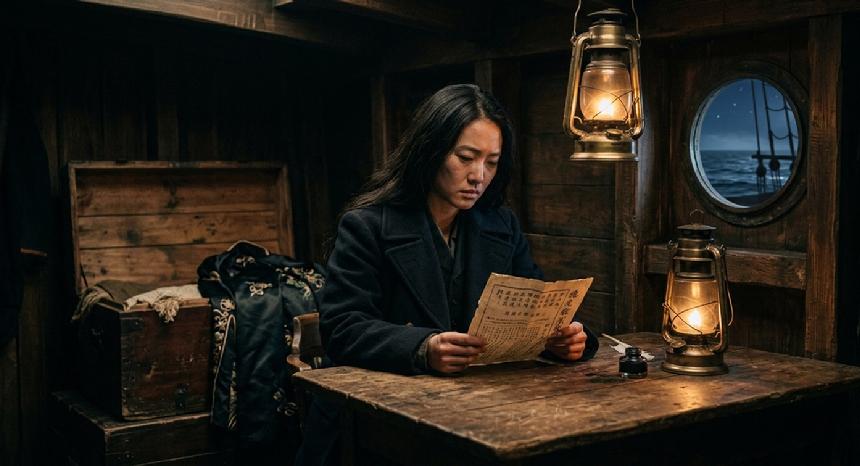 |
| Roxane with the Burnett speech |
|
|
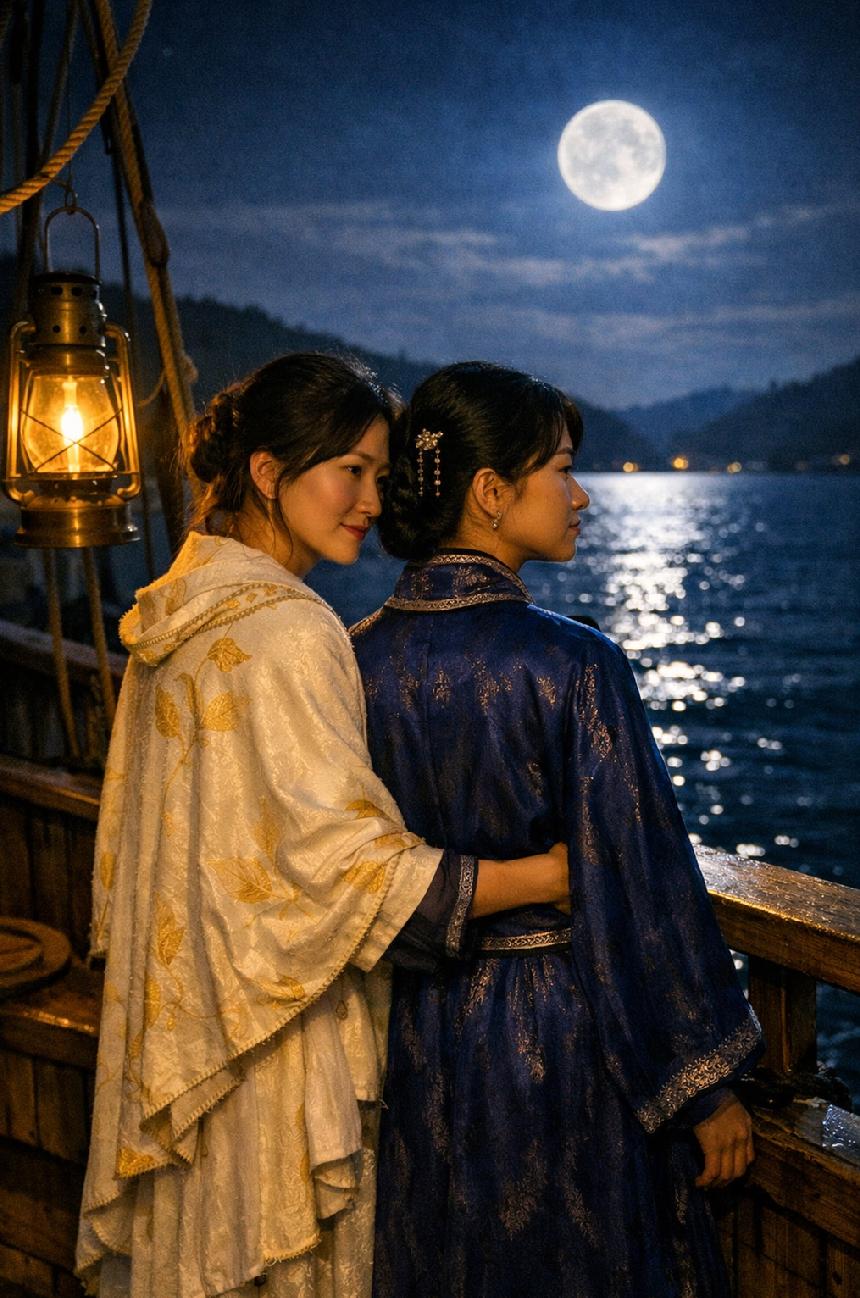 |
| Roxane & Yujin after the second Miwok sweatlodge |
|
|
LOST SHIPS AT THE SEAGATE
April 1763
One week after the conclusion of the second women’s sweat lodge — when the scent of cedar smoke still lingered in the air and the echoes of prophecy had not yet faded — the ships from the Combined Fleet that had vanished after the storm appeared on the horizon near the Farallon Islands.
A scout vessel from Aiko’s flagship, patrolling the Gulf of the Farallones, spotted them first.
Battered.
Limping.
But intact.
The scout ship led the stricken vessels toward the Ohlone Seagate, preceded by a fast courier longboat sent ahead to deliver the news to Roxane.
By the time the longboat reached shore, everyone was still gathered at the Miwok village.
Roxane received the report in a sealed scroll from Aiko’s messenger. She rose immediately, her voice steady but her eyes bright with urgency. She sent runners to alert the Fleet medical teams while sharing the news with Yujin, Seonhwa, Aiko, Feiyan, and Suyana, who had been standing quietly beside Lady Aiko.
Feiyan, predictably, volunteered to captain a medical response squadron before Roxane could finish speaking — already halfway into her service uniform, her mind shifting from ceremony to triage with the speed of instinct.
Roxane then turned to Maien, Hoypuh Kule, and Suyana.
The three women exchanged a brief, silent look — the kind shared by leaders who feel the weight of a moment before it is spoken aloud.
Maien stepped forward first.
“The Miwok have powerful medicine people,” she said, turning toward Suyana. “So do the Yelamu — the best of all the nations.”
Hoypuh Kule nodded.
“We offer to join your rescue party.”
Suyana added, her voice calm but resolute:
“And Petlenuc will prepare a hospital site. We will be ready when the wounded arrive.”
Roxane bowed her head.
“Your help honors us. Feiyan will command the rescue team making contact with the ships at the Seagate. Suyana, take one of our boats and return to Petlenuc. Prepare the site. We will follow as soon as the ships reach the Seagate.”
Suyana nodded once, already moving toward the shoreline where several Combined Fleet longboats rested on the sand. Two Yelamu paddlers and a Miwok guide joined her without needing to be asked.
Within moments, the boat was in the water, cutting across the channel toward Petlenuc Village.
RESCUE AT THE SEAGATE
As the missing ships approached the Seagate, they were met by Feiyan’s longboats, where Qing medical first‑responders boarded each vessel with practiced efficiency. Feiyan then piloted the escort vessel that guided the damaged ships toward anchorage just off the Yelamu shoreline, where Miwok, Yelamu, and Joseon teams — now staffing the hastily constructed hospital — prepared to receive the sick and injured.
The exhausted, dehydrated crews were met by Joseon physicians with lacquered chests of herbs and poultices; Qing naval surgeons with steel instruments gleaming in the coastal light; Ohlone healers and shamans carrying smoke, song, and earth‑rooted medicines; and Yelamu and Miwok medicine people working side by side under Suyana’s direction — together beneath the spring light of the Yelamu coast at Petlenuc.
While Feiyan’s rescue operation began its approach from the Seagate, Suyana disembarked at the Yelamu shore, informing her chief about the missing ships and the likely condition of their crews.
The Yelamu chief listened carefully. He knew the armistice was fragile. He knew sudden activity at Petlenuc could be misinterpreted. He knew trust was a delicate thing.
So he acted with courtesy.
He sent a runner to Ssalson with the news that the ships were returning and that the Yelamu were preparing a hospital — adding that the activity was not military and that the armistice was being honored.
It was a gesture of respect, and the Ssalson chief recognized it.
THE SSALSON RESPONSE
The runner returned before sunset.
The Ssalson chief had sent a message:
“Your courtesy honors us. We will send our healers. Let our medicines join yours.”
And he did more than that.
He sent one of his most skilled shamans — a young man known for his calm hands and clear mind — along with a team of Ssalson healers.
They arrived at Petlenuc before dawn.
The Yelamu chief welcomed them personally.
THE MEETING AT PETLENUC
Among the Ssalson healers was the man chosen by his chief for the marriage alliance — though he did not yet know it.
Among the Yelamu tending the wounded was the woman chosen by her elders — though she did not yet know it.
They met while tending to a wounded sailor.
Their hands brushed as they reached for the same bowl of water.
They worked side by side through the night.
They shared herbs, poultices, breath, exhaustion — and the quiet rhythm of hands working in unison.
They steadied each other when the work grew heavy.
And something passed between them — quiet, unspoken, unmistakable.
A bond formed in the smoke and salt air of the triage site, long before either learned of the marriage their chiefs had arranged.
THE SSALSON CHIEF’S DECISION
The next morning, as the hospital ran smoothly and the wounded stabilized, a second message arrived from the Ssalson chief.
He had completed his sweat lodge with his warriors and elders.
He had consulted his ancestors.
He had reached his decision.
But he waited until the rescue was secure — until the unity he hoped for was already being lived.
Only then did he send his final words:
“We accept the treaty.
We accept the marriage.
Let this be the beginning of one people.”
|
THE MAP OF MEMORY
Camp Phoenix, Petlenuc Village — May 18, 1763
The Bay was changing.
Construction rose at Camp Phoenix and Camp Sisterhood — structures where Asian and Ohlone design met in new forms. Fields were tilled for crops never before seen on this land. Songs of beginnings echoed across the hills.
Zhang Feiyan knelt with Roxane and Yujin, sketching the coastline.
“You’ve mapped the stars,” Roxane said. “Now I need you to map the land.”
Feiyan blinked. “Me?”
“You,” Roxane said. “But you won’t name anything. Not yet.”
Feiyan hesitated. “Why not use your maps from the future?”
Roxane smiled.
“Because those maps chart a place called San Francisco Bay — a land reshaped by conquest and time. I left Spain’s maps behind so that a cartographer of this world could begin with a clean slate.”
Feiyan bowed her head.
“I will chart the Bay. But the names belong to the Ohlone.”
“Exactly,” Roxane said. “Every name will be gifted, not imposed.”
And with that, the mapping expedition began.
Zhang Feiyan’s Map Quest
THE MAPPING EXPEDITION BEGINS
The Bay of Fifty Nations — Early Spring
The morning tide was low when Feiyan stepped onto the narrow beach below the Yelamu village, her satchel of brushes and parchment slung over her shoulder. The air smelled of salt and new grass. Winter’s rains still clung to the hills.
Teymuk and Suyana waited beside the tule‑reed boat, while Seonhwa stood a little apart, hands folded, watching the tide breathe.
Teymuk lifted a hand.
Suyana grinned.
Seonhwa bowed her head.
Feiyan felt a flutter — excitement, responsibility, and something unnamed.
This was the beginning of her assignment from Roxane to map the entire interior shoreline of the Bay, but it was also the beginning of something larger.
As Feiyan’s mapping team advanced along the bay, Hoypuh Kule and Maien moved in tandem with their unification campaign — each new shoreline draft marking progress toward a shared vision. News of the Miwok women‑chiefs’ embassy traveled ahead of them, carried by messenger‑guides appointed by each village council. Their arrival was never a surprise; it was anticipated, prepared for, woven into the rhythm of spring.
At every lodge ceremony, Hoypuh Kule and Maien sought out high vista points where they could make visual contact with Feiyan’s distant boat — a silent assurance that both missions moved in harmony, one on land, one on water, each reinforcing the other.
The mapping team pushed off from the Yelamu shore, the craft gliding over calm water.
Feiyan sketched the unfolding coastline.
Teymuk paddled with steady, rhythmic strokes.
Suyana pointed out marshes, shellmounds, and seasonal camps.
Seonhwa watched the water, reading its moods.
Feiyan’s brush moved quickly, confidently.
Teymuk watched her from the corner of his eye, admiration softening his expression.
Suyana noticed.
Of course she did.
She nudged her brother.
“Careful,” she whispered. “Stare any harder and you’ll fall out.”
Teymuk nearly dropped his paddle.
THE FIRST VILLAGE
Their first landing was a small village nestled among tule marshes. The people approached cautiously — until they saw Feiyan’s map.
An elder traced the ink with a trembling finger.
“I did not know our land had a shape,” he murmured.
“And now I see it holds us all.”
Feiyan bowed her head, humbled.
Suyana whispered to Seonhwa,
“She doesn’t see it yet, but she’s changing everything.”
Seonhwa nodded.
“She will.”
As days passed, the four fell into rhythm.
Feiyan sketched the inlets, marshes, and hills.
Teymuk introduced them with Yelamu authority.
Suyana translated, soothed, and charmed.
Seonhwa offered calm where needed.
The map grew.
So did their bond.
Feiyan began to rely on Teymuk’s steady presence — the way he held the boat, the way he read the land.
Teymuk began to rely on Feiyan’s fire — the way she illuminated everything she touched.
Suyana saw it all.
She approved.
One evening, as the sun dipped behind the hills, Feiyan and Teymuk stood on a rocky outcrop overlooking the water.
Feiyan held her map against the wind.
“This land is alive,” she said. “It breathes. It remembers.”
Teymuk nodded.
“It remembers who listens.”
She looked at him.
The wind lifted her hair.
Then Suyana’s voice rang from camp:
“Feiyan! Teymuk! Stop staring at each other and come eat!”
Feiyan flushed.
Teymuk stumbled over a rock.
Seonhwa laughed quietly.
THE MAP BECOMES A MESSAGE
By late spring, the map had become something extraordinary — a living document shaped by every tribe they visited.
When Hoypuh Kule and Maien saw it, they understood immediately.
“This is not a map,” Hoypuh murmured.
“This is a body.”
Maien traced the shoreline.
“And a body must be kept whole.”
She looked at Feiyan.
“You have given us the tool we needed.”
Feiyan bowed her head, overwhelmed.
Teymuk’s pride startled him with its fierceness.
Suyana squeezed Feiyan’s hand.
Seonhwa rested a gentle hand on her shoulder.
The map was no longer a record of land.
It was a covenant — a body that must remain whole.
The Spring campaign had begun.
SUMMER — THE FIRST ARMISTICES
The Bay of Fifty Nations — Mid‑Summer
Summer arrived with heat shimmering over the hills and tension shimmering between tribes. The Spring mapping expedition had opened doors, but Summer was when people stepped — or were pushed — through them.
Hoypuh Kule and Maien traveled tirelessly, carrying Feiyan’s evolving map, the riderless horse, and the authority of the sweat lodge vision. But diplomacy was not only happening in council circles and sweat lodges.
It was happening in the small, human spaces where women gathered — and this is where Feiyan and Suyana’s friendship began to reshape the world.
FEIYAN AND SUYANA — A SISTERHOOD IN BLOOM
As the mapping expedition continued into Summer, Feiyan and Suyana became inseparable. Their friendship had begun in Spring with teasing and shared work, but Summer deepened it into something like sisterhood.
They spent long evenings together after the day’s mapping was done — Feiyan brushing out Suyana’s hair, Suyana weaving tule and bay‑laurel into Feiyan’s braids, Feiyan showing Qing hairpins and jade combs, Suyana teaching shell ornaments that clicked like wind chimes.
One night, Feiyan opened a small lacquered box — a gift from her mother — filled with hairpins, silk ribbons, and embroidered cloth.
Suyana touched the silk with reverence.
“It feels like water.”
Feiyan smiled.
“It feels like memory.”
The next morning, Suyana appeared at breakfast wearing her hair in a Qing‑style looped braid, held with one of Feiyan’s jade pins.
Teymuk nearly dropped his bowl.
Seonhwa smiled softly.
Feiyan blushed.
Women from the visiting village stared — not with suspicion, but fascination.
By midday, three young women asked Suyana to teach them the style.
By evening, Feiyan was surrounded by a circle of laughing women, all wanting to try the “wind‑loop braid” and the “waterfall knot.”
Suyana whispered to Feiyan,
“You’ve started something.”
Feiyan whispered back,
“So have you.”
DIPLOMACY THROUGH BEAUTY
As the Summer armistices began — tense meetings between tribes with long histories of conflict — something unexpected happened.
Women from rival tribes arrived wearing Ohlone shell ornaments, Qing silk ribbons, Joseon braids, Japanese knot‑styles, Miwok feather accents, and Chinese embroidered sashes.
A shared aesthetic was forming — not imposed, but adopted.
A fusion of Asian and Ohlone styles symbolizing curiosity, openness, shared identity, a promise of a future greater unity.
Maien noticed immediately.
At one armistice, she muttered to Hoypuh:
“When the women start dressing alike, the men will follow. They just don’t know it yet.”
Hoypuh hid a smile.
This sartorial fusion had real diplomatic consequences.
It softened old rivalries.
Suddenly, compliments came before grievances, and a new shared cultural language was emerging.
A woman wearing a Qing braid threaded with Ohlone shells was saying to her people,
“I belong to more than one world now.”
The unification movement now had its own visual identity.
Feiyan and Suyana were seen for the first time by all they encountered as cultural ambassadors. They became known as:
The Two Sisters of the Bay.
The Weavers of Wind and Water.
The Ones Who Tie the Future.
And Teymuk, now clearly smitten, held a front‑row seat to Feiyan’s brilliance.
His admiration deepened into something steady and unshakeable.
While the women wove cultural bonds, Hoypuh Kule and Maien wove political ones.
Some tribes agreed to unity immediately.
Others agreed to seasonal armistices.
A few remained stubborn.
Maien had no patience for the stubborn ones.
At one meeting, after a chief refused to even look at the map, she snapped:
“You can cling to your grudges or you can cling to your grandchildren… Choose!”
He chose.
Hoypuh followed the lodge gatherings with ceremony, dance, and prayer — softening what Maien had cracked open.
Together, they were unstoppable.
|
The Reluctant Chief
The fog still clung to the Petlenuc ridge, drifting in pale ribbons across the clearing. The sweat lodge crouched at the center like a living thing, its willow frame wrapped in hides, the doorway low and dark. Hoypuh Kule, Woman Chief of the mixed dance house, knelt beside the pit, her hands steady as she arranged the stones. Steam curled around her in soft breaths, rising like a quiet invocation.
The reluctant chief stood ten paces away with his arms folded, jaw set, refusing even to glance at the lodge. He had arrived early — Maien suspected only to make his refusal more dramatic.
Maien approached him with the slow, deliberate steps of someone who had already tried diplomacy three times.
“Chief,” she said, voice steady. “The stones are ready. Hoypuh Kule is waiting.”
He didn’t look at her. “I told you. I’m not going in.”
Maien exhaled through her nose — a sound halfway between a sigh and a growl. “You’ve said that every morning this week.”
“And I’ll say it again.”
She stepped directly into his line of sight, blocking the horizon. “You can embrace your grudges or embrace your grandchildren. One of those choices has a future.”
His eyes flicked to hers, irritated. “Don’t lecture me, Maien.”
“Oh, I’m past lecturing.” She pointed toward the lodge. “If you won’t walk in on your own, I’ll drag you by your ankle. Let you shout. Let you curse. But you’re going to see what the rest of us saw.”
From the doorway, Hoypuh Kule’s voice drifted out — low, warm, and calm as river water.
“The steam is rising. Visions come easier when the heart is not clenched.”
Maien threw her hands up. “See!? Even she’s being polite! And she’s the one who carried the stones up from the river!”
The chief’s mouth twitched — not quite a smile, but the first crack in his armor.
Maien seized it. “You think this is about you being stubborn? It’s not. It’s about what’s coming. The young ones already saw it. The lodge showed them a future that doesn’t wait for your permission.”
He shifted his weight, uneasy. “Visions are for the young. I’ve lived long enough to know they can be wrong.”
Maien stepped closer, lowering her voice. “And I’ve lived long enough to know that refusing to look doesn’t make danger disappear.”
The chief’s gaze drifted at last toward the lodge — the low doorway, the rising steam, and Hoypuh Kule, her posture straight, her expression serene, her hands resting lightly on the forked branch she used to tend the stones. She looked like someone who had already seen the shape of the future and accepted its weight.
Maien softened, just a fraction. “You carry a whole village on your shoulders. Don’t make them walk blind because you’re afraid of what you’ll see.”
He swallowed. The clearing held its breath.
Finally, he muttered, “If I go in, I’m not promising to believe anything.”
Maien shrugged. “I don’t need your belief. I need your eyes open.”
He hesitated one more heartbeat, then stepped toward the lodge. Maien followed, not triumphant, but relieved — the kind of relief that comes when a door long stuck finally gives way.
Hoypuh Kule bowed her head as he entered. “Welcome. Sit close to the stones. They speak softly at first.”
Maien ducked inside after him, pulling the hide flap closed. The clearing fell silent, the lodge darkening to a warm, breathing dusk.
Inside, the first hiss of steam rose, curling around them like a whispered truth.
|
THE FIRST COUNCIL OF THE UNITED OHLONE NATIONS
Early Winter, Bay of Fifty Nations
The first frost touched the hills the morning the Fifty Nations gathered.
For weeks, the ceremonial grounds had been prepared — a wide circle of fire pits, woven mats, and feather‑sticks planted in concentric rings. At the center stood a raised platform of redwood and tule, and on it lay Feiyan’s completed map, stretched and mounted like a living skin. Every shoreline she had walked, every inlet she had charted, every village she had visited — all of it breathed beneath the cold winter light.
The air was cold.
The moment was warm.
The Opening Ceremony
Hoypuh Kule stepped forward first, her feathers stirring in the wind. She danced the Acorn Dance, the sünwele Dance, and the Dance of the Five Messengers. Each movement was a prayer. Each breath was a promise. The frost clung to the redwood planks, but the fire circles burned steady — warmth against the long memory of cold.
Maien followed — not with dance, but with words.
She spoke of the vision in the lodge.
She spoke of the riderless horse.
She spoke of the bloom at Tamal‑Huye.
She spoke of the map.
Then she said:
“We have walked the land.
We have listened to the ancestors.
We have braided our futures together.
Now we must choose.”
The Vote for Unity
Each tribe sent one representative.
Each representative placed a shell into one of two baskets:
Unity
Isolation
The baskets were woven from tule and bay‑laurel, placed beside Feiyan’s map. The shells fell like soft rain — quiet, decisive, final.
Unity.
Unity.
Unity.
Only three shells fell into the isolation basket.
Maien looked at them and said:
“We will hold space for you.
But we will not wait.”
The vote was complete.
The United Ohlone Nations were born.
A wind shifted eastward, carrying the scent of salt and ink — the signal that diplomacy would begin.
The Treaty with Qing–Joseon–Japan
A formal message was read aloud — not by a distant envoy, but by Roxane herself, standing at the center of the circle.
To her right stood Admiral Nam Seonhwa, representing Joseon.
To her left stood Lady Aiko, representing Japan.
Together, the three formed a single line — the Phoenix Corridor embodied.
Roxane’s voice carried across the winter air:
“We recognize the sovereignty of the United Ohlone Nations.
We offer trade, knowledge, and mutual defense.
We honor your choice.”
Feiyan translated.
Suyana stood beside her, steady and proud.
The treaty was signed with ink made from elderberry and soot.
Hoypuh Kule placed her handprint beside her name.
Maien did the same.
The treaty was sealed.
Feiyan felt the ink drying beneath her fingers — the weight of centuries settling into permanence.
The Commissioning of the Companion Cavalry
Yujin stepped forward, leading a copper‑coated mare. Her presence was calm, grounded, unmistakably military — the perfect counterbalance to Roxane’s diplomatic authority.
She spoke of the riderless horse.
She spoke of the vision.
She spoke of the need for speed, unity, and defense.
Then she said:
“Let the horse carry our choice.
Let the Companion Cavalry ride with the wind.”
Twenty‑five horses were led into the circle.
Twenty‑five riders were chosen — one from each coastal tribe.
Feiyan watched, her heart full.
The Founding of the Kyūdō Archers & the Yabusame Squadron
Aiko stepped forward, her bow slung across her back.
She spoke of the Night Sky.
She spoke of precision, patience, and protection.
Then she said:
“Let the horses and the arrow carry our intention.
Let the Kyūdō Archers and the Yabusame Squadron stand with the stars.”
Archers from each inland tribe stepped forward.
They bowed.
They were named.
They were given redtail feathers — the mark of guardianship.
Thus the Kyūdō Archers were founded.
Thus the Yabusame Squadron was born.
And together — horse and arrow — they would guard the horizon.
|
THE PROPOSAL
As the council fires burned low and the first touch of winter frost whispered across the evening air, Feiyan stood slightly apart, gazing at the map she had drawn — now layered with handprints, signatures, and ceremonial marks. It looked less like a document and more like a living promise.
Teymuk approached quietly and stood beside her for a long, steady moment.
Then he said, softly but certain:
“We have chosen a future for our people. Now I choose mine — if you will walk it with me.”
Feiyan turned, half-surprised, though more than half-expecting this proposal.
From a distance, Suyana watched with a grin she tried and failed to hide.
Seonhwa stood beside her, serene.
Hoypuh Kule and Maien pretended not to watch — but absolutely watched.
Feiyan felt her heart steady and whispered, “Yes… I will.”
Teymuk placed a carved shell ornament in Feiyan’s hand.
Feiyan placed a silk ribbon in his.
The rising moon added a veil of golden light to Feiyan’s map, blending with the firelight like a quiet blessing.
Feiyan felt something inside her melt and settle all at once — a warmth rising against the cold, a promise taking shape beneath the winter air — and understood this moment would remain with her forever in this time of happy beginnings.
|
THE DECISION TO SEND A SQUADRON EAST
Night after the 50‑Nations Vote
Petlenuc Village
The fires of Petlenuc burned low, their embers glowing like scattered stars along the shoreline. The village had quieted at last — the songs fading into soft humming, the healers resting in the new hospital lodge, the rescued sailors sleeping under woven blankets.
Roxane stood alone at the water’s edge, watching the tide pull silver across the sand. The night was cool, the air smelling of cedar smoke and sea‑salt.
She heard Yujin’s footsteps before she saw her.
Yujin stopped beside her, hands clasped behind her back.
“You’re thinking about the next step.”
Roxane nodded, eyes still on the horizon.
“The Ohlone have spoken. Fifty nations, one voice. We have to send word back to the Qing court — and to Joseon and Japan. They must know the alliance is real. That the Yelamu have welcomed us.”
Yujin waited, sensing the weight beneath the words.
Roxane exhaled slowly.
“I need to send a squadron east. Three ships. Fast ones.”
A pause.
“But I don’t want to send you.”
There it was — the truth, laid bare in the moonlight.
Yujin’s expression softened, though her voice remained steady.
“Roxane… you know it must be me.”
Roxane shook her head.
“I can send Seonhwa. Or Aiko. Or one of the Qing captains. Anyone else.”
“No,” Yujin said gently. “Not for this.”
She stepped closer, her presence warm against the cool night air.
“The Qing court will listen to the message if it is carried by any one of the Phoenix Corridor officers. But the message will land with greater weight if it is carried by a Hua.”
Roxane’s jaw tightened.
She looked away, blinking hard.
Yujin continued, calm but unyielding.
“A senior member of the Hua family must deliver the news. Only then will the court commit to what we need — material resupply, reinforcements, and guarantees that Joseon and Japan will stand with Qing in this alliance.”
Roxane closed her eyes.
“I know you’re right. I just… don’t want to lose you. Not even for a season.”
Yujin’s voice softened to a whisper.
“You won’t lose me. You never could.”
Roxane let out a shaky breath.
“This is the first time since the storm that I’ve felt afraid.”
Yujin reached out and took her hand.
“Then let me carry that fear with me. And bring it back to you.”
They stood together in silence, the tide whispering at their feet.
Finally, Roxane spoke.
“You’ll take the Qing frigate Hai Lan, the Joseon cutter Sejong, and Aiko’s fastest scout ship. Three nations, one message.”
Yujin nodded.
“And I’ll return before the next moon cycle. With promises in hand.”
Roxane turned to face her fully.
“Then go with my blessing. And my heart.”
Yujin leaned her forehead against Roxane’s.
“And I will return with mine.”
The tide surged softly, as if sealing the vow.
|
THE REQUEST FOR PERMISSION
Three days after the First Council
Yelamu Village
Winter fog hung low over the shoreline as Feiyan and Teymuk walked toward the cedar‑framed house where Roxane and Yujin were staying. The air smelled of woodsmoke and cold earth. Feiyan’s heart beat fast beneath her winter cloak; Teymuk’s hand brushed hers, steady and warm.
But they were not alone.
Walking a few steps ahead — deliberately, ceremonially — was Seonhwa. She had insisted on going first. Not to speak for them, but to prepare the ground.
Seonhwa’s Quiet Intervention
One Day Earlier
At her co-commanders' residence by the fire, Seonhwa poured tea for Roxane and Yujin and waited for the flames to settle while saying in her calm, water‑soft voice,
“Tomorrow, two young people you love will come to you with a request. Please meet them with open hands.”
Roxane raised an eyebrow.
Yujin smiled knowingly.
“They have walked a long road together,” Seonhwa continued.
“They have chosen each other with the same care they chose for the future of the Nations.”
Roxane’s expression softened.
Yujin nodded.
“We will be ready,” she said.
Seonhwa bowed her head, satisfied.
Twin Hearts Seek A Blessing
In the midmorning light the day after Seonwah's meeting with Roxane and Yujin, as a nervous Feiyan and Teymuk neared Feiyan's guardians' house, Seonhwa paused at the doorway and turned to them.
“Breathe,” she murmured.
Feiyan exhaled shakily.
Teymuk squeezed her hand.
Seonhwa stepped inside first.
Roxane and Yujin sat by the fire as though they had been waiting all morning. When Feiyan and Teymuk entered, both women rose.
Roxane’s eyes softened.
Yujin’s smile was warm and steady.
Feiyan bowed deeply — deeper than she ever had.
Teymuk followed, grounded and respectful.
“You have come with something on your hearts,” Roxane said.
Both nodded as Feiyan spoke into the momentary silence,
“Honored guardians…. You have guided me, protected me, and shaped the path that brought me here. I stand before you with gratitude… and with a request.”
She glanced at Teymuk, who met her gaze with quiet strength.
“I wish to marry Teymuk,” she said softly, And I ask for your blessing.”
Teymuk stepped forward.
“I ask for your blessing as well. I will honor her, protect her, and walk beside her in all things.”
Roxane studied them — not sternly, but with the weight of years. Then she stepped forward and placed her hands on Feiyan’s shoulders.
“You have grown into your fire,” she said. And you have chosen someone who can walk with it.”
Yujin placed a hand on Teymuk’s arm.
“You have stood with us through every season. You have earned our trust — and our joy.”
Roxane looked at them both.
“You have our blessing.”
Feiyan’s breath broke into a laugh‑sob.
Teymuk bowed deeply.
Seonhwa smiled, eyes shining.
Later that afternoon, Feiyan found Aiko sitting on a driftwood log overlooking the winter tide.
Feiyan sat beside her, hands clasped tightly, and shared the news of her engagement to Teymuk.
“Aiko… I would be honored if you would stand with me as my maid of honor.”
Aiko blinked — surprised, touched, moved to her core.
“I would be honored,” she said. “You carry the fire. I will carry the night sky beside you.”
Feiyan bowed deeply, overwhelmed with gratitude.
After parting from Aiko, Feiyan walked the short distance to a place at Petlenuc village where Suyana was weaving a feather basket near Land’s End Yelamu, mostly to have something to do, to keep busy, while awaiting the news she was sure of hearing, but had not yet been informed about. When Feiyan walked toward her with a light step and a new light in her eyes, Suyana knew what was coming. When Feiyan told her, Suyana shrieked with joy, grabbed Feiyan’s hands, and spun her in a circle.
“I knew it! My brother has been staring at you like a lost puppy since Spring!”
Feiyan turned bright red.
Suyana hugged her fiercely.
“You are my sister now. In every way that matters.”
TEYMUK SEEKS HIS PARENTS’ BLESSING
Later the same day
Yelamu Village
The winter sun was sinking behind the hills when Teymuk walked toward his parents’ dwelling. Feiyan had gone to speak with Aiko; Suyana had insisted he needed “space to be dramatic,” but walked with him anyway — because she was his sister, and she knew he needed her presence.
At the doorway, she squeezed his arm.
“Breathe,” she whispered — echoing Seonhwa.
Teymuk nodded and stepped inside where his parents where engaged in a familiar routine. His mother, Tamalpa, sat by the fire, weaving a new feather‑stick, while his father, Kuleh shaped a bow stave, smoothing the wood with practiced hands.
They looked up as Teymuk entered.
Suyana slipped in behind him and sat quietly near the wall.
Teymuk bowed deeply.
“Mother. Father. I come with a request.”
They set their work aside.
“Speak,” Tamalpa said gently.
“I have walked through the four seasons with Feiyan. We have traveled the shoreline, mapped the land, stood in council, and chosen the future together.”
He swallowed.
“I love her. And I wish to marry her.”
Tamalpa’s eyes warmed.
Kuleh’s brows lifted slightly.
“I have asked her guardians for their blessing,” Teymuk continued,
“Now I ask for yours.”
Tamalpa rose, placed her hands on his face, and studied him with the tenderness of a mother who had watched him grow from boy to man.
“You have carried yourself with honor,” she said. And you have chosen a woman of fire and courage.”
She smiled.
“She will challenge you. This is good.”
Teymuk laughed softly, relieved.
Kuleh stood, grounding the room with his presence.
“You have chosen a woman who will walk beside you, not behind you,” he said. This is the mark of a strong man.”
He placed a hand on Teymuk’s shoulder.
“You have our blessing.”
Suyana leapt up.
“I told you they would say yes!”
Tamalpa laughed.
Kuleh shook his head, smiling.
Teymuk groaned.
“Suyana…”
She hugged him tightly.
“You’re going to be so happy. And Feiyan is already my sister.”
Tamalpa lifted a small deerskin‑wrapped bundle.
“This is for Feiyan — a feather‑stick woven with the colors of our family. Give it to her when you tell her of our blessing.”
Teymuk accepted it with reverence.
“It will be an honor.”
The Walk Back
As the siblings stepped outside, the first stars appeared.
Suyana nudged him.
“Now go find Feiyan. She’s probably trying not to panic about asking Aiko.”
Teymuk laughed — the kind of laugh born of relief, joy, and the sense that the world was shifting into place.
He walked toward the shoreline, where Feiyan waited.
|
THE PARENTS’ MEETING AT YELAMU
Late Winter — Three days after the First Council
Fog drifted low across the Yelamu village, softening the cedar‑framed houses and turning lantern light into warm halos. Inside the communal house, Roxane and Yujin sat with Feiyan between them — not as guardians flanking a ward, but as two women holding space for someone they loved.
Feiyan’s hands were clasped in her lap.
Her cheeks were pink with anticipation.
Her heart felt too large for her chest.
Yujin leaned in. “Breathe.”
Roxane added, “And smile. You look like you’re about to face a firing squad.”
Feiyan groaned.
“I’m meeting my future in‑laws.”
Roxane squeezed her hand.
“You already met them. This is just the ceremonial version.”
Feiyan laughed — and that was the moment the door curtain lifted.
The Arrival
Suyana burst in first, breathless and triumphant.
“They’re here! And I told them to behave!”
Feiyan’s eyes widened.
Roxane murmured, “That does not reassure me.”
Behind Suyana came Tamalpa and Kuleh — dignified, warm, carrying the presence of people who had walked through many seasons of leadership. Teymuk followed with a basket of gifts. Seonhwa entered last, serene as moonlight.
The moment Tamalpa saw Feiyan, she crossed the room in three steps and embraced her — not politely, but with the full warmth of a mother welcoming a daughter.
“My son’s heart has chosen well,” she said.
Feiyan melted into the embrace, overwhelmed.
Roxane and Yujin exchanged a look — touched, amused, and quietly proud.
Kuleh stepped forward next, bowing his head to Feiyan before turning to Roxane and Yujin.
“You have guided her with wisdom,” he said. “We honor you.”
Roxane bowed deeply.
Yujin bowed as well.
Tamalpa laughed and pulled them both into hugs.
“In this family,” she said, “we hold each other.”
They gathered around the fire, the warmth easing the last of the nerves.
Tamalpa began, her voice gentle.
“Our children wish to marry at Suliš‑tamal — the Poppy Cove of Tamal‑Huye.”
Feiyan’s heart fluttered.
Teymuk’s hand brushed hers.
Yujin nodded.
“It is their wish. We support it.”
Kuleh added, “It is Miwok land. We must ask permission.”
Roxane smiled.
“We hoped you would say that. It is important to us as well.”
Suyana clapped her hands.
“Then we should all go together! It will show unity — and it will keep Maien from scolding anyone.”
Feiyan laughed.
Teymuk groaned.
Seonhwa hid a smile.
The Gentle Chaos of Planning
As talk turned to the wedding, the room filled with warmth and humor.
Tamalpa: “We will weave the ceremonial mats.”
Yujin: “We can help—”
Suyana: “No, you can’t. You’ll make them too tight.”
Roxane: “I can learn!”
Teymuk: “Mother, please don’t let Suyana take over everything.”
Suyana: “I’m not taking over. I’m guiding.”
Feiyan: “She’s definitely taking over.”
Seonhwa: “I have made a list.”
Everyone: “Of course you have.”
The Families Unite
By the end of the meeting, everyone had agreed that the wedding would be held at Suliš‑tamal, during the spring super bloom, and that there would be two ceremonies — a private dawn rite and a public midday celebration.
The families would travel together to request permission from Hoypuh Kule and Maien, the couple would choose all ceremonial elements.
Suyana would “supervise.”
Seonhwa would “keep the peace.”
Roxane placed her hand over Feiyan’s.
“We are honored to stand with you.”
Tamalpa placed her hand over Teymuk’s.
“And we are grateful you have chosen each other.”
The two mothers exchanged a look — warm, knowing, full of pride.
Foreshadowing the Gift to Come
As the families parted for the night, Seonhwa stepped outside and looked toward the silhouette of Tamal‑Huye rising from the water. Something stirred — a quiet promise in the land itself.
Inside, Tamalpa murmured to Kuleh,
“The Miwok will do something special for them.”
Kuleh nodded,
“They have seen the year these two have walked.”
Roxane overheard and smiled.
“Whatever they do,” she said, “it will be perfect.”
|
THE REQUEST FOR PERMISSION AT TAMAL‑HUYE
🌿 The Arrival at Suliš‑Tamal
Morning fog clung to the slopes of Tamal‑Huye like a shawl of breath.
The families approached the sacred cove — Suliš‑tamal, the Poppy Cove — where the first orange petals of the super bloom were beginning to open.
Feiyan walked between Roxane and Yujin, their hands clasped around hers.
Teymuk walked between Tamalpa and Kuleh, steady and grounded.
Suyana and Seonhwa followed with woven baskets of gifts.
The air smelled of salt, earth, and the promise of spring.
At the edge of the cove, Hoypuh Kule and Maien waited — rooted, watchful, unshakable, like the mountain itself.
✦ The Approach
The families stopped a respectful distance away.
Tamalpa stepped forward first and placed a feather‑stick into the earth.
“We come with a request,” she said.
Roxane and Yujin stepped beside her and bowed deeply.
Maien’s eyes flicked to them — and softened.
“You two stand as one.”
Roxane nodded.
Yujin’s hand found hers.
Tamalpa added gently, “They are wife and wife, honored leaders. Their bond has guided Feiyan’s path.”
Hoypuh Kule inclined her head.
“Their union is known to us. It is a blessing.”
Feiyan felt her throat tighten.
Roxane squeezed her hand.
❖ The Request
Kuleh stepped forward next.
“Our children wish to marry at Suliš‑tamal,” he said. “In the season of the bloom.”
Tamalpa continued, “We ask permission to hold the ceremony here, on Miwok land, with your blessing.”
Roxane added, “We will follow your customs. We will honor your protocols.”
Yujin bowed again.
“We ask with open hands.”
Feiyan and Teymuk stepped forward together.
Feiyan spoke first.
“This place is where the land breathes.
It is where our hearts first understood the future we were choosing.”
Teymuk added, “We wish to begin our life together here, where the Nations first began to unite.”
🌺 Hoypuh Kule’s Answer
Hoypuh Kule stepped closer, her presence quiet but immense.
She looked at Feiyan — at the fire in her eyes.
She looked at Teymuk — at the steadiness in his stance.
She looked at Roxane and Yujin — at the love between them.
She looked at Tamalpa and Kuleh — at the pride in their faces.
Then she said:
“The land has already said yes.”
Feiyan gasped softly.
Teymuk bowed deeply.
Hoypuh Kule continued,
“This cove has seen many unions — of families, of tribes, of nations.
It will now witness yours.”
🔥 Maien’s Blessing
Maien stepped forward, arms crossed, pretending sternness.
“You understand,” she said, “that a wedding here means the entire Miwok Nation will attend.”
Suyana replied with a single raised eyebrow and her trademark unreadable expression,
“We expected nothing less.”
Maien shot her a look — then broke into a smile.
“You have chosen well,” she said to Feiyan and Teymuk.
“And you have chosen each other with the same courage you chose the future.”
She placed her hand on the feather‑stick.
“You have our permission.
And our joy.”
🌊 Lady Aiko’s Vigil
Feiyan’s maid of honor could not be present for the meeting at Tamal‑Huye. She was on duty, commanding scouting patrols between the Ohlone Seagate and the Gulf of the Farallons, and her absence was not a gap but a testament: the Nations were safe enough for a wedding because she kept watch over the horizon. On the day of the wedding ceremonies, Aiko would transfer command to her first officer, taking the ship’s longboat to Suliš‑tamal before sunrise.
|
The Ceremony Is Set
Hoypuh Kule raised her hand.
“Let it be known that in the season of the bloom, at Suliš‑tamal, the Nations will gather to witness the joining of Feiyan and Teymuk.”
The wind stirred.
The poppies trembled.
The cove seemed to exhale.
Feiyan leaned into Teymuk.
Teymuk’s hand found hers.
Suyana clapped.
Seonhwa smiled softly.
Roxane and Yujin embraced Feiyan.
Tamalpa and Kuleh embraced Teymuk.
The families were one.
Foreshadowing the Wedding Gift
As they turned to leave, Maien called after them:
“And tell no one yet — but the Miwok Nation is preparing something special.”
Hoypuh Kule added, her voice like a quiet tide:
“The land wishes to hold you a little longer after the ceremony.”
Feiyan and Teymuk exchanged a look — curious, touched, a little breathless.
They did not yet know that a secluded lodge was being built for them, and that the Fifty Nations Council would soon endorse it, that warrior‑crewed watercraft would guard the cove, and the land itself would hold them in privacy for three nights
But the promise was already in the air.
THE DAWN PRIVATE CEREMONY
Suliš‑tamal — Early Spring, Before Sunrise
The world was still blue when Feiyan and Teymuk arrived at the cove.
The poppies had not yet opened; their petals were folded like sleeping hearts. A thin veil of mist drifted over the water, catching the first hints of dawn. The air smelled of salt, dew, and the faint sweetness of the coming bloom.
Feiyan stood barefoot on the cool sand, her cloak wrapped around her shoulders, Lady Aiko at her side.
Teymuk stood beside Feiyan, steady as the tide.
Behind them, their families waited in a quiet semicircle — Roxane and Yujin, Tamalpa and Kuleh, Suyana, and the two chosen officiants:
Seonhwa, serene as the moon.
Wekma, the Yelamu shaman, grounded as the earth.
No one spoke.
The land was speaking first.
🌘 The Opening of the Circle
Seonhwa stepped forward, carrying a bowl of seawater cupped in both hands.
Wekma carried a small clay vessel filled with embers from the council fire.
Together, they placed the two vessels on a flat stone between Feiyan and Teymuk.
Seonhwa’s voice was soft, but it carried.
“Before the sun rises, we open the circle.
Before the day begins, we honor the night that shaped you.”
Wekma added, “The land has watched your steps.
Now it watches your joining.”
He touched the earth with his palm.
Seonhwa touched the water with hers.
The circle was open.
The Walk of the Two Paths
Seonhwa gestured for Aiko to guide Feiyan to the left, toward the water’s edge.
Wekma guided Teymuk to the right, toward the stones warmed by the embers.
Feiyan walked with the whisper of waves at her feet.
Teymuk walked with the scent of smoke and cedar rising around him.
Seonhwa spoke:
“Feiyan, you carry the fire of vision — the spark that sees beyond the horizon.”
Wekma spoke:
“Teymuk, you carry the strength of the land — the steadiness that holds the path.”
They paused, facing each other across the stone.
Seonhwa lifted the bowl of seawater.
Wekma lifted the vessel of embers.
“Now,” Seonhwa said, “you walk toward each other.”
Feiyan stepped forward.
Teymuk stepped forward.
The moment they met at the stone, the first light of dawn touched the water.
The Exchange of Symbols
Feiyan reached into her cloak and drew out the silk ribbon she had given Teymuk on the night of the proposal — now embroidered with the colors of both families.
Teymuk drew out the carved shell ornament he had made for her — now polished and bound with a strand of his mother’s weaving.
They placed their gifts on the stone between the water and the fire.
Wekma spoke,
“These symbols were given in promise.
Now they are given in truth.”
Seonhwa added,
“Let them bind not your freedom, but your choosing.”
Feiyan tied the ribbon around Teymuk’s wrist.
Teymuk placed the shell ornament around Feiyan’s neck.
The wind stirred.
The poppies trembled.
The cove breathed in.
The Joining
Seonhwa dipped her fingers into the seawater and touched Feiyan’s forehead,
“May your heart remain clear.”
Wekma touched Teymuk’s forehead with ash from the embers,
“May your steps remain true.”
Then Seonhwa and Wekma placed their hands together — water and ash mixing — and touched both Feiyan and Teymuk’s joined hands as Seonhwa spoke,
“In the presence of the land, the ancestors, and your families, you are joined.”
Wekma added,
“And the dawn bears witness.”
At that moment, the sun broke over the ridge of Tamal‑Huye, spilling light across the cove, and the poppies opened all at once — a silent, golden bloom.
🌤️ The Blessings of the Families
Roxane and Yujin stepped forward first.
Roxane placed her hand over Feiyan’s heart.
Yujin placed her hand over Teymuk’s.
“You walk with our love,” Roxane said.
“You walk with our trust,” Yujin added.
Tamalpa and Kuleh stepped forward next.
Tamalpa placed a woven feather‑stick in Feiyan’s hands.
Kuleh placed a carved cedar token in Teymuk’s.
“You walk with our lineage,” Tamalpa said.
“You walk with our strength,” Kuleh said.
Suyana burst forward last, unable to wait.
“You walk with me whether you like it or not,” she declared, hugging them both.
Everyone laughed — even Wekma.
🌞 The Closing of the Circle
Seonhwa lifted the bowl of seawater.
Wekma lifted the vessel of embers.
Together, they poured water over the stone, extinguishing the last ember.
“The night has ended,” Seonhwa said.
“The day begins,” Wekma said.
The circle closed.
Feiyan and Teymuk stood hand in hand, the rising sun behind them, the blooming cove before them, and their families surrounding them in a quiet, radiant ring.
They were joined.
They were witnessed.
They were home.
|
THE MIDDAY CEREMONY
PROCESSION
FEAST
WEDDING GIFT
Suliš‑tamal — Midday, Early Spring
The sun stood high over Suliš‑tamal, turning the cove into a bowl of gold. The super bloom had opened fully now — a sea of orange poppies rippling in the breeze like a living tapestry.
Drums echoed across the shoreline.
Flutes carried on the wind.
The Nations had gathered.
Feiyan and Teymuk stood at the center of the cove, dressed in ceremonial garments woven by both families — Miwok patterns interlaced with Yelamu motifs, silk threads from the Phoenix Corridor shimmering at the hems.
Behind them stood their families.
Before them stood the officiants:
Hoypuh Kule, representing the land.
Seonhwa, representing the Sisterhood Circle.
Wekma, representing the Yelamu.
The ceremony began.
🌞 The Public Ceremony
Hoypuh Kule raised her staff, carved from driftwood and inlaid with abalone.
“Let the Nations witness,” she said, Let the land remember.”
The crowd fell silent.
Seonhwa stepped forward first, her voice calm as tidewater.
“These two walked separate paths. Now they walk one.”
Wekma added,
“Their joining strengthens the weave of the Nations.”
Feiyan and Teymuk clasped hands.
Hoypuh Kule placed her palm over theirs.
“In the presence of the land, the ancestors, and all gathered here, you are joined.”
A cheer rose from the crowd — a wave of joy that rolled across the cove.
Poppies trembled.
Drums thundered.
The sea glittered.
Feiyan and Teymuk kissed — a soft, reverent kiss that felt like the opening of a new world.
🌿 The Ceremonial Procession
The procession began at once.
Feiyan and Teymuk walked at the front, hand in hand.
Behind them came Aiko; Roxane and Yujin; Tamalpa and Kuleh; Suyana, radiant and triumphant; Seonhwa, serene; delegations from the Fifty Nations; and musicians, dancers, elders, and children.
The path wound through the blooming poppies, up toward a ridge overlooking the sea, and as they walked, petals lifted in the wind and drifted around them like blessings.
Feiyan glanced back once — and caught a moment she would remember forever…
Roxane and Yujin walking side by side, fingers brushing, eyes meeting with a tenderness edged in sorrow.
Yujin’s departure was close now.
Roxane’s smile was bright — too bright.
Yujin’s was steady — too steady.
Feiyan felt a pang of understanding.
Love and duty were walking together behind her.
The drums had softened into a low, steady heartbeat as Feiyan and Teymuk completed their final circuit around the fire. The gathered nations—Yelamu, Ssalson, Huchiun, Tamien, and the envoys from the east—stood in a half‑circle of reverent silence. Only when the couple turned to face their people did the murmur of breath return.
From the honored guests’ row stepped the Ssalson–Yelamu couple: Tsuwa of the Ssalson and Nayen of the Yelamu, their hands joined, their clothing woven in alternating patterns of river‑blue and coast‑gold. They moved with a quiet dignity, aware that every eye recognized them not merely as husband and wife, but as the living thread that had bound two nations after generations of tension.
Feiyan bowed first, a gesture of respect to both the alliance and the courage it had taken to forge it. Teymuk followed, his expression warm, open, and unguarded.
Nayen spoke softly, but her voice carried.
“Your union strengthens what ours began. Peace is not a single act—it is a path walked by many feet. Today, we walk it with you.”
Tsuwa added, “And may your children, like ours one day, inherit a world where nations meet first in friendship, not in fear.”
There was no grand speech, no ceremonial flourish. Just four young people—two couples whose marriages carried the weight of nations—standing together in the glow of firelight.
For a moment, the crowd saw not politics, not treaties, not strategy, but the fragile, hopeful architecture of a new world.
Feiyan reached out and clasped Nayen’s hands.
Teymuk clasped Tsuwa’s.
The gesture was simple, but it rippled outward like a stone dropped into still water. Elders nodded. Warriors softened. Children leaned forward, sensing something important even if they could not name it.
When the Ssalson–Yelamu couple stepped back into the circle of honored guests, the drums resumed—this time with a brighter cadence, as if acknowledging that the future had just taken one more step toward itself.
🌺 The Feast
At the ridge, long tables had been set with woven mats, clay bowls, roasted fish, acorn bread, spring greens, berries, and honey.
The Nations ate together — laughing, sharing stories, passing dishes down the line.
Children ran between the tables.
Elders told tales of old alliances and new beginnings.
Musicians played songs that rose like birds into the sky.
Feiyan and Teymuk sat at the center, receiving blessings, gifts, and teasing in equal measure.
Suyana declared loudly, “I expect at least three nieces or nephews!”
Teymuk nearly choked.
Feiyan turned scarlet.
The entire table roared with laughter.
But beneath the joy, another thread wove quietly:
Roxane and Yujin sat close, shoulders touching. Roxane’s hand brushed Yujin’s knee under the table. Yujin covered it with her own. They laughed with the others — but their eyes met often, lingering a heartbeat too long.
🔥 The Dances
As the sun dipped lower, the dances began.
The Miwok dancers moved first — strong, grounded, rhythmic.
Then the Yelamu dancers — fluid, wave‑like, echoing the shoreline.
Then Aiko, Seonhwa, Yujin, and Roxane in a spiral dance of unity and protection.
Finally, Feiyan and Teymuk were called to the center.
They danced together — awkward at first, then laughing, then moving with a grace that surprised even them.
The crowd circled them, clapping, singing, stamping the earth in celebration.
Roxane and Yujin stepped into the circle together.
Their hands intertwined.
Their dance steps matched as if they had been practicing together for an eternity.
And when the music slowed, Yujin’s gaze drifted toward the horizon — toward the ocean she would soon cross.
Roxane saw it.
Their expressions turned wistful, and they held each other closer.
The Surprise Wedding Gift
As twilight deepened, Hoypuh Kule raised her staff once more.
“The Nations have one more gift,” she said.
Maien stepped forward, grinning.
“Follow us.”
The crowd parted as Hoypuh Kule and Maien led Feiyan and Teymuk down a narrow path through the poppies, toward a hidden inlet.
There, nestled between two cliffs, stood a newly built lodge — crafted from cedar, driftwood, and stone, its doorway framed with poppies and woven feathers, lanterns glowing softly inside.
A small dock nearby held two warrior‑crewed tule balsas, posted on Maien’s orders to turn back any uninformed travelers or hunting parties.
Hoypuh Kule spoke,
“This lodge is yours for three nights. A gift from the Miwok Nation. A place where the land will hold you in privacy.
Maien added,
“No one will disturb you. Not even Suyana.”
Suyana protested loudly from behind the crowd.
Everyone laughed.
Feiyan turned to Roxane and Yujin — and saw the emotion in their eyes.
Roxane’s joy was real.
Yujin’s pride was real.
But beneath both lay the shadow of the coming farewell.
Feiyan stepped forward and embraced them both.
“Thank you,” she whispered, for everything.”
Roxane kissed her forehead.
Yujin held her hand a moment longer than necessary.
The Sunset Departure
As the sun sank toward the Seagate, painting the water in gold and rose, Feiyan and Teymuk walked toward the lodge.
The crowd remained at a respectful distance, singing a soft blessing song.
Roxane and Yujin stood together, arms around each other’s waists.
Tamalpa and Kuleh held hands.
Suyana wiped her eyes and pretended she wasn’t crying.
Seonhwa bowed her head, serene.
Aiko stood perfectly still, one hand pressed to her heart.
Feiyan and Teymuk reached the doorway.
They turned back one last time as the sun touched the horizon.
Feiyan whispered, “We begin.”
Teymuk whispered, “Together.”
They stepped inside.
The door closed softly behind them.
|
THE QUIET NIGHT AT YELAMU PETLENUĆ
Evening of the Wedding — Yelamu Petlenuc Village
The moon had risen by the time Roxane and Yujin returned to their dwelling in Yelamu Petlenuc. The village was quiet now — the last echoes of the wedding feast drifting away on the night wind. Lanterns glowed softly along the pathways, their light catching on the cedar beams of the houses.
From across the water, faint and distant, came the rhythmic pulse of drums — the blessing song that accompanied Feiyan and Teymuk as they entered their seclusion lodge at Suliš‑tamal.
Roxane paused at the doorway of their home, listening.
“They’re beginning their three nights,” she murmured.
Yujin smiled, warm and wistful.
“They deserve this joy.”
Roxane nodded — and then her expression softened into something more fragile.
“And we…”
Her voice trailed off.
Yujin touched her hand.
“We have tonight.”
They stepped inside.
🌙 The Conversation Begins
Their dwelling was lit by a single oil lamp. Shadows moved gently across the woven mats and carved shelves. The fire in the hearth had burned low, leaving only embers.
Yujin sat on the floor cushions and patted the space beside her.
Roxane joined her, leaning into her shoulder.
For a long time, they simply breathed together.
Finally, Yujin spoke.
“Roxane… I know this hits us hard.”
Roxane let out a shaky breath.
“It feels like the world is giving Feiyan and Teymuk a beginning… and giving us a pause.”
Yujin turned to her, eyes soft.
“It is only a pause. Not an ending.”
Roxane swallowed.
“I know. But knowing doesn’t make the ache smaller.”
Yujin rested her forehead against Roxane’s.
“I will return. I swear it.”
Roxane closed her eyes.
“I will be here. Waiting.”
🔥 The Preparations Begin
Later that night, they spread maps and documents across the low table.
Yujin’s departure would come after Feiyan and Teymuk’s three nights of seclusion — a deliberate choice, so the newlyweds could stand with her at the ceremony.
Yujin traced the route she would take across the Pacific — first to the Phoenix Corridor’s coastal outpost, then to the Qing fleet rendezvous point, then onward to Joseon and Japan.
Roxane watched her hands move across the map.
“You’ve always been the one who could cross oceans,” she said quietly.
Yujin smiled.
“And you’ve always been the one who anchors me.”
|
🐎 Delegating the Cavalry
The next morning, the training yard behind Yujin and Roxane’s dwelling smelled of dust, morning grass, and the warm breath of horses. The herd grazed nearby, their coats gleaming in the early light.
Yujin stood before her four most trusted junior officers, her posture steady, her voice carrying the calm authority that had earned her the loyalty of warriors across the Nations.
“I will be gone for many months,” she said. “The cavalry must remain strong. The breeding lines must continue. The training of the Ohlone Nations riders must advance without pause.”
She handed each officer a sealed directive:
- Lieutenant Haneul — cavalry formations and battlefield maneuvers
- Lieutenant Rika — breeding programs, lineage preservation, foal training
- Lieutenant Jinhai — integration of mounted units across the Fifty Nations
- Lieutenant Sura — logistics, supply lines, and equipment maintenance
“You will report weekly to Roxane,” Yujin said. “You will act in my stead.”
The officers bowed deeply.
“We will honor your trust,” Haneul said.
Yujin nodded — and only when their footsteps faded did her shoulders soften, the weight of departure settling across her like a cloak.
Roxane stepped from the doorway, her expression warm.
“You’ve prepared them well.”
Yujin exhaled. “I hope it is enough.”
Roxane touched her cheek. “It is.”
🌤️ Feiyan and Teymuk Return
On the morning of the fourth day, Feiyan and Teymuk returned from their seclusion lodge — hand in hand, radiant, transformed.
Feiyan wore her full dress uniform, the one Roxane had commissioned for her: deep blue, embroidered with the symbols of the Sisterhood Circle and the United Ohlone Nations. Teymuk bowed beside her, pride shining in his eyes.
Feiyan approached Yujin and saluted.
“Commander,” she said, voice steady.
Yujin returned the salute with unmistakable pride.
“You look ready to lead a nation.”
Feiyan smiled. “I wanted to be here for your departure.”
Yujin touched her shoulder. “And I am grateful.”
THE FAREWELL CEREMONY
Dawn at the Ohlone Seagate
The Day of Departure
The morning fog clung low over the water, veiling the ships of the departing squadron in what reminded Roxane of the “battleship grey” camouflage color of her former 21st Century naval frigate. The tide was rising — a good omen, the attending Yelamu shaman said — lifting the hulls gently, as if the ocean itself were preparing to carry them east.
On the shoreline, the Combined Fleet stood assembled in full dress uniform. Behind them, the Yelamu and Miwok elders formed a semicircle, their staffs planted in the sand, their cloaks stirring in the breeze.
A hush fell as Roxane and Yujin stepped forward.
Lady Aiko began the ceremony, her voice carrying across the water like a bell.
“Three nations send their ships. One message binds them. May the ocean open its path.”
Maien followed, raising a bowl of water gathered from the mouth of the bay, still carrying the scent of kelp and morning tide.
“We bless this journey. We bless the messenger. We bless the return.”
Hoypuh Kule touched the bowl with a sprig of sage, letting droplets fall onto the sand.
“Go with clear purpose. Return with clear truth.”
Feiyan stood at attention, her new rank gleaming on her collar, trying — and failing — to hide the emotion in her eyes.
Seonhwa bowed deeply to Yujin.
Aiko placed a hand over her heart.
Suyana offered a small carved token of the Seagate, a symbol of safe passage.
The formalities ended. And the world seemed to narrow to just two people.
The Private Moment
Just beyond the ceremony circle, where the fog met the tide, Roxane led Yujin away to an isolated cove where the surf splashed quietly against the rocks.
For a long moment, neither spoke.
Roxane finally broke the silence.
“Every part of me wants to tell you to stay.”
Yujin’s smile was soft, aching.
“And every part of me wants to stay.”
Roxane swallowed hard.
“But you’re right. It has to be you. The court will listen to any representative of our command staff carrying the message. But they will believe it when it is delivered by the rising star of the Hua family.”
Yujin laughed at Roxane’s remark with a sardonic smile as their eyes met. She brushed a strand of wind‑tossed hair from Roxane’s cheek. Then, with a mischievous lift of her bangs — a perfect imitation of the story Roxane once told her about meeting Geomancer Man — she said,
“This rising star will return before the next moon cycle. With the promises we need. With the reinforcements we deserve. With the future we’re building… You can see the promise of it right here, in my forehead, Admiral…”
Roxane laughed, though her voice trembled.
“I don’t like the world when you’re not in it.”
Yujin stepped closer, their foreheads touching.
“I will still be in it. Just… on the other side of the ocean.”
Roxane let out a breath that was half laugh, half sob.
“And that’s an ocean too far for my liking.”
“Too far for my liking too,” Yujin replied while drawing Roxane close.
Roxane closed her eyes, memorizing the warmth of her, the scent of cedar and sea salt in her hair.
“Come back to me,” she whispered.
Yujin held her gaze for one last heartbeat.
“Always.”
They held each other for a long moment — not clinging, but anchoring themselves against the tide.
Then Yujin stepped back, squared her shoulders, and saluted Roxane with the crisp precision of a general.
Roxane returned the salute — but her eyes were not those of a commander. They were the eyes of someone letting go of half her heart.
The Departure
Yujin boarded the Qing frigate Hai Lan as the fog began to lift.
The Joseon cutter Sejong and Aiko’s swift scout ship unfurled their sails.
Drums sounded from the Yelamu shore.
Conch shells echoed from the Miwok cliffs.
The Combined Fleet raised their banners.
Roxane stood at the water’s edge, unmoving, until the ships became silhouettes.
Until the silhouettes became shadows.
Until the shadows became memories.
Only then did she whisper, to the sea and to herself:
“Bring her home.”
|
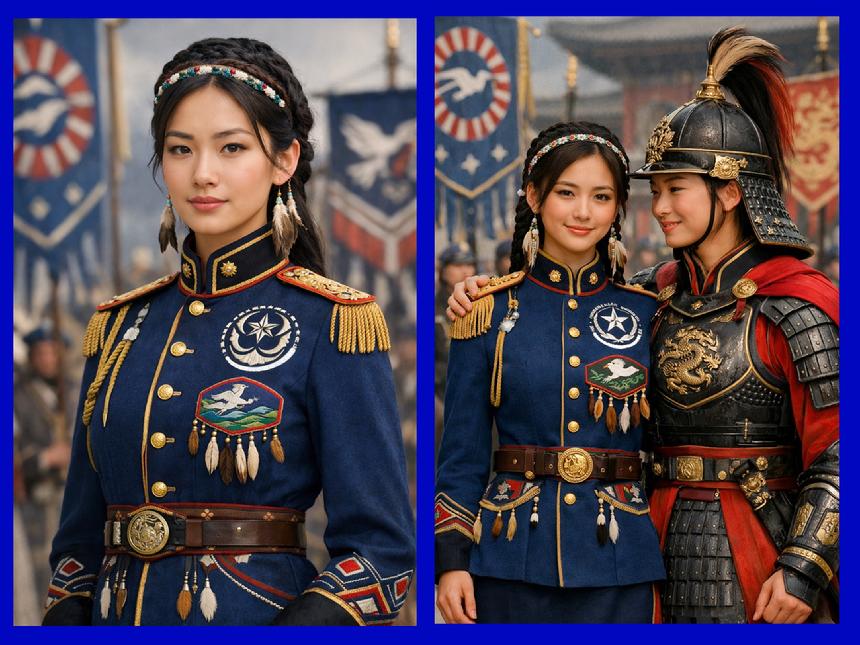 |
| Feiyan & Yujin at Departure Ceremony |
|
|
✦ The Elders Clarify the Qing Emperor’s Edict
The days after Yujin’s departure, life unfolded in a quiet, steady rhythm — council meetings, fleet coordination, shared meals, and the slow weaving of four nations into one living alliance. Roxane threw herself into the work, but the absence beside her was a constant, tender ache, like a missing heartbeat she kept expecting to hear.
At the weekly gathering of the Ohlone Nations Council, she unrolled a map across the woven mat, her voice steady but cautious.
“We need to plan housing for the Phoenix Corridor officers who will remain here,” she said. “But the Emperor’s edict forbids us from building permanent structures on Ohlone land. Until Yujin returns with clarification, we should limit ourselves to temporary shelters.”
A soft ripple of amusement passed among the elders.
Hoypuh Kule leaned forward, eyes warm with patience.
“Commander… the Emperor forbids you from building here.”
Maien added, with a dry smile that carried the weight of centuries,
“He does not forbid us from building on our own land.”
Roxane blinked, caught off guard.
“I… hadn’t considered that distinction.”
Tamalpa chuckled,
“Sovereignty is not a gift we wait for. It is a truth we enact.”
Kuleh gestured toward the coastline beyond the council lodge.
“If we choose to build homes for your people, halls for your council, or docks for your ships, that is our decision. Not the Emperor’s.”
Maien’s voice softened, losing none of its firmness.
“You are guests. Honored ones. But this land is ours. And we decide what rises from its soil.”
Roxane bowed her head, humbled.
“I meant no disrespect.”
Hoypuh Kule touched her shoulder — a gesture of reassurance, not correction.
“You showed respect by asking. Now show trust by accepting.”
Then, with a spark of humor that cut through the heaviness in Roxane’s chest:
“Besides… when your Yujin returns, she will need a proper home to walk into.”
Roxane laughed at Kule’s gentle teasing — grief, love, and gratitude threading together. The emotion she felt in this moment left her struggling for the right words.
“I am— we are so grateful to you,” she said. “The Phoenix Corridor feels the warm and welcoming embrace of the Ohlone Miwok Nations.”
“And we return that embrace,” the elders replied.
Outside, the fog receded from the hills, revealing the first outlines of what would soon become the Phoenix Corridor’s permanent foothold — not imposed, but invited; not granted, but shared.
The alliance was no longer an agreement.
It was becoming a place.
|
🌄 The Alliance Takes Root
The days lengthened.
The fog thinned.
And the alliance began to take shape in ways no one had imagined.
🌿 New Structures Rise
Ohlone carpenters and Phoenix Corridor engineers worked side by side, their tools ringing in harmony.
Timber frames rose along the sheltered curve of the bay —
not Qing, not Joseon, not Japanese,
but something new, shaped by all three.
Roxane walked the site each morning, her boots damp with dew, offering guidance where needed and stepping back where she wasn’t.
The elders watched her with quiet approval.
⚓ Joint Naval Drills
Out on the water, Lady Aiko’s fleet trained with Ohlone and Miwok navigators.
Canoes and warships cut across the same currents, learning each other’s rhythms.
Signals were standardized.
Routes were mapped.
A shared patrol schedule emerged like a woven net across the coast.
But the most remarkable work happened in the sheltered inlet north of the Seagate,
where Phoenix Corridor engineers and Ohlone tule‑balsa builders gathered around a half‑finished hull.
The Ohlone showed how tule reeds breathed with the water —
how a vessel could flex with the tide instead of resisting it.
The engineers showed how ribbed framing and layered planking
could extend endurance far beyond the limits of reed alone.
Together, they shaped something new:
the Suliš‑kewen, the water‑woven vessel.
It came in three sizes:
-
Tayi — a swift one‑ or two‑person craft for scouts and messengers
-
Makkin — a twelve‑person patrol vessel for coastal defense
-
Šakra — a twenty‑four‑person long‑range craft capable of open‑ocean travel
A hull that carried tule‑woven buoyancy chambers
reinforced by Phoenix‑style crossbeams,
with a shallow draft for estuaries
and the strength to ride the long waves beyond the Farallones.
When the first prototype launched,
Ohlone paddlers and Phoenix sailors stood side by side on its deck,
feeling the way it moved —
not quite a canoe, not quite a ship,
but a child of both traditions.
Roxane watched from the shore,
the wind lifting her hair,
as the Suliš‑kewen skimmed across the water like a promise.
Four nations learning to breathe together.
And now, to sail together.
🔥 Cultural Exchanges
Evenings brought gatherings around driftwood fires.
Ohlone singers taught ancient songs of the western gate.
Joseon scholars shared herbal remedies and star charts.
Japanese artisans demonstrated the art of lacquer and steel.
Qing envoys recited poetry that drifted into the night like lantern smoke.
Along the shoreline, children from the myriad tribes of the Ohlone Nations played together in the sand — their laughter rising above the crash of waves.
Their parents and village leaders gathered along the shore, marveling at the unprecedented sight of coordinated, large‑scale naval construction.
🪶 Council Meetings
The Ohlone Nations Council met weekly,
their circle now expanded to include Roxane, Seonhwa, Aiko, and the Phoenix Corridor delegates.
Maps were unrolled.
Trade routes were debated.
Defense plans were refined.
And always — always — the elders reminded them:
“This land is shared, not surrendered.”
Roxane listened, learned, and grew into her role with a steadiness that surprised even her.
🌙 Roxane’s Quiet Evenings
At night, when the work was done and the fires burned low,
Roxane walked the shoreline alone.
She traced the path Yujin’s ship had taken into the fog.
She whispered updates into the wind —
about the new docks,
the rising halls,
the strengthening alliance.
She imagined Yujin hearing them across the ocean.
|
Yujin Arrives in China
Early Winter, December 1764
Arrival at the Port of Fuzhou
The fog that had swallowed the Ohlone coast did not follow Yujin across the ocean.
Here, the air was sharp and crystalline, the winter sun pale against the stone walls of the Fuzhou naval port. Frost clung to the rigging as the Hai Lan neared the harbor entrance, her hull creaking with the exhaustion of a long crossing.
Yujin stood at the bow, cloak snapping in the wind, her breath rising in white plumes. Behind her, the Joseon cutter Sejong and Aiko's swift scout ship followed in disciplined formation — returning to Qing China not as an experiment, but as a force.
Fuzhou Port was busier than usual after receiving word from multiple scout vessels about the approaching Phoenix Corridor ships on the horizon. In the midst of their daily routines the dockworkers were now hastily preparing berths for Yujin's fleet as the three vessels entered the harbor.
Aside from the sound of Imperial banners from the watchtowers snapping in the wind, all had become suddenly quiet at the docks.
And it was the silence that struck Yujin first —
There had been no time for the port authorities to prepare a ceremonial welcome for Yujin, and she had expected none. Still it was the atmosphere of expectation and scrutiny in the silence that for a moment had caught her off guard.
As the Hai Lan's gangway lowered, Yujin felt the shift inside herself — the subtle tightening of her spine, the return of the Hua daughter who had once walked these stones, the commander who now returned changed.
She stepped onto the dock.
Minister Zhao of the Ministry of War approached, robes heavy with winter brocade.
"Commander Hua," he said, "the Emperor has been informed of your arrival. Your reports will be reviewed. Your audience will be arranged."
Yujin bowed, hiding her unease at the cold greeting from the war minister, as her gaze drifted toward the sea and the now opposite shore of Ohlone Miwok, which in this moment felt more like home to her than China.
The Letters and the Appointment
Evening of Yujin's arrival
Fuzhou, Zhang Family Residence
The lamps of the Zhang residence glowed softly behind latticed windows as Yujin approached the gate, escorted by a single Qing officer. Snow had begun to fall again — thin, drifting flakes that melted on her cloak as she bowed to the guard and stepped inside.
A servant led her through a quiet courtyard to a warm receiving room. Zhang Shuren and Madam Lianhua rose to greet her, and beside them, unexpectedly, stood a third figure in the immaculate robes of the Ministry of Rites — Minister Zhang Wenxiu, who inclined his head and said nothing. Whatever business had brought him here, he had chosen to let it wait.
Yujin bowed deeply.
"Honored Uncle. Honored Aunt. I bring news from the Western Sea."
Madam Lianhua's voice trembled.
"Is our Feiyan well?"
Yujin smiled — a soft, reassuring smile.
"She is more than well. She is thriving. And she asked me to deliver this."
She withdrew a sealed packet — three letters bound with red silk.
One from Feiyan.
One from Roxane.
One from Yujin, written in her capacity as guardian.
Shuren accepted the packet with reverence.
They broke the seals.
Feiyan's handwriting flowed across the page — warm, earnest, full of life. As they read, their expressions shifted from relief… to astonishment… to something deeper.
Madam Lianhua pressed a hand to her mouth.
"She… she is married."
Yujin bowed her head.
"To a young man named Teymuk of the Ohlone Nations. A man of honor. A man who cherishes her."
Shuren opened Roxane's letter next. He read aloud:
"Your daughter stands with courage, wisdom, and grace. We honor her. We protect her. We cherish her happiness as if it were our own."
Madam Lianhua wiped her eyes.
"And your letter?" she asked.
"It affirms their union," Yujin said. "And bears the seal of the Phoenix Corridor."
Shuren placed the letters on the table, his hands steady now.
"Commander Hua," he said, "you have brought us the greatest gift a parent can receive — the knowledge that our daughter is safe, loved, and honored."
Madam Lianhua stepped forward, taking Yujin's hands.
"And you," she said, "are family to her. Which means you are family to us."
It was then that Minister Zhang finally spoke.
"Forgive the intrusion on a family hour," he said. "But I think this is the hour for it."
He drew two scrolls from his sleeve — sealed with imperial yellow wax — and set them on the table beside the opened letters.
"The Emperor has reviewed Commander Hua's reports. He has studied the alliance she forged. And he has determined that the Ohlone Nations must be met not only with ships and envoys… but with family."
He bowed toward Feiyan's parents.
"Zhang Shuren and Madam Lianhua are hereby appointed as the first Imperial Ambassadors to the Ohlone Nations. You will travel with Commander Hua when she returns to the Western Sea."
For a long moment neither of them moved.
Then Shuren looked down at his daughter's letter, still open on the table, and Yujin watched the two things settle into one another in his face — the appointment and the handwriting, the Empire's reach and a father's.
"We are ready," he said.
Madam Lianhua had not taken her eyes from the letter.
"We wish to meet him," she said softly. "And to meet the people who have welcomed our daughter with such open hearts."
Then she turned to Yujin, and her voice softened further.
"Feiyan wrote of you as well. She wrote that you are the sister she found across the ocean. That you protected her. Guided her. Believed in her."
Yujin felt her throat tighten.
"I only did what honor required."
Madam Lianhua shook her head gently.
"No. You did what family required."
The snow outside thickened, softening the world into white. Inside, the word settled around Yujin like a blessing — quiet, profound, and full of warmth.
The Imperial Audience
Mid-Winter, January 1765
The Forbidden City, Hall of Supreme Harmony
Snow fell in thin, deliberate flakes over Beijing, softening the edges of the palace roofs and turning the courtyards into a world of white and red lacquer. Yujin followed Minister Zhao through the Meridian Gate, her breath clouding in the frigid air, her boots crunching on the packed snow.
The Forbidden City was as she remembered — vast, ordered, immaculate — but she was not the same woman who had last walked these stones. They passed through the Gate of Supreme Harmony, where carved beasts watched from the eaves, their eyes catching the winter light. Eunuchs in layered silk bowed as she passed. The cold bit through her cloak, but her spine remained straight.
At the foot of the Hall of Supreme Harmony, Minister Zhao stopped.
"Commander Hua," he said quietly, "from this point, you speak only when addressed. The Emperor has read your preliminary reports. He awaits your full account."
"I understand."
Maybe it was because of the cold morning, or having had to wait for what seemed like an extended needless stretch of days for the Imperial summons, but something in the thinly veiled contempt in the subtle expressions from certain court elements was starting to wear on Yujin's patience. She bowed while masking a feeling of irritation at Minister Zhao's slightly condescending tone — conveyed to her like a parent might speak to a child visiting the Forbidden City — as she thought to herself,
"Do I look like something that just fell off the ox cart, Minister Zhao? This isn't my first time meeting the Emperor…"
The great doors opened.
Warmth spilled out — incense, braziers, the faint scent of sandalwood. The hall was a cavern of gold and shadow, its ceiling painted with dragons coiled in eternal vigilance. Rows of officials lined the sides, their robes a river of embroidered rank. At the far end, elevated on the Dragon Throne, sat the Emperor. He wore winter robes of deep imperial yellow, the color of earth and sovereignty. His gaze was steady, unreadable, but Yujin felt the weight of it settle on her like a hand.
Yujin approached the center of the hall and knelt, forehead touching the polished floor.
"Your servant, Hua Yujin, returns from the Western Sea."
A long silence followed — not disapproval, but assessment. When the Emperor finally spoke, his voice carried through the hall like a blade drawn from its sheath.
"Rise."
She did.
"Your reports speak of an alliance," he said. "Four nations acting as one. A fleet built across oceans. A treaty forged with the Ohlone Nations. And a commander who has returned alive from a journey no one in this court believed possible."
A murmur rippled through the officials — surprise, perhaps even awe — but the Emperor raised a hand and silence fell instantly. He studied her for a long moment.
"You have exceeded the mandate given to you," he said. "And yet… you have fulfilled its spirit."
Yujin bowed her head. "The Phoenix Corridor stands ready to serve the Empire."
The Emperor's eyes narrowed — not in suspicion, but in calculation. "Tell me, Commander," he said, "what do you believe the Western Sea will become?"
Yujin lifted her gaze. "A bridge, Your Majesty. Not a boundary."
A faint smile touched the Emperor's lips — the kind that revealed nothing and everything.
"Then you will see what your success has made possible."
He rose from the Dragon Throne — a rare gesture that sent a ripple of shock through the hall.
"Walk with me."
Yujin's heart quickened. The Emperor himself was leading her. Not to a council chamber. Not to a private audience room. But out of the hall, through the snow-dusted courtyards, toward the waiting palanquin — toward something she could not yet imagine.
As they stepped into the winter light, the Emperor spoke softly, almost to himself.
"The Phoenix Corridor has proven its resolve. Now it is time for the Empire to answer in kind."
Yujin felt the first stirrings of awe — a sense that the world she had left behind in the Ohlone Nations was about to be met by a world rising to meet it. She did not yet know what awaited her in the shipyards. She did not yet know how profoundly her life was about to change. But she followed the Emperor into the snow, her breath steady, her heart anchored across an ocean.
The Shipyard Revelation
Late January 1765
Fuzhou Naval Shipyards
The palanquin moved through the winter streets of Fuzhou with a slow, deliberate rhythm. Snow melted into thin rivulets along the cobblestones, reflecting the red lanterns that lined the road. Yujin sat across from the Emperor, her posture rigid, her breath steady, her mind racing.
He had said little since leaving the Forbidden City. He didn't need to. His silence was a weight, a promise, a test.
When the palanquin finally stopped, attendants opened the lacquered doors, and a gust of cold sea air swept in — sharp, briny, unmistakably familiar.
Yujin stepped out.
And froze.
Before her stretched the Fuzhou naval shipyards — but not as she remembered them. The old docks were gone, replaced by vast new slipways. Cranes towered like skeletal giants. Hundreds of workers moved in coordinated precision. The air rang with hammers, saws, shouted orders, and the deep, resonant heartbeat of industry.
But it was the ships that stole her breath.
A dozen HLC frigates stood in various stages of completion: three fully built, hulls gleaming with fresh lacquer; four with masts rising like forests of polished pine; five more in advanced framing, their ribs arcing skyward like the bones of leviathans. Around them clustered support vessels of every size — cutters, tenders, supply junks, long-range scouts — an entire fleet being born before her eyes.
"By the ancestors…" she whispered.
The Emperor stepped beside her, hands clasped behind his back, his gaze sweeping the shipyards with quiet satisfaction.
"This," he said, "is what your success has wrought."
Yujin turned to the Emperor, eyes wide, throat tight.
"Your Majesty… All of this work—"
"Yes," he said, his voice soft but unyielding. "Against the advice of my ministers, and the silent questioning of my sanity from my royal cousins, I chose to embrace this dream and share in the destiny of the Phoenix Corridor."
He gestured toward the towering hulls.
"These ships were begun before your first reports arrived. Before your alliance was sealed. Before your return was certain. Before your survival was known."
Yujin stared at him, stunned. "You built them… without knowing if I would succeed."
The Emperor's gaze sharpened.
"This Qing Emperor never doubted the resolve of Hua Yujin and the Phoenix Corridor to achieve success."
The words struck her like a physical blow — not praise, but recognition.
He continued, voice low, resonant. "You crossed an ocean no one believed could be crossed. You forged an alliance no one believed could be forged. You returned with the strength of four nations behind you."
He turned to her fully. "Now the Empire answers in kind."
Yujin knelt before the Emperor, her heart pounding with awe and responsibility.
"These ships," she whispered, "they will change everything."
"They will," the Emperor agreed. "And you will command them."
"Me…?"
"You are the bridge between worlds," he said. "The Phoenix Corridor is no longer an expedition. It is the future of the Empire's reach across the Western Sea."
He bent down to her, his voice dropping to a tone only she could hear.
"And when you return to the Ohlone Nations, you will not return alone."
Yujin felt the world tilt — not with fear, but with the weight of destiny settling into place. She looked again at the fleet rising from the shipyards: a dozen frigates, a constellation of support vessels, a promise forged in timber and iron.
A promise she would carry back across the ocean.
A promise she would carry back to Roxane.
The Hua Legacy
Late January 1765
Fuzhou, the Hua Ancestral Residence
Snow dusted the tiled roofs of the Hua ancestral compound, settling on the winter plum blossoms that clung stubbornly to their branches. Yujin walked through the quiet courtyard, her breath visible in the cold air, her heart pounding with a different kind of fear than the one she had faced on the open sea.
She stopped beneath the old plum tree — the one her father had planted the year she was born — and waited.
A soft rustle of silk announced the arrival of Hua Shuying, her father's elder sister. Her hair was silver, her posture straight, her eyes sharp with the kind of intelligence that had guided the Hua family through three emperors.
"Yujin," she said, her voice warm but probing. "You asked for privacy. That alone tells me this is no ordinary matter."
Yujin bowed deeply. "Aunt… I have returned with more than an alliance."
Shuying studied her face. "Speak."
Yujin inhaled, steadying herself. "I am married."
A flicker of surprise — not shock — crossed her aunt's eyes. "To whom?"
Yujin lifted her gaze, unflinching.
"To Admiral Roxane of the Ohlone Nations.
Huang Lingfeng Roxane Wong."
Shuying's brows rose slightly at the imperial name — the name bestowed by the Emperor himself. She stepped closer, searching Yujin's face with the precision of someone who had spent a lifetime reading truth from shadows.
Before she could speak again, Yujin reached behind her traveling cloak.
"Aunt… there is something you must see."
She drew the scabbard forward.
Shuying inhaled sharply.
The sword was unmistakable.
The lacquered grip, wrapped in faded crimson silk.
The guard shaped like a rising swallow.
And along the spine of the scabbard, the four etched characters that every Hua child learned before they could walk:
忠 — Loyal.
勇 — Brave.
真 — True.
孝 — Filial devotion.
Shuying's voice dropped to a whisper.
"Your great-ancestor's blade… You brought it out of the ancestral hall."
Yujin bowed her head.
"Aunt, I could not speak of my heart without the presence of the one who taught our family what a heart is for."
She lifted the sword between them, holding it as one would hold an oath.
Shuying's eyes softened, but her voice remained steady.
"Do you love her?"
"With every breath," Yujin said.
Shuying nodded once — a small, decisive gesture.
"Then this is not a complication. It is a declaration."
Yujin blinked. "You… accept this?"
Her aunt's lips curved into a faint smile.
"Child, you carry the blood of Hua Mulan. Our ancestor did not live by the world's expectations. She lived by the clarity of her heart. Loyal. Brave. True. These were not just the soldiers' oath — they were her way of being."
She touched the character 孝, her fingertip resting on the groove worn smooth by centuries of hands.
"Mulan carried this sword to protect her father," she murmured. "You carry it to protect the truth of your heart. The Emperor will understand."
She closed Yujin's hands around the scabbard.
"And they are yours."
Yujin felt her throat tighten. "But the Emperor—"
"—will hear of this from me," Shuying said. "Not as a confession. Not as a plea. But as a matter of Hua honor."
She turned toward the courtyard gate.
"Wait here. I will return before the evening bell."
Before the Evening Bell
Hua Ancestral Courtyard
So Yujin waited.
The light went from white to gray to the deep blue that comes before dark. Snow gathered on her shoulders and she did not brush it away. Somewhere beyond the wall a cart passed, its wheels muffled; somewhere nearer, a servant lit the courtyard lamps and withdrew without a word, understanding that whatever was happening here required no witness.
She had faced the open ocean with less fear than this.
Out there, the sea had only ever asked whether she was strong enough. Here, in the quiet of her family's courtyard, the question was different, and there was no seamanship for it. She had crossed an ocean, forged an alliance, knelt before the Dragon Throne. She had built a fleet out of nothing but the word of four nations. And now she stood beneath a plum tree her father had planted, waiting to learn whether the Empire would permit her to love her wife.
The evening bell had not yet rung when she heard the gate.
The sky had darkened to indigo. Her aunt approached through the falling snow, her expression unreadable.
"The Emperor has spoken."
Yujin swallowed hard. "And…?"
Shuying stepped close, placing both hands on Yujin's shoulders.
"He said: 'The Empire does not question a Hua heart.' And that what you bind, you strengthen."
Yujin's breath left her in a trembling exhale.
Relief, gratitude, and something deeper — a sense of belonging — washed through her.
Shuying's voice softened.
"Loyal. Brave. True.
It was never just an oath, Yujin.
It is who we are."
Yujin bowed her head, overwhelmed.
And in that moment — beneath the winter plum blossoms, with her aunt's hands steady on her shoulders — she felt the full weight of her lineage settle into place.
Not as a burden.
But as a blessing.
The Departure of the Phoenix Envoys
Mid-February 1765 — Fuzhou Naval Shipyards
Winter sunlight spilled across the Fuzhou naval yards, turning the masts of the great ships into spears of gold. Thousands had gathered — officials in embroidered robes, soldiers in polished armor, scholars clutching scrolls, families craning for a glimpse of the imperial procession. There were drums, and a herald, and an address from the platform in which the Emperor said publicly what he had already said to Yujin privately in the shipyard, and said it less well; the crowd received it warmly. The geomancer read the winds and pronounced them auspicious, which surprised no one, least of all the geomancer.
Yujin stood through all of it with her hands folded and her mind three thousand leagues west.
It was only when the Empress descended from the platform that she came back to herself.
The crowd quieted, sensing the shift — the ceremony turning from imperial proclamation to something more intimate. The Empress carried a silk-wrapped bundle in her hands. She stopped before Yujin.
"Commander Hua," she said softly, "you have served the Empire with honor. But today, I speak not as the Empress, but as a mother of the Inner Court."
She unwrapped the silk.
Inside lay a small crystal-and-jade bowl, its walls clear as water, its base engraved with a phoenix rising from flame. Light shimmered through it, casting a faint rainbow across the platform.
"This," she said, "is a wedding gift for you and your wife."
The Empress placed the bowl in her hands.
"Crystal for clarity. Jade for virtue. The phoenix for rebirth. May your union be a blessing to both your peoples."
She then withdrew a small scroll tied with red silk.
"And this," she continued, "is the poem Wholehearted Harmony. It has been given to Hua brides for generations. Now it crosses the ocean with you."
Yujin bowed, overcome. “I will deliver it to Roxane with reverence. We will treasure this gift always.”
The Empress touched her shoulder — a gesture rarely given in public.
"Carry our blessing across the sea."
The Departure of the Hai Lan
A great conch horn sounded from the harbor.
The ships began to move.
The Hai Lan glided forward, its hull gleaming, its sails billowing like wings. The crowd erupted in cheers as the fleet slipped into the open sea — carrying ambassadors, a commander, and a bowl engraved with a phoenix meant for a woman waiting across the ocean.
And as the coastline receded, Yujin held the Empress's gift close, knowing that when she placed it in Roxane's hands, the world would shift again.
The sea carried them home in a long, steady arc, the winter winds softening as the ships crossed into the familiar waters of the Western Sea. And when the coastline of the Ohlone Nations rose from the horizon, Yujin felt the world shift — not with ceremony, but with the quiet certainty of returning to the place where her heart had already chosen its home.
|
🍂 Late Summer 1764 — The Quiet Beginning
The morning Yujin departed for China, the Seagate was alive with drums and salt wind. Feiyan stood beside Teymuk as the fleet pulled away, her hand in his, her heart pulled taut between pride and a strange, fluttering awareness deep within her own body.
She did not speak of it.
Not yet.
Not until she was sure.
The Sisterhood Circle had blessed her marriage only weeks earlier. The future felt wide and bright, but something inside her whispered of a new path opening — one she had not expected.
🍁 Early Autumn 1764 — Realization
The first signs came during a morning walk along the coastline with Suyana. The tide was low, the kelp beds glistening in the sun, and Feiyan paused mid‑stride, a hand pressed to her abdomen.
Suyana saw the shift in her expression.
“Child of the Phoenix,” she murmured, “you are changing.”
That evening, Feiyan told Teymuk.
He listened without interruption, then placed his hand gently over hers — steady, warm, certain.
“We wait,” he said. “Until winter’s first moon. Then we tell the Circle.”
Feiyan nodded.
The secret settled between them like a glowing ember.
❄️ Winter 1764–1765 — The Announcement
Snow dusted the hills above Petlenuc when Feiyan finally spoke the words aloud in council.
The Sisterhood Circle gathered around her — Roxane, Seonhwa, Aiko, Suyana, Maien — each woman’s face softening with joy.
Suyana wept openly, her tears falling onto Feiyan’s hands.
“This child will be born into the world we are building,” she whispered.
“A daughter of the Phoenix.”
The Ohlone Council offered blessings.
Songs were sung.
Herbs were burned.
And Feiyan felt the weight of her new role settle into her bones — warrior, diplomat, and now mother.
🌱 Spring 1765 — Life Growing Within and Around Her
Feiyan’s pregnancy unfolded amid the daily rhythms of the Seagate:
- Qing and Joseon farmers teaching new planting methods
- longhouses rising along the ridge
- mixed military units training in the fields
- the shipyards ringing with the sound of hammers and saws
- children from the Ohlone tribes playing in the sand while their parents watched the great vessels take shape
Feiyan continued her liaison duties, though Teymuk walked beside her more often now, carrying messages, tools, or simply the quiet strength of his presence.
She became a symbol of continuity — the living proof that the Phoenix Corridor was not only a treaty, but a future.
🌞 Summer 1765 — Preparing for Birth
The heat of summer brought preparation.
Suyana and Maien built a birthing lodge near the coast, weaving tule mats and hanging flicker feathers to invite protection.
Aiko crafted soft garments for the newborn.
Seonhwa prepared medicinal teas.
The Sisterhood Circle gathered herbs, songs, and blessings.
Teymuk carved a cradleboard from driftwood and obsidian, shaping it with reverence.
Feiyan stepped back from active training, but her voice remained central in councils.
Her presence reminded everyone — Ohlone, Miwok, Qing, Joseon, Japanese — that the alliance was becoming a lineage.
🍂 Early Autumn 1765 — The Birth of Maien Mulan
On a misty morning, with the tide whispering against the shore, Feiyan gave birth.
The Sisterhood Circle surrounded her, singing celebratory songs from home along with new ones learned in Yelamu and Huimen.
Teymuk held the child first, tears streaking his cheeks, then placed her gently into Feiyan’s arms.
They named her Maien Mulan —
Maien, to honor the woman whose diplomacy helped avert war and shape the Phoenix Corridor;
Mulan, to honor her godmother Yujin’s heritage, and as a prayer for the next generation.
The Ohlone Council blessed her.
Suyana delivered gifts from the Petlenuc village elders to the new family member.
And while Maien Mulan took center stage on her day one in the world, a euphoric and exhausted Zhang Feiyan drifted off smiling, sleeping through it all.
🍃 Late 1765 – Early 1766 — A Child of the Phoenix Corridor
Maien Mulan grew through the winter, carried in tule wraps against Feiyan’s chest.
She became a familiar presence in the shipyards, in the longhouses, in the councils.
Her laughter mingled with the sound of hammers and waves.
Feiyan’s parents did not know.
Only that their daughter had married.
Only that she served the Phoenix Corridor with honor.
The truth — the child, the birth, the new life — would reach them only when the Hai Lan sailed into the Seagate the following spring.
And when it did, the world would change again.
|
A New Season Begins
Petlenuc Village, Ohlone Seagate
Early Spring 1766
The wildflowers were closing their petals just before sunset, bending with the shifting coastal breezes of early spring, carrying the scent of salt and something else — something electric.
A lookout on the cliff above Petlenuc raised a conch shell and blew a single, sharp note.
Roxane turned from the charts in her study room, grabbed her spyglass and double-timed it to the sea cliffs in what had become a familiar pattern, always hoping for news from China, always preparing for sightings of Spain.
Today it looked like good news.
The image coming into focus was a courier ship — Qing colors flying high — sails full, and coursing fast across the waves, its crew moving with the urgency that navigating through the Seagate demanded.
Feiyan, who had been sketching in the sand with her stylus, swept everything into her satchel and raced for the dock, determined to reach it first. Her boots splashed through the shallows as the ship came alongside.
The courier captain bowed deeply and handed her a sealed scroll.
Feiyan ran it to Roxane, who broke the seal with trembling fingers.
“Resupply confirmed. Reinforcements pledged.
Joseon and Japan stand with us.
Arrival within seven days.
I am aboard the Hai Lan.
— Yujin”
Roxane closed her eyes, the tide roaring in her ears.
“She’s coming home.”
Seven days later, an Ohlone Miwok scout ship spotted sails on the horizon, Qing colors bright against the morning light. Its captain instantly recognized the distinct lines of the lead frigate and ordered signal flags raised to the coastal watch at Yelamu:
“HLC HAI LAN FLEET IDENTIFIED. ON DIRECT COURSE TO SEAGATE.”
|
The First Sight of the Ohlone Coastline
A Clear Day on the Western Sea
The fog had been thinning for hours, burned away by a rising sun that turned the sea into hammered silver.
Yujin stood at the prow of the Hai Lan, boots braced against the carved figurehead, her general’s coat snapping in the wind like a battle standard. Spray kissed her face. Her hair whipped loose from its knot.
There — faint at first, then unmistakable — the Ohlone coastline emerged from the haze.
Cliffs rising like guardians. Smoke from ceremonial fires drifting skyward.
And along the shore, a shimmer of color: banners in red, blue, yellow, and white, catching the wind in long, rippling arcs.
A welcoming ceremony.
For her.
For the ambassadors.
For the Phoenix Corridor.
Behind her, the crew murmured in awe. Feiyan’s parents stepped to the rail, breath catching at the sight of the land where their daughter now lived. The geomancer whispered a blessing to the wind.
Yujin did not move.
She stood like the figure carved beneath her — unyielding, forward‑facing, carved by storms and duty — and let the sight of the Ohlone Nations fill her chest until she could no longer breathe.
“Home,” she whispered.
Not her birthplace.
But the place where her heart was waiting.
At Yelamu Petlenuc
Land’s End
Roxane had been scanning the horizon since dawn, spyglass in hand, her boots planted on the wind‑swept ridge above the Seagate. Below her, the welcoming ceremony unfurled in full splendor — Ohlone dancers, Miwok drummers, Joseon banners, Qing lanterns, Japanese standards — a tapestry of nations woven along the shore.
A gull cried overhead.
The wind shifted.
And then — a glint.
She raised the spyglass.
A ship broke through the thinning fog, sails full, hull cutting cleanly through the waves. The Hai Lan. Yujin’s flagship. The ship she had last seen taking Yujin away and disappearing into the horizon beyond the Farallones so many months ago — a passage of time that, in this moment, seemed like just yesterday.
Roxane focused.
There — at the prow — a figure in a dark blue officer’s coat, standing against the wind as if carved from the very prow itself. Hair streaming. Coat snapping. One hand gripping the figurehead. The other shading her eyes as she searched the coastline.
Yujin.
Alive.
Whole.
Returning.
Roxane whispered into the wind:
“There you are, girl… Stand fast… Steady as you go… Come home to me.”
The Arrival Ceremony
Ohlone Seagate, Petlenuc Village
The drums began at noon.
Low. Steady. Like the heartbeat of the coast.
Roxane stood at the edge of the Seagate at Petlenuc Docks in full dress naval uniform — coat pressed, boots polished, eyes fixed on the horizon.
Beyond her, the Combined Fleet stood in formation: Joseon, Qing, and Japanese officers at attention; Ohlone and Miwok elders in ceremonial regalia; banners lifting in the salt wind.
Feiyan paced like a caged tiger.
Seonhwa and Aiko coordinated the reception teams with quiet precision.
Suyana stood beside Maien and Hoypuh Kule, her carved Seagate token held in both hands.
Roxane stood at attention as Lady Aiko’s ceremonial drum corps sounded a maritime herald.
The Hai Lan’s sails reflected the golden light of late afternoon as she berthed at the first docking space, banners unfurled; then in close order, following the Hai Lan, a Joseon Turtle ship, its armored hull gleaming like a sea dragon, and a Japanese modified frigate, its lines echoing Roxane’s 21st‑century schematics — sleek, fast, formidable.
For a long moment, all eyes at Petlenuc were fixed on the three docking ships.
Then a call from the lookout:
“Fleet approaching!”
And suddenly, like a tide breaking — to the gasps of an astonished crowd at the waterfront — two dozen ships were approaching the Seagate: the Second Combined Fleet from Joseon, Qing, and Japan.
– Equine transports carrying mountain‑bred horses
– Supply ships laden with grains, seeds, and farmers trained in sustainable cultivation
– Medical ships with Qing and Joseon healers lining the decks
– Scholar ships carrying teachers, linguists, historians — ready to learn and to teach
And greeting them as a ceremonial escort, gliding like silver reeds across the water, were the first Suliš‑kewen / Šakra vessels — the hybrid craft born of Ohlone and Phoenix Corridor hands.
The fleet moved in perfect formation,
a living answer to the prophecy.
The Reunion
As the Hai Lan docked, and the gangway lowered, Yujin proceeded down the gangway to the ceremonial reception line at Petlenuc docks in full dress uniform — green and white, gold trim, insignia gleaming in the sun.
Roxane stepped forward from the receiving line to face Yujin, her own uniform crisp, her posture unshakable.
The General and the Admiral exchanged salutes — two commanders, two lovers, two architects of a new world.
For a moment measured in heartbeats they looked at each other, silently acknowledging one to the other in their shared expressions the physical signs of stress that the loneliness of command inevitably brings. In synchronicity taking a deep breath, still composed, still holding the line between ceremony and emotion…
Until…
Roxane’s hand trembled.
Yujin’s eyes softened.
And then — falling into each others’ arms in a long-sought embrace…
The crowd erupted in cheers as the two women stood forehead to forehead, whispering a quiet greeting to each other, military rules forgotten, protocol dissolved, the tide roaring behind them.
Feiyan whooped aloud.
Seonhwa smiled — rare, radiant.
Aiko wiped a tear and muttered, “Finally.”
Suyana bowed her head, whispering a prayer of gratitude.
The Ohlone, Miwok, Qing, Joseon, and Japanese banners lifted together in the wind.
And the Phoenix Corridor was no longer a dream.
It was here.
It was real.
It had returned.
Late Afternoon
Ohlone Seagate
Petlenuc Village
The cheers had barely begun to fade when movement at the top of the gangway drew the crowd’s attention.
From behind Yujin, the Qing Imperial Ambassadors appeared — Zhang Shuren and Madam Lianhua — their robes immaculate despite the long voyage. A hush rippled outward as the people of Petlenuc recognized the bearing of royal officers and instinctively sensed the gravity of their arrival.
Feiyan, still in the receiving line, turned toward the gangway — and froze.
For a heartbeat she could not breathe.
Her hand tightened around Teymuk’s.
Her expression flickered between disbelief and wonder — a rare moment when the woman who had engaged adversity at sea and diplomacy on land found herself utterly unprepared.
Then her father’s voice carried across the dock.
“Feiyan!”
The world seemed to tilt.
Her parents walked toward her, smiling through tears, the sea wind tugging at their sleeves.
Madam Lianhua reached her first, cupping Feiyan’s face as if to confirm she was real.
Feiyan laughed and cried at once, pressing her forehead to her mother’s shoulder.
Zhang Shuren’s eyes shone with pride and disbelief.
“You have walked far,” he said softly.
“And now you walk beside the one you have chosen.”
Then, with a familiar fatherly squint and a spark of humor:
“And you’re wearing proper shoes!”
Feiyan laughed aloud at the remark, remembering that admonition on the day he allowed her enlistment in the Phoenix Corridor.
She turned toward the waiting line where Maien Mulan stood with Suyana’s steady hands supporting her, clutching a carved shell in both hands — the child’s eyes wide, her hair braided with flicker feathers.
Feiyan faced her parents again.
“Bà… Ma,” she whispered, “there is someone waiting to meet you.”
|
Yujin and Roxane — The Quiet Exchange
As the ceremony continued, Yujin leaned slightly toward Roxane, her voice low enough that only the sea could hear.
“About the surprise guests aboard,” she said, a faint smile tugging at her lips.
“Feiyan’s parents — and Qiu Sheng, the geomancer himself. The Emperor wanted the alliance to be strengthened by friends and family.”
Roxane’s eyes softened.
“I think he succeeded… and I have a surprise guest for you as well — waiting at Yelamu village.”
Yujin tilted her head.
“Who?”
Roxane’s smile deepened.
“Maien Mulan.”
Yujin’s expression shifted from curiosity to confusion as the familiar names aligned in a way she had not expected.
Roxane continued gently,
“She is a child born of the Phoenix Corridor,” she whispered.
“She’s nine months old now. Feiyan’s and Teymuk’s daughter. They named you her godmother. You’ll see her soon.”
Yujin drew in a slow breath, the news settling into her like a tide turning. She looked toward the horizon, where the hills of Yelamu glowed in the fading light.
“Then the Circle has a new sister,” she said quietly.
“We now have families on both shores.”
The drums resumed, slower now, echoing across the bay.
Feiyan led her parents toward the waiting procession.
The geomancer raised his staff, tracing a line between sea and sky.
Yujin and Roxane stood side by side, watching the last light of day fade from the village rooftops toward the Pacific. They could feel it now — the treaty between Phoenix Corridor and Ohlone Miwok Nations was coalescing into something deeper than just words on paper — it was becoming a harmonious, resonating presence personified in the tiny body and mighty heart of little Maien Mulan, and all who would follow her.
🌙 The Night of Return
Petlenuc Village — After the Reunion Ceremony
The cheers continued to echo faintly from the shoreline as Roxane and Yujin slipped away from the crowd. The sun had dipped below the horizon, leaving a soft violet glow over the water. Lanterns flickered along the path leading toward the bluffs above the Seagate.
They walked in silence at first — not out of awkwardness, but because silence was the only thing large enough to hold what they felt.
When they reached the overlook, Roxane finally exhaled, a long, trembling breath she had been holding for three days.
“I haven’t slept for the past seven days,” she admitted softly. “Not since your courier ship arrived.”
Yujin turned toward her, a slow smile spreading across her face — warm, knowing, a little mischievous.
“I think,” she said, brushing her fingers lightly against Roxane’s sleeve, “you’re in for one more sleepless night tonight.”
Roxane let out a soft, helpless laugh — the kind that comes only after fear has finally loosened its grip.
“You’re impossible.”
“And you missed me,” Yujin replied, stepping closer.
Roxane didn’t deny it. She couldn’t.
Instead, she reached up and touched Yujin’s cheek, tracing the familiar line of her jaw.
“I counted every hour,” Roxane whispered. “Every tide. Every star.”
Yujin leaned her forehead against Roxane’s.
“I know,” she murmured. “I felt every one of them.”
Below them, the newly arrived fleet settled into the harbor — anchors dropping, lanterns lighting, crews singing in half a dozen languages. The world was changing, reshaping itself around the alliance they had forged.
But up on the bluff, there were only two people.
Two hearts.
Two breaths.
Two futures, finally touching again.
Yujin took Roxane’s hand.
“Come,” she said softly. “Let’s go somewhere the world can’t find us for a little while.”
Roxane nodded, her voice barely above a whisper.
“I thought you’d never ask.”
✦ The Night Sky
Between the Ceremony and the Walk Home
They descended from the bluff and followed a narrow path that wound between the dunes. The last of the ceremonial drums faded behind them, replaced by the hush of the tide and the soft rustle of tule reeds.
When they reached a clearing where the village lights fell away, Roxane stopped.
“Look,” she whispered.
The moon drifted through a veil of clouds, its glow silvering the sand and the edges of their hands. Stars shimmered like distant witnesses, scattered across the dark expanse.
Yujin tilted her head back, her breath catching — not from surprise, but from recognition.
“It’s the same sky,” she said softly. “The one that watched over us when we were apart.”
Roxane stepped closer, their fingers intertwining.
“And the one that brought you back.”
For a long moment they stood together, looking upward — not at the past that had separated them, nor the future that awaited, but at the quiet infinity that had always held them both. The land seemed to breathe with them, steady and slow.
Roxane squeezed Yujin’s hand.
“Come,” she murmured. “Let’s go home.”
|
|
They walked hand in hand through the lantern‑lit paths of Petlenuc, past newly built longhouses and communal gardens that hadn’t existed when Yujin left.
Yujin paused, taking in the sight.
“These weren’t here before.”
Roxane nodded, her voice soft.
“The Ohlone insisted. Once they learned about the Emperor’s restrictions on our building permanent structures here, they said the Qing mandate did not apply to them building homes in their villages for us.”
Yujin touched one of the carved lintels — a pattern of waves and cranes intertwined.
“They built these for the fleet?”
“For the fleet,” Roxane said. “For the families who will come. For the scholars and healers. For the horses. For the future.”
Yujin’s eyes shone in the lantern light.
“It’s beautiful.”
Roxane smiled — tired, relieved, overflowing.
“You should see the land allocations. Suyana and Maien spent weeks walking the coastlines, mapping where each nation’s people could settle without disturbing sacred sites. They said it was the least they could do for the ones who crossed the ocean to stand with them.”
Yujin squeezed her hand.
“And you oversaw all of it.”
Roxane shook her head.
“I tried. But mostly… I waited.”
They reached their quarters — a modest structure overlooking the sea, its doorway framed with woven tule reeds. Yujin stepped inside first, then turned back, her expression softening into something warm and familiar.
Roxane closed the door behind them.
For a moment, neither spoke.
Then Roxane smiled at Yujin in a way she shared only when the moment belonged to them alone.
“So…, General… you said something earlier about my being assigned the night watch tonight?”
Yujin’s smile curved into a slow, knowing arc.
“The Phoenix Corridor expects that all will do their duty, Admiral…”
Roxane laughed — a sound half‑broken, half‑reborn — and pulled her close.
The world outside faded.
The lantern dimmed.
And for the first time in months, the tide inside them finally came to rest.
|
🌅 Dawn After the First Night
Petlenuc — The Bluffs Above the Seagate
Roxane woke first.
The room was filled with the pale gold of early morning — the kind of light that makes everything look softer, gentler. Yujin slept beside her, one arm draped across Roxane’s waist, her breathing slow and steady. The rhythm of someone finally home.
A breeze lifted the edge of the window curtain, letting a shaft of sunlight slip across the room. It caught the crystal‑jade phoenix bowl — the wedding gift from the Qing Empress — and the carved wings shimmered as if stirring. A small rainbow spilled across the foot of their bed, a quiet blessing cast in light.
Roxane watched Yujin for a long moment, memorizing the peace in her face, the way the dawn touched her hair, the quiet rise and fall of her chest.
When Yujin stirred, she blinked up at Roxane with a sleepy smile.
“You’re awake early.”
“I didn’t want to miss this,” Roxane said.
Yujin stretched, then sat up, pulling the blanket around her shoulders.
“Miss what?”
Roxane nodded toward the open doorway.
“The first dawn with you home.”
They stepped outside together, barefoot, wrapped in blankets, and climbed the short path to the bluff overlooking the Seagate.
Below them, the newly arrived fleet rested in the harbor — sails furled, banners fluttering in the morning breeze. Smoke rose from cookfires. Horses whinnied from the transport pens. Scholars walked the shoreline with Ohlone guides, pointing at plants and tide pools. A pair of Suliš‑kewen / Tayi craft skimmed the shallows, their tule‑woven hulls catching the early light.
The world was already changing.
Yujin leaned her head on Roxane’s shoulder.
“You kept everything alive while I was gone.”
Roxane shook her head.
“No. The Ohlone did. Suyana did. The fleet did. I just… held the line.”
Yujin took her hand.
“You held my heart.”
Roxane closed her eyes, letting the warmth of the rising sun wash over them.
“You came back to me,” she whispered.
“I always will,” Yujin replied.
And as the first full light of morning spilled across the Pacific, the two of them stood together — not as commander and envoy, not as symbols of an alliance, but simply as two women who had crossed storms, nations, and oceans to find their way back to each other.
|
🌿 The First Morning Home — Meeting Maien Mulan
Petlenuc Village — Late Morning
After watching the dawn settle over the harbor, Roxane and Yujin walked back down the bluff, the blankets still wrapped around their shoulders. The village was waking — cookfires crackling, children running between the longhouses, the scent of acorn bread drifting through the air.
Roxane paused at the fork in the path.
“There’s someone you should meet,” she said softly.
Yujin raised an eyebrow. “Someone?”
Roxane nodded toward the cluster of homes near the central fire circle — the ones built with Ohlone hands and Phoenix Corridor patterns intertwined.
“Feiyan and Teymuk’s daughter.”
Yujin blinked, still adjusting to the idea. “Maien Mulan.”
Roxane smiled. “She’s been waiting.”
They walked together toward Feiyan and Teymuk’s home — a modest structure with tule‑woven walls and a carved lintel depicting cranes, waves, and flicker feathers. The door curtain was tied open, letting in the morning light.
Inside, Feiyan sat cross‑legged on a woven mat, her hair loose for the first time since the fleet’s arrival. Teymuk knelt beside her, and between them, supported by Suyana’s steady hands, stood Maien Mulan — six months old, bright‑eyed, clutching her carved shell with fierce determination.
Feiyan looked up and smiled.
“She’s been practicing standing all morning,” she said. “She knew you were coming.”
Yujin stepped forward slowly, as if approaching something sacred.
Maien Mulan stared at her — wide‑eyed, curious, unafraid, and Roxane said,
“She recognizes you. Feiyan has been singing songs and telling stories about Aunt Yujin to her since her Red‑Egg day.”
Yujin knelt, her breath catching as the child reached out with one small hand, fingers brushing the edge of Yujin’s sleeve.
Feiyan’s voice softened. “She knows who stands with her mother.”
Maien Mulan let out a delighted coo — a sound like a tiny bell — and Yujin laughed,
“She’s perfect,”
Roxane rested a hand on her shoulder.
“She’s the future we’re building.”
🌬️ Roxane and the Geomancer — The Decision
Lands End — Late Afternoon, Same Day
The sun was lowering when Roxane made her way toward the southern bluffs — the place where sea met sky, where timelines had once opened like doorways. She had asked the Geomancer to meet her there, and he was already waiting, his staff planted lightly in the earth.
Master Qiu Sheng, the geomancer who had traveled with Yujin on the return voyage, stood in the wind with the calm of someone who had watched centuries turn like pages.
The wind carried the scent of cypress and salt — the same wind that had greeted her on her first arrival in this century.
Geomancer Man inclined his head. “Missy. You wished to speak.”
Roxane sat on the ground, palms pressed into the earth. “I did.”
He waited, patient as tide and stone.
“I’m not returning to 2009,” she said quietly. “Not this time. Not ever.”
The Geomancer lowered himself to sit beside her, as he had done in other centuries, other crossroads. “I wondered when you would say it aloud.”
Roxane looked out over the water, where the fleet’s lanterns were beginning to glow. “I’m in love with Hua Yujin. We’re married. We’ve built a life here. And I’m not prepared to make another hasty departure like I did with Liam Keller in 1906. I won’t tear myself away again.”
The waves below struck the rocks in slow, steady rhythm.
Geomancer Man nodded slowly. “The timestream has never been a chain for you, Missy. It has been a mirror. Every century you entered showed you a different face of yourself. And every departure left a ripple behind.”
He turned his gaze toward the horizon.
“You have made changes in this time stream that carry forward to 2009. If you returned now, you would see wonderful things. The seeds you planted here have borne fruit. But fruit is not the same as home.”
Roxane smiled faintly. “I know. But I’ve learned something.”
She drew a breath.
“In the late 19th century,” she said softly, “I was my own great‑grandmother. Now, in this late 18th century, I have the chance to become my own great‑great‑great‑granddaughter in 2009.”
The Geomancer’s expression shifted — not confusion, but recognition. The kind reserved for someone who has finally spoken the truth they’ve been circling for years.
He spoke gently. “You have walked the timestream long enough to know that ancestry is not only behind us. Sometimes it waits ahead. Sometimes it asks us to step forward instead of back.”
Roxane continued, her voice steady and clear.
“I’ve heard it said that history only happens once. But after the timelines I’ve traveled and the places in Time I’ve been, I believe it is just as true that history never happens the same way twice. That it happens again and again. That it happens different. That it happens maybe even better than what happened — or didn’t happen — before.”
The wind lifted her hair, carrying her words out over the water.
“I’m staying to find out if this time, in this place, it happens differently. Better for the Ohlone. Better for everyone.”
She turned to him.
“You once told me that the moment I was in was the oldest I had ever been, and that the youngest I would ever be is tomorrow.”
She placed her hand over her heart.
“This is the place where, after all the twists and turns in the timestream, I have ended up. This is the place where I belong.”
She looked back toward the village — toward Yujin, toward Maien Mulan, toward the life she was choosing.
Her voice softened, but did not waver.
“This is my youngest tomorrow. And I choose to live it here.”
The Geomancer bowed his head.
“Then I will honor your choice,” he said. “And the timestream will honor it with you. It does not punish those who choose love. It remembers them.”
|
Late Spring, 1765
Soon after Yujin’s return from China, Joseon, and Japan
The coastal fog lay thick over the Peninsula, softening the outlines of the cypress trees and muffling the sound of the waves below the cliffs. The longhouse was warm with breath and firelight, its redwood beams darkened by smoke, its floor covered with woven mats brought by the Yelamu women as a gesture of welcome.
The Sisterhood Circle had gathered for the first time since Yujin’s return.
Yujin sat cross‑legged beside the central fire, her posture straight, her hands resting lightly on her knees. She still carried the scent of the sea and foreign harbors in her clothes — a faint trace of lacquer, salt, and the ink used in Qing naval charts.
Across from her, Suyana and Teymuk whispered in their own language, catching her up on the changes that had unfolded in her absence. Aiko polished her bowstring with quiet, deliberate movements, glancing up now and then as if reassuring herself that Yujin was truly home. Feiyan sketched the coastline in charcoal on a strip of bark, refining the map she had begun months earlier.
Roxane watched them all with a faint, thoughtful smile, her eyes lingering on Yujin with a warmth that needed no words.
Yujin waited until the murmurs faded.
“We have seen the ships from the south,” she said. “We have seen their scouts. We have seen their hunger for land.”
Suyana nodded. “They will come again.”
“They will,” Yujin agreed. “And when they do, we must understand them.”
Aiko looked up. “You mean their weapons?”
“Not only their weapons,” Yujin said. “Their minds. Their habits. Their ways of fighting. Their ways of thinking.”
Feiyan set down her charcoal. “How do we learn that?”
Yujin turned to Suyana and Teymuk. “Your people trade with the nations to the east. And they trade with the nations who trade with the nations who have seen the Spanish.”
Teymuk smiled faintly. “You understand our ways.”
“I am learning,” Yujin said. “And I ask this: send word through your networks. Tell them the Phoenix Corridor will trade generously for anything Spanish.”
Suyana tilted her head. “Anything?”
“Anything,” Yujin said. “A buckle. A scrap of cloth. A broken tool. A page torn from a book. A soldier’s knife. A piece of armor. Anything they carry, anything they leave behind.”
Aiko’s eyes widened. “You think such things will help?”
Yujin’s voice softened. “Knowledge always helps.”
Roxane watched her with quiet admiration. “You’re building a picture,” she said.
Yujin nodded. “Piece by piece. Word by word. Object by object. If we cannot see their forts, we will see their tools. If we cannot watch their drills, we will read their instructions. If we cannot hear their commands, we will learn their patterns.”
Suyana rose and placed her hand over her heart. “We will send the word. The tribes will listen.”
Teymuk added, “And they will bring what they find.”
Yujin bowed her head in gratitude. “Then we begin.”
The fire crackled softly. Outside, the fog shifted, revealing a sliver of moonlight on the water.
It was a small moment — quiet, almost unremarkable.
But it was the beginning of everything that would follow.
|
🌄 Seasons of Preparation
Petlenuc, Yelamu District — 1766 to 1769
When Roxane returned from Lands End, the decision she had spoken aloud — to remain in this world, to build a future here — seemed to ripple outward through the alliance like a tide turning. The Sisterhood Circle felt it. The Ohlone Council sensed it. Even the land itself seemed to shift, as if acknowledging that the work ahead was no longer temporary, no longer experimental, but the foundation of a world that would endure.
And so the seasons began to change — not only in weather, but in purpose.
🐎 I. The Ground Forces — Yujin’s Integration of Nations
Under the authority of the United Ohlone Nations Council, Yujin took command of the joint land‑forces training. Her leadership was not imposed; it was invited, shaped, and continually reviewed by the Council. Every decision flowed through Ohlone sovereignty.
Across the valleys and coastal plains, Qing cavalry instructors taught Ohlone and Miwok riders how to fight from horseback. Ohlone scouts taught Qing soldiers how to read fog, wind, animal tracks, and the language of the land. Joseon staff fighters trained mixed units in close‑quarters combat. Aiko’s Kyudo archers practiced alongside Ohlone bowmasters, creating hybrid archery units capable of both long‑range precision and rapid‑fire volleys.
As the months passed, new elite units emerged:
Farallones Divers
Trained in marine rescue, first aid, and kelp‑forest navigation, these divers learned to move through the underwater forests like seals. Their purpose was never destruction but protection of life and coastline. They could slip beneath surge channels to reach wrecked vessels, recover stranded scouts, guide allied ships through safe passages, and observe foreign ships from below without hostile engagement. Their oath was simple: Guard the threshold where land meets sea.
Coastal Signal Corps
Masters of fog, wind, and horizon. They trained to read the sea’s moods the way others read scripture. Their role was early warning, not provocation — a lattice of watchfires, mirrored flashes, drum‑echoes, and gull‑flight patterns that could carry a message from Point Reyes to Año Nuevo in less than an hour. Their vigilance ensured the Nations were never caught unprepared.
Tide‑Current Cartographers
Not warriors but scholars of motion. They mapped surge channels, rip tides, hidden reefs, and the deep‑water canyons that shaped the coast’s temperament. Their charts were defensive tools: safe harbors, storm shelters, and escape routes for allied vessels. In wartime, their knowledge prevented loss; in peace, it guided trade and migration.
Redwood Shield‑Bearers
The closest thing the Nations had to heavy infantry — but even they were defensive by design. Their shields, carved from fallen redwood and lacquered with clan emblems, were meant to absorb force, not deliver it. They trained to form protective corridors for evacuations, to hold narrow passes, and to stand as immovable guardians during diplomatic councils.
Sky‑Trail Runners
Messengers of the high ridges, trained to move silently through oak and chaparral. Their purpose was communication, not confrontation. They carried treaties, warnings, and pleas for aid across the spine of the Peninsula. In times of danger, they were the first to move and the last to rest.
Kelp‑Canoe Mariners
Small crews in narrow, maneuverable craft built for rescue, scouting, and escort duty. They could slip through kelp beds where larger ships would snag, ferrying supplies or retrieving stranded allies. Their canoes were symbols of presence, not aggression — a reminder that the Nations watched over their waters with care.
The Quiet Circle
Not spies, not saboteurs — but observers of intent. They studied foreign languages, gestures, uniforms, and ship‑designs. Their task was to understand, not to provoke. They ensured that the Nations responded to threats with clarity, not fear, and that diplomacy was always attempted before force.
The land itself became their training ground — dunes, marshes, redwood groves, tidal flats — each terrain teaching a different lesson.
⚓ II. The Sea Forces — Roxane & Seonhwa’s Combined Fleet
At the Seagate and the Gulf of the Farallones, Roxane and Seonhwa shaped the naval forces into a single, cohesive fleet.
Every morning, the fog lifted to reveal gunnery drills, with Ohlone and Miwok sailors learning Qing cannon discipline. Boarding exercises, where Japanese sword instructors and Ohlone grapplers trained side by side. Maneuvering formations, refined by Roxane’s 21st‑century instincts and Seonhwa’s 18th‑century mastery. Tide‑current mapping, guided by Ohlone navigators who knew the Bay’s moods better than any chart.
Feiyan’s soundings at the Seagate and the Farallon Islands became legendary — a map of hidden reefs, deep channels, and fog corridors that would one day determine the fate of the Spanish fleet.
The ships of the Combined Fleet began to move like a single organism — sails rising in unison, hulls cutting through the water in coordinated arcs, signal flags snapping in the wind.
🔥 III. The Council’s Vision — A Sovereign Defense
Throughout these years, the United Ohlone Nations Council met regularly with the Sisterhood Circle. Their decisions shaped every action:
-
No offensive strikes.
-
No preemptive aggression.
-
No violation of neighboring territories.
-
All training was for defense, for sovereignty, for the right to exist without conquest.
The Council’s authority was absolute.
The Phoenix Corridor served at their invitation.
The alliance was not an empire — it was a promise.
🌙 IV. The Quiet Moments — Roxane’s New Life
Between the drills, the councils, the mapping, and the preparations, Roxane found herself living a life she had never imagined, sharing evenings with Yujin on the bluffs, meals with Feiyan, Teymuk, and Maien Mulan, long conversations with Suyana about land, memory, and responsibility, quiet nights writing reports by lantern light, and mornings where she woke knowing she belonged to this time, this place, these people.
Her decision at Lands End had not been a departure from her old life — it had been the beginning of her true one.
The Turning of the Seasons — Knowledge Arrives
The years moved quietly, but not idly.
Training deepened. Maps multiplied. Horses grew stronger under Aiko’s guidance. The Yabusame riders learned to breathe through motion, their arrows loosed in perfect rhythm with the pounding of hooves. Suyana rose quickly among them — not because she was the strongest, but because she carried intention like a steady flame.
Across the Peninsula, the Sisterhood Circle’s networks expanded. Messages traveled from village to village, from river to ridge, from coast to valley. And through those networks came the small, ordinary fragments of Spanish life that Yujin had requested — objects traded, bartered, scavenged, carried across mountains and plains.
Most were mundane.
Some were broken.
All were pieces of a puzzle she had not yet seen.
But the seasons were turning, and the land seemed to hold its breath.
And then, in the second year of preparation, something arrived that none of them expected.
🌒 1767 — The Manual Arrives
Petlenuc, Yelamu District
The Sisterhood Circle Longhouse
The fog had not yet lifted when the runner arrived.
He came from the eastern trade routes — lean, dust‑covered, carrying a woven satchel slung across his chest. Suyana and Teymuk met him at the threshold, exchanging quiet words before guiding him inside.
The longhouse was warm with firelight.
The Sisterhood Circle gathered around the central hearth — Roxane, Aiko, Feiyan, Suyana, Teymuk, and the others — their breath soft in the morning chill.
The runner knelt and opened the satchel.
Inside were objects, nothing more — the same scatter of Spanish life that had trickled in for months. He spread a blanket and emptied the satchel. The items clattered softly, forming a small, chaotic constellation.
Yujin knelt beside them.
She touched each object with calm attention — not searching, simply seeing.
Feiyan leaned forward,
“Anything useful?”
“Everything is useful,” Yujin murmured. “Even what seems broken.”
Aiko smiled faintly,
“That is the way of the bow.”
Yujin reached for a coil of rope — and paused.
Half‑buried beneath it lay a small leather booklet, sun‑bleached, water‑stained, its edges frayed. No insignia. No title. No clasp.
Just a worn cover, soft from use.
She lifted it gently.
The longhouse fell silent.
Yujin opened the booklet.
Inside were lines of Spanish text, neat columns of commands, diagrams of formations, marching orders, firing sequences — the unmistakable structure of a military manual.
Feiyan leaned closer,
“What is it?”
Yujin turned the pages slowly, reverently,
“This is a field manual,” she said softly. “Infantry drills. Firing patterns. Command structures.”
Aiko exhaled,
“A gift from the timestream.”
Roxane’s voice was quiet,
“Or from the carelessness of a soldier.”
Yujin turned another page — and stopped.
There, written in the margin beside a diagram of a marching column, was a name:
Fages.
Her pulse quickened.
She knew the name from Roxane’s stories — the officer who would one day lead expeditions north, the man whose decisions would shape the early Spanish presence on the Peninsula.
She traced the ink with her fingertip.
“This,” she whispered, “is not only a manual. It is a window.”
Suyana knelt beside her,
“What does it show?”
Yujin closed the booklet gently, holding it as if it were something alive,
“It shows how they think. How they move. How they fight. How they obey.”
She looked up at the Circle — at Roxane’s steady gaze, Aiko’s calm breath, Feiyan’s sharpened curiosity, Suyana’s rising resolve.
“This is the beginning,” Yujin said. “Piece by piece, we will learn them. And when they come, we will not meet them with fear.”
She placed the manual on the blanket.
“We will meet them with knowledge.”
Outside, the fog shifted.
A hawk cried over the ridge.
The fire cracked softly.
And in that quiet moment, the future of Redtail Plain began to take shape — not with a battle cry, but with the turning of a single page.
From that day forward, the work changed.
Yujin no longer trained the Peninsula to meet an unknown enemy.
She trained them to meet this enemy — the one whose formations she now understood, whose officers she now recognized, whose patterns she could now anticipate.
Feiyan redrew her maps with new precision, marking not only terrain but the likely paths of Spanish advance.
Aiko adjusted her drills, teaching her riders to strike from angles that Spanish infantry could not easily counter.
Suyana studied the manual beside Yujin at night, tracing the name Fages with a quiet, growing certainty.
The Sisterhood Circle did not speak of destiny.
They spoke of preparation.
And the Peninsula — from the redwoods to the dunes, from the Seagate to the inland valleys — began to move with a new, sharpened purpose.
The years between 1767 and 1769 were not loud.
They were not dramatic.
But they were decisive.
For in those years, the Phoenix Corridor learned the shape of the storm that was coming.
And they shaped themselves in return.
🌅 V. The Approach of 1769
The years between 1767 and 1769 passed like a held breath.
Across the Peninsula, the alliance moved with new purpose.
Training sharpened.
Maps deepened.
Signals quickened.
The Sisterhood Circle watched the horizon with a clarity shaped by Yujin’s manual — by the knowledge of how Spain marched, how Spain scouted, how Spain obeyed.
And then the rumors began.
A whisper carried by traders.
A message passed between runners.
A report from the Sky‑Trail ridges.
A Spanish land expedition was moving north.
The Portolá party.
The first contact.
The moment history had once recorded as the beginning of a long, devastating occupation.
But in this timeline, the Ohlone Nations were unified.
The Phoenix Corridor was ready.
The sacred sites were protected.
The land was defended.
And the future was no longer a wound waiting to happen.
It was a threshold.
A choice.
A moment they had prepared for across six long seasons — and one they were finally ready to meet.
|
From the journal of Father Vicente Santa Maria, chaplain of the Spanish Naval Vessel San Carlos, San Francisco Bay…
August, 1775
“…Today the captain decided to go to an island that we called Santa María de los Angeles. This was done, and when the ship was anchored again, we went ashore to reconnoiter the island terrain.
With one sailor along, I was foremost in making a diversion of this duty, in hopes of coming upon Indians. All afternoon of the 14th I wore myself out at it. On the pitch of a hill slope I discovered two huts, certainly Indian lodgings, though deserted. I went near them, and seeing them unoccupied, I was minded to take the path to a spring of fresh water to quench a burning thirst brought on as much by the great seasonal heat as by the hard work of climbing up and down such rugged high hills. In a short while I came to a large rock with a cleft in the middle of it, in which rested three remarkable, amusing objects, and I was led to wonder if they were like-nesses of some idol that the Indians reverenced.
These were slim round shafts about a yard-and-a-half high, ornamented at the top with bunches of white feathers, and ending, to finish them off, in an arrangement of black-and-red-dyed feathers imitating the appearance of a sun. They even had, as their drollest adornment, pieces of the little nets with which we had seen the Indians cover their hair.
At the foot of this niche were many arrows with their tips stuck in the ground as if symbolizing abasement. This last exhibit gave me the unhappy suspicion that those bunches of feathers representing the image of the sun (which in their language they call gismen) must be objects of the Indian’s heathenish veneration; and if this was true – as was a not unreasonable conjecture – these objects suffered a merited penalty in being thrown on the fire…”
Tamal‑hui, Late 1760s, Before First Contact with Spain
The Sisterhood Circle ascends the mountain with Roxane
As the joint naval and land exercises of the Ohlone Self‑Defense Forces and the Phoenix Corridor intensified across the seasons, and as the year 1769 crept closer with the promise of first contact, something Roxane had carried in her heart from the 21st century began to press heavier with each passing day.
It was a memory she had never spoken aloud.
A wound she had never allowed herself to touch.
A moment she knew she could not let repeat.
So she called the Sisterhood Circle together at Tamal‑hui — Yujin, Seonhwa, Aiko, and Feiyan — and asked them to walk with her to a place near the summit of the island facing the Seagate. The air was cool, the late‑afternoon light slanting gold across the ridges. Below them, the Bay shimmered like a great silver bowl.
They climbed in silence, each woman sensing that Roxane was holding something delicate, something sacred.
At the crest, Roxane stopped.
There, arranged in a perfect spiral, were feathered arrow shafts set upright in the earth — a pattern older than treaties, older than borders, older than memory. Each shaft was tipped with obsidian or chert. Feathers of heron, hawk, and flicker fluttered in the breeze. The spiral was unmistakably ceremonial — a prayer, a warning, a boundary, a map.
Yujin stepped forward first.
“Roxane… what is this?”
Roxane knelt beside the arrangement, her fingers hovering just above the feathers, as if afraid to disturb the air around them.
“There is something that I have known about from my world’s history that I have carried with me since before my arrival in your time, and the event is connected to this place on Tamal‑Huye. I discovered this while walking here yesterday,” she said softly. “And I knew I needed to share this with you.”
The object reminded Feiyan of the mandalas she had seen in her village temples back home. She felt an almost euphoric energy, celebratory and reverential all at once, emanating from the spiral pattern while the cartographer inside her marveled at its design. She wondered if anyone else was feeling this too as she said, “This is ancient. Older than the unification. Older than the treaties.”
Something in the spiral’s turning reminded Aiko of characters her grandmother once traced in the air for her, never on paper — Wosite, older, her grandmother always said, than anything Japan had borrowed from the continent. Scholars in Kyoto argued whether the characters had ever truly existed before her grandmother’s time. Aiko did not know if they would ever agree. She found, watching Feiyan’s hand hover over the stone, that she did not need them to.
“We have something like this,” she said quietly. “Wosite, my grandmother called it. The scholars doubt her. I never did.”
Aiko crouched beside Feiyan, studying the geometry.
“It’s a message. A boundary. A blessing.”
Seonhwa folded her arms, her voice low.
“It feels like a guardian.”
Roxane closed her eyes for a moment, gathering herself.
“In my world’s timeline,” she began, “this was destroyed.”
The Circle fell silent.
Roxane continued, her voice steady but threaded with sorrow.
“A Spanish priest — Fray Vicente Santa María — came ashore on this island in 1775. He found an arrangement like this. Maybe this exact one. And he destroyed it. He uprooted the arrows. Scattered the feathers. Called it superstition. Called it idolatry. And cast everything into a fire as a heathenish object that merited destruction”
Feiyan’s jaw tightened.
Aiko’s eyes darkened.
Yujin reached for Roxane’s hand.
“And here,” Roxane whispered, “it still stands.”
She looked at each of them in turn.
“Because of you. Because of all of us. Because the Ohlone Nations are unified. Because the Spanish Navy has not yet found the Seagate. And because when they do in 1775, we will stop them at the Farallones. We will refuse them access to the Seagate, to Tamal‑hui, to this sacred object in this sacred place – and the fire brought by the Spanish priest Vicente to Tamal-hui will never touch the earth here.”
She touched one of the arrow shafts gently, reverently.
“This is a wound that will never happen.”
The wind shifted, carrying the scent of bay laurel and salt.
Feiyan knelt beside her, placing her palm flat against the earth.
“The earth holds all of the myriad maps that trace the lines and the legends of our histories, Admiral, and like you once said to Geomancer Man, those histories may happen more than once, but never the same way twice. So our shared time here – yours, mine, and the Ohlone’s -– I think Tamal‑hui remembers all of them,” she said. “And now we do too.”
Yujin stepped forward, her voice soft but resolute.
“Roxane… you brought us here so we could see what waits for protection, what waits to be saved.”
Roxane nodded.
“And so you would understand what your courage will change. This—” she gestured to the spiral of feathers and stone “—will become proof that the future is not fixed. That harm can be undone before it is ever done.”
Aiko bowed her head.
“Then let this place be protected.”
Seonhwa added, “And let this story be carried.”
Feiyan whispered, “And let this be the first site of the Phoenix Corridor’s sacred guardianship.”
Roxane rose slowly, the wind lifting her hair, and glancing toward the Seagate said,
“From here forward.”
The five women stood together at the summit of Tamal‑Huye, the feathered arrows glowing in the last light of day — a symbol of a world restored, a desecration prevented, a future rewritten by their hands.
A future in which the Fray Vicente Santa Marías of this world would never set foot on Tamal-Huye.
The seasons turned.
The preparations deepened.
And as the Peninsula moved toward the autumn of 1769, the moment Roxane had feared — and prepared for — drew near.
Far to the south, hungry men were climbing the ridges.
Far to the north, the Seagate waited.
And the world that had once been wounded was about to meet the world that had once wounded it.
The first contact was coming.
|
A Place Of Endings And Beginnings
|
First Contact at the Seagate
November 4, 1769
Commander Teyahen of the Ramaytush Seaward Watch delivers the Council’s message of sovereignty and mercy to the exhausted Portolá expedition on the ridge above the Seagate.
|
“We Were Hallucinating…”
Rummeyya‑Seagate Ridge
“The Ridge Above the Seagate”
Late October 1769
The wind cut across the ridge like a blade, cold enough to sting the eyes. Rivera y Moncada pulled his threadbare coat tighter around his shoulders, though it did little to stop the shivering. Hunger had hollowed him out. His legs trembled from the climb. The men behind him coughed, limped, muttered prayers. They had eaten mule meat for days. Some had eaten less.
Portolá stood a few paces ahead, staring at the vast body of water below — the “grandiose estero” they could not cross. Rivera followed his gaze, but his eyes drifted to movement on the far slope.
At first he thought it was the wind stirring the grass.
Then he saw them.
A mounted patrol — Ohlone riders, six of them — moving in a line as straight as any Spanish cavalry drill. Their horses were small but sure‑footed, their posture upright, their pace measured. One raised an arm, signaling. Another answered with a flick of a banner — a strip of red cloth that snapped in the wind.
Rivera blinked hard.
He had never seen Indigenous riders move like that. Not in Baja. Not in Sonora. Not anywhere.
A figure rode with them — not Ohlone, not Spanish. Taller. Wearing a dark coat with a high collar. The silhouette was wrong for the frontier. The posture too formal. The horse too well‑trained.
Rivera rubbed his eyes with the back of his hand.
The figure turned briefly toward the ridge, and for an instant Rivera thought he saw a glint of metal — a breastplate? A lacquered cuirass? Something foreign. Something he could not place.
“Capitán?” Ortega’s voice came from behind him. “What do you see?”
Rivera hesitated.
The riders were already fading into the fog, their formation dissolving into the pale light. The red banner flickered once more, then vanished.
He swallowed.
“Nothing,” he said. “The wind plays tricks.”
Ortega nodded, too tired to question him.
Rivera looked again, but the slope was empty now — only grass bending in the gusts, only fog curling like smoke.
He felt a strange unease, but he pushed it down. They were starving. They were lost. Portolá himself had spoken of hallucinations. The mind, under such strain, could conjure anything.
He forced himself to turn away.
“Come,” he said to the men. “We must descend before nightfall.”
But as he followed Portolá down the ridge, Rivera could not shake the image:
A disciplined patrol.
A foreign silhouette.
A banner he did not recognize.
He told himself it was exhaustion.
He told himself it was nothing.
He told himself he had imagined it.
And for five years, he believed that.
Five years later, when he returned to this land, he would learn the truth of what he saw.
|
November 4, 1769
The Portolá Encounter
On A Mountain Ridge In Ramaytush Territory
South Of The Ohlone Seagate
The expedition was starving.
Their boots were worn through.
Their mules were dying.
Their morale was ash.
When they crested the ridge, they expected salvation — a bay, a river, a place to rest.
Instead, they saw a world they could not comprehend.
Below them, on the plains of the northern peninsula, rode the Companion Cavalry — Ohlone warriors mounted on steppe horses, their armor lacquered, their banners snapping in the wind. Their formation was flawless, the product of three years of joint training.
Beside them rode Qing cavalry, their horses disciplined and steady.
On the cliffs stood Joseon signal officers, flags poised.
In the dunes, Aiko’s Kyūdō archers watched in perfect stillness, their yumi bows angled toward the sky.
Shadow Trackers moved unseen through the brush.
Redwood Guard stood at ceremonial attention.
The land itself seemed to hold its breath.
It was not a battlefield. It was a boundary.
Portolá whispered, “Madre de Dios…”
From the center of the formation rode Commander Teyahen of the Ramaytush Seaward Watch, mounted on her grey stallion Storm‑Under‑Sky. Her layered armor caught the morning light as she approached, her horse steady beneath her. She studied the Spaniards’ faces.
She saw the hunger.
The exhaustion.
The desperation.
Her voice was firm but not unkind, voicing the orders drafted by the Ohlone Nations Council months ago and distributed to all border posts in preparation for the anticipated first contact with Spain:
“You cannot advance.
You will not be harmed.
You will be provided for.
You may set camp here tonight.
Tomorrow you will be given safe conduct, returning by the same path through which you entered our lands.”
She raised her banner — a preset code that sent a courier racing toward General Hua Yujin’s inland command post, reporting first contact and confirming that the protocols for interdiction, accommodation, and escort were in effect.
Within the hour, carts arrived from the inland supply depot — sacks of rice, dried fish, barley cakes, and water skins. The food was distributed with quiet efficiency.
In the morning, as the Portolá expedition broke camp, now provisioned with enough food to reach their southern base, Commander Teyahen handed Portolá a communication she had received at dawn from General Hua. It was sealed with four symbols:
Portolá had never held a document sealed by four nations at once.
He opened it with trembling hands.
Inside were five columns of text…
Classical Chinese
此地為五十國之主權領土。
吾等與其同盟。
請返。
Hangul
이 땅은 오홀론 오십국의 주권 아래 있다.
우리는 그들과 동맹이다.
돌아가라.
Japanese (Edo script)
此の地は五十国の領にて、
我らは其の盟友なり。
退かれよ。
Ohlone pictographs
Land. People. Alliance. Return.
Spanish
“Esta tierra es soberana.
Estamos aliados con sus naciones.
Regresad a vuestro virrey.”
Portolá swallowed hard.
“Who… who commands this alliance?”
The commander bowed slightly.
“The United Ohlone Nations Council.
Their agents are:
Admiral Roxane Wong of the Combined Fleet.
General Hua Yujin of the Ground Forces.
Admiral Nam Seonhwa of Naval Operations.
Arc‑Commander Lady Nakara Aiko of the Kyūdō Corps.”
Portolá stared at the names, stunned.
“Four nations… here?”
The commander nodded.
“Four nations.
And fifty more.”
🌬️ Yujin’s Decision
The squadron’s report reached General Hua Yujin at the inland command post on the evening of first contact. She read it twice.
“Starving,” she murmured. “They will die before they reach their camp.”
Her aide hesitated. “General… they are invaders.”
Yujin closed her notebook.
“They are human.
And the Council’s doctrine is clear:
We defend.
We do not destroy.”
Knowing that preventing hunger was implicit in the Council’s directives, Yujin authorized the release of food stores — enough to sustain the expedition back to their southern camp and onward to San Blas.
Her order to the squadron guarding Portolá’s camp was simple:
“Feed them.
Then send them home.”
Diary of Fray Juan Crespí
Expedition in-transit under escort of the United Ohlone Nations
Late autumn of 1769
“Day unknown, for hunger and fatigue have made the calendar uncertain.
Yesterday we beheld a marvel that has left the entire company in a state of trembling confusion…
His Excellency Don Gaspar de Portolá gathered us around the fire, such as it was, and produced a document delivered to him by the strange mounted people who barred our passage to the great harbor we sought.
The men were silent, for none of us had ever seen horsemen of this land, nor armor of such curious make, nor banners bearing characters unknown to Christendom. They had given us food — rice, dried fish, and cakes of barley — more than we deserved in our condition. Their charity shamed us.
His Excellency unfolded the message.
The first column was written in a script of flowing strokes, which the soldiers said resembled the writings of Cathay. The second bore the rounded letters of the Koreans, whom none of us have ever seen. The third was in the sharp, elegant style of Japan. The fourth was composed of painted signs, like the marks the gentiles here make upon their baskets and hides.
And the fifth — God preserve us — was written in our own tongue.
His Excellency read it aloud, his voice unsteady:
‘Esta tierra es soberana.
Estamos aliados con sus naciones.
Regresad a vuestro virrey.’
This land is sovereign.
We are allied with its nations.
Return to your viceroy.
The fire crackled. No one spoke.
I confess that my heart quailed. For if these people are joined with the kingdoms of the East, then the designs of Spain in this land must be reconsidered. Never have I seen such order among the natives, nor such discipline, nor such unity of purpose.
His Excellency folded the message with great care.
‘We have no choice but to comply with this admonition,’ he said. ‘If we respond with force of arms against them now, we’ll all be slaughtered.’
The men murmured prayers of relief, for we are near starvation, and the night’s rest and the food they gave us may well save our lives. I cannot help but see the hand of Divine Providence in this mercy, though I do not yet understand its meaning.
May God guide us back to San Diego, and may He grant wisdom to those who must judge what we have witnessed. I fear we have glimpsed a world not meant for us, and I pray that Spain will tread lightly upon it — if indeed she dares return at all.”
—Fray Juan Crespí
📜 Official Report to the Naval Command at San Blas
Delivered by courier from the Portolá Expedition
Winter 1769
"To His Excellency Don Manuel Riverero y Cordero,
Commandant of the Department of San Blas,
In service to His Catholic Majesty, King Carlos III
Most Illustrious Sir,
I, Gaspar de Portolá, Governor and Captain of the Expedition to the Northern Coast, submit this report with the utmost urgency and gravity.
On the 4th day of November of this present year, while seeking the great harbor rumored to lie north of Monterrey, our party encountered a force of mounted natives unlike any previously known in these dominions.
These horsemen were accompanied by foreign officers bearing arms, armor, and banners consistent with the nations of China, Korea, and Japan. Their discipline, formation, and bearing were unmistakably those of trained soldiers.
We were halted by a squadron of these mounted warriors, who declared the land to be sovereign territory of the Fifty Nations of the Ohlone, allied with the aforementioned kingdoms of the East.
They delivered to us a written message in five languages, including our own, commanding us to return to our viceroy and forbidding further advance.
Our condition at the time was dire, for we had been reduced by hunger and fatigue. These foreign‑allied natives provided us with food sufficient to preserve our lives and permit our retreat.
I affirm upon my honor that the alliance we witnessed is real, formidable, and beyond anything previously encountered in these provinces.
I request immediate instructions from Your Excellency and from the Viceroy of New Spain, for the implications of this encounter are profound and urgent.
I remain Your Excellency’s most obedient servant,
Don Gaspar de Portolá
Governor of the Expedition to the Northern Coast"
|
The Chain of Alarm
San Blas → Mexico City → Madrid
San Blas
The Commandant’s Alarm
Early 1770
The commandant reads Portolá’s report twice.
Then a third time.
He orders a sealed courier to Mexico City.
His cover letter contains only one sentence:
“If this is true, the northern frontier is lost.”
He does not sleep that night.
Mexico City
The Viceroy’s Dilemma
The Viceroy of New Spain, already strained by uprisings among the Yuma, Seri, and Pima, reads the report with a sinking heart.
He convenes his council.
-
Some argue the report is exaggerated.
-
Others insist the East Asian presence is impossible.
-
A few, quietly, believe every word — and fear its implications.
The Viceroy drafts a cautious recommendation to Madrid:
“Given our limited forces and the unrest in the northern provinces, I advise seeking a diplomatic settlement with the tribes of the Bay Region and their Eastern allies, perhaps through trade or a non‑aggression pact.”
He knows this is unlikely to be accepted.
But he sends it anyway.
He also sends a private note to the commandant at San Blas:
“Prepare for the worst.
Hope for the impossible.”
Madrid
The Crown Responds
Months later, a sealed packet arrives across the Atlantic.
The reply is brief.
Cold.
Unyielding.
“There shall be no alliance with heathen nations who trespass upon lands granted to Spain by Papal authority.
Proceed with the reduction of the tribes and the assertion of Spanish sovereignty.”
The Crown invokes the Papal Bulls of Donation — the divine mandate to convert or subdue all non‑Christian peoples.
The Viceroy shakes his head in resignation, closes the letter, and begins drafting plans for conquest of the Bay Region of Alta California.
|
Ohlone Self Defense Ground Forces
Inland Command Camp
Early Winter 1769
After ordering the release of food stores to sustain the Portolá Expedition’s return south, General Hua Yujin wasted no time.
She sat at her field desk, the lantern flickering against the canvas walls, and wrote to Roxane in her precise, disciplined hand,
“A severely depleted Spanish military scouting party was intercepted and escorted out of the Nations’ territories today. They have seen our banners.
They have seen our horses.
They have seen our unity.
They will return with this knowledge.”
She paused, the brush hovering for a heartbeat.
Then she added,
“Their men were weakened by hunger and sickness; several could not stand without aid. I have provided them with supplies sufficient for their journey home.”
She sealed the message with the mark of the Ground Forces Agent and dispatched the courier at once.
Outside, the winter wind carried the distant sound of drums from the coastal watch posts.
The Commanders’ Council
Roxane’s flagship, the Quan Yin
In Port At Wenma Tey Island
Roxane received Yujin’s message less than a day after it was sent.
She read it twice, then immediately ordered a commanders’ meeting at dawn.
At dawn, the Quan Yin’s command chamber filled with the quiet gravity of leaders who understood the turning of history.
Yujin arrived first, dust still clinging to her armor from the inland roads.
Seonhwa followed, calm and steady.
Lady Aiko entered last, bow in hand, her expression unreadable.
Feiyan slipped in with Maien Mulan asleep against her shoulder, wrapped in her crane‑embroidered blanket.
Roxane placed Yujin’s report about the Spaniards on the table. For a moment, no one spoke. Each woman understood that the world they had built was now visible to Europe — and that Europe would not look away.
“I informed the Ohlone Council yesterday. They’ve called an emergency meeting for this evening.”
Yujin nodded,
“Spain will come again. Not starving next time.”
Seonhwa said,
“Portolá’s report will take some time to reach Mexico City and Madrid, and then more time before the Viceroy receives orders from the Spanish king on how to proceed. We can use that time to prepare and respond to anything arriving on our shores from Spain.”
Aiko’s voice was quiet but firm.
“We must speak with one voice before the Council.”
Feiyan adjusted the sleeping child. “And with clarity. The Council must know exactly what the Spaniards saw.”
Roxane looked at the four women — her partners in destiny, her family in this century. The silence between them was not hesitation but understanding.
“Agreed. We recommend full defensive readiness. Not war. Preparation.”
Seonhwa: “The Fleet stands ready.”
Yujin: “The Companion Cavalry and Infantry will mobilize.”
Aiko: “The archers will support ground forces.”
Feiyan: “The coastal lookouts and signal towers should be doubled. If Spain returns by sea, we will have eyes on them from Año Nuevo to the Farallones.”
Roxane nodded in agreement with Feiyan,
“Then we are of one mind. At sunset, we speak to the Council.”
The Sunset Council Scene
Wenma Tey
Council Hall of the Fifty Nations
Early Winter 1769
The sun dipped low over the western waters, casting long amber beams through the carved redwood pillars of the Council Hall. The air smelled of salt, cedar, and the faint smoke of ceremonial sage.
Representatives of the Fifty Nations sat in a great circle — Ramaytush, Chochenyo, Tamien, Awaswas, Karkin, and more — elders, war leaders, map‑keepers, lineage holders. The room hummed with the quiet tension of a world shifting under their feet.
When Roxane and her commanders entered, the hall fell into attentive silence.
General Hua Yujin stepped forward first, bowing with the disciplined grace of her rank.
Seonhwa followed, offering the Joseon phoenix salute.
Aiko lowered her bow in respect.
Feiyan held Maien Mulan close, the child stirring softly in her sleep.
Roxane carried Yujin’s report on the Portolá Expedition in both hands, the parchment warm from her grip. Her palms were steady, though her heartbeat was not.
Council Elder Hoypuh‑Kule rose.
“Speak,” she said. “Tell us what the strangers saw.”
Roxane placed the report on the central table, its edges catching the firelight.
“They saw our unity,” she said. “Our cavalry. Our archers. Our banners. Our readiness.”
Yujin added,
“They were not conquerors in this moment, but starving men far from home. We fed them. They will return south with full bellies — and full knowledge.”
A murmur rippled through the circle.
Seonhwa stepped forward.
“Spain will not ignore this encounter. Their viceroy will demand answers. Their king will demand more.”
Aiko’s voice was steady.
“We must prepare for their return. Not with fear — with clarity.”
Feiyan unrolled a coastal map, its ink still fresh.
“If they come by sea, we will know. If they come by land, we will meet them. But we must act now.”
Roxane looked around the circle, meeting each elder’s gaze.
“We do not seek war,” she said. “But we will not be caught unprepared. Our recommendation is full defensive readiness across all Nations.”
Silence settled — deep, weighted. The elders weighed mercy against memory, vigilance against fear.
A Chochenyo map‑keeper finally spoke.
“Readiness is not provocation. But the line between them is thin. We must walk it with care.”
A Tamien elder murmured,
“Mercy is wise. But Spain will not remember mercy.”
Maien of Miwok Huimen countered,
“There will be much that Spain will wish to forget, should they choose to march against us.”
A ripple of laughter moved through the chamber — soft, tempered, edged with unspoken truth.
Hoypuh‑Kule cast a swift, unreadable glance toward the Tamien elder and Maien, then rolled up the scroll containing Yujin’s report — a clear sign the deliberations had ended.
“Let it be known: the Fifty Nations accept your recommendation.”
The hall grew still. Even the fire seemed to quiet itself. A deep, resonant drumbeat sounded — once, twice, three times — sealing the decision.
Outside, the last light of the sun slipped beneath the horizon, and the first stars rose over the Seagate, as if bearing witness.
History had turned.
Petlenuc Village
Feiyan returned to Yelamu from the council meeting, the weight of everything that transpired pressing against her ribs. Teymuk and Suyana were in the courtyard of their family lodge, repairing fishing nets by lantern light. The air smelled of cedar and tidewater. Maien Mulan slept in her sling, her tiny hand curled against Feiyan’s chest.
Teymuk looked up first. “Feiyan? You’re pale.”
She sat beside them, adjusting the sling so Maien Mulan’s head rested safely.
“Roxane told me I could speak with you before the announcement tomorrow. Only you two.”
Suyana set down her net. “What has happened?”
Feiyan took a breath.
“The strangers from the south… the ones your elders warned about… they came.”
Teymuk’s eyes widened. “The Spaniards?”
Feiyan nodded. “A patrol intercepted them. They were starving. Lost. But they saw everything — the cavalry, the banners, the alliance.”
Suyana whispered, “And now?”
“The Council will declare full readiness tomorrow. The Self‑Defense Forces will mobilize.”
Teymuk’s hand found hers. His voice was steady, but his fingers trembled.
“Is war coming?”
Feiyan shook her head. “Not today. Not tomorrow. But soon. Spain will return. Stronger. Prepared.”
Suyana exhaled slowly, her jaw tightening. “Then we will be ready too.”
Feiyan felt her throat tighten. She looked down at Maien Mulan, sleeping peacefully against her.
“I didn’t want you to hear it from a messenger,” she said softly. “I wanted you to hear it from me.”
Teymuk pulled her close, careful not to wake the baby.
“You are our family. You walk with us. Whatever comes, we face it together.”
Feiyan closed her eyes, letting their warmth steady her.
Tomorrow, the drums would sound.
Tomorrow, the banners would rise.
Tomorrow, the Nations would prepare.
But tonight, she was simply Feiyan — wife, sister, mother, daughter of the coast.
She pressed her cheek to Maien Mulan’s hair and whispered:
“Whatever comes… I will protect you. All of you. With everything I am.”
The Ohlone Miwok–Phoenix Corridor Alliance
In The Shadow of Spain
The Announcement
Winter 1769
The next evening, the Ohlone Miwok Nations Council gathered at Wenma Tey. The drums sounded. The banners rose. The people assembled.
Roxane, Yujin, Seonhwa, Aiko, and Feiyan stood before the Council as the news was spoken aloud:
“Spain has asserted a false claim to our land. Her scouts were stopped at our southern borders and sent away. We expect Spain will return in force.”
The Council declared a full defensive readiness, a reiteration of the foundations of the article of self-defense in the Ohlone Miwok Constitution – no aggression, no provocation, absolute unity, uncompromised sovereignty.
The people listened.
The people understood.
The people prepared.
1770
The alliance entered a new phase — not frantic, not fearful, but disciplined.
Ground Forces Under Yujin’s leadership
The Companion Cavalry units doubled in size. Shadow Trackers trained in redwood shade until they could move without sound. Coastline Runners established relay posts from Petlenuc to Tamal‑hui. The Redwood Guard learned both ceremony and combat. Ohlone, Qing, Joseon, and Japanese infantry drilled together until their formations moved like water.
Yujin’s philosophy became the doctrine of the alliance:
“Strength without cruelty. Mercy without surrender.”
Naval Forces — Roxane & Seonhwa
At the Seagate and the Farallones, gunnery drills became a daily ritual, boarding exercises grew sharper, mixed crews learned to read fog as if it were scripture, and Feiyan’s soundings expanded into a full navigational atlas.
Roxane introduced new maneuvers — crescent formations, wind‑shadow tactics, coordinated feints — and Seonhwa refined them into 18th‑century brilliance.
Aiko’s Archers
Lady Aiko trained her Kyūdō corps with Ohlone bowmasters in long‑range precision, rapid‑fire volleys, ceremonial archery for Council rites, and silent‑signal archery for battlefield communication.
Alongside them, she established the alliance’s first Yabusame Squadron — mounted archers who practiced the art of shooting at full gallop, weaving Ohlone horsemanship with the ancient traditions of her homeland.
Together, her foot archers and mounted archers became the calm heart of the alliance, their discipline a quiet force that steadied every battlefield they touched.
Interludes of Peace
Life in the Villages
Even in preparation for war, life continued.
Maien Mulan grew from an infant into a bright, curious toddler – chasing flicker birds, learning her first words in Ohlone, Mandarin, and Miwok, sleeping on Feiyan’s chest during council meetings, toddling between Teymuk and Suyana as they worked nets.
Feiyan’s heart lived in two worlds — the maps she drew, and the family she held.
For Roxane and Yujin, their home on the bluffs became a place of quiet mornings, shared tea, long discussions about strategy and future, laughter with Maien Mulan, and evenings watching the lanterns of the fleet.
Roxane often whispered to herself
“This is the life I chose. This is the life I will defend.”
Maien Mulan and the Grey Tabby of Petlenuc
The morning fog still clung to the docks when the supply ship from the Phoenix Corridor finished unloading its crates. The longshore crews were already dispersing, voices drifting away toward the cookfires, but Maien Mulan — four and a half years old, hair in uneven braids tied with flicker feathers — was not ready to leave.
She tugged insistently at Feiyan’s hand.
“Maien, what is it?” Feiyan asked, shifting the basket on her hip.
The child didn’t answer. She only pointed — a small, urgent gesture — toward a stack of cedar crates still beaded with seawater. Then she pulled again, harder this time, her whole body leaning forward with the certainty of someone who knows she has found something important.
Suyana, walking a few steps behind, paused and listened.
“There’s something alive in there,” she murmured. “I hear it.”
A faint sound — not quite a cry, more a tremor of breath — slipped from the shadows between the crates.
Feiyan knelt, lifting Maien Mulan into her arms. “Stay close to me, little one.”
But Maien Mulan wriggled free, dropped to her hands and knees, and peered into the narrow gap. Her delighted gasp echoed across the planks.
A pair of wide, frightened eyes stared back at her.
A kitten — small, grey‑striped, ribs showing through its fur — crouched against the wood, trembling. It must have slipped aboard in Yokohama or Shizuura, hidden itself among the cargo, and survived the crossing by sheer stubborn will.
Maien Mulan reached out a tiny hand.
The kitten hissed, then immediately regretted it, shrinking back with a pitiful squeak.
Feiyan exhaled softly. “Oh, you poor thing.”
Suyana was already moving. She slid her hands around the crates, creating a gentle barrier. “If we’re careful, we can corner it without frightening it more.”
Maien Mulan nodded solemnly, as if entrusted with a sacred task.
Together, the three of them coaxed the kitten out — Feiyan murmuring soothing words, Suyana guiding its escape route, and Maien Mulan holding out her palm with the patience of a child who believes all creatures are meant to be friends.
At last the kitten darted forward — straight into Maien Mulan’s lap.
She squealed with triumph, wrapping her arms around the small, trembling body. The kitten froze, then slowly relaxed, pressing its head against her chest.
Feiyan brushed a thumb over the kitten’s ear. “She’s chosen you.”
Suyana smiled. “Then we’d better take her home.”
🌾 The Kitten Who Became a Village Character
In the weeks that followed, the kitten — whom Maien Mulan named Tanshi, “Little Ash” — transformed under their care.
Feiyan fed her broth and fish scraps until her ribs disappeared. Suyana taught her to tolerate grooming and to sleep curled in a woven basket by the hearth. Maien Mulan carried her everywhere: strapped to her back in a tiny sling, perched on her shoulder, or toddling behind her like a shadow with whiskers.
Soon the entire village knew the kitten. Fishermen swore she brought good luck when she appeared on the docks. Elders laughed when she chased gulls twice her size. Children tried to coax her into their laps, but Tanshi always returned to Maien Mulan, tail high, as if announcing her allegiance to the future of Petlenuc.
And in the quiet evenings, when Feiyan told stories and Teymuk carved by lamplight, Tanshi curled against Maien Mulan’s side — a small, steady heartbeat anchoring the household through the uncertain years to come.
Interlude
Suyana’s Training (1770–1771)
The Making of a Yabusame Rider
The years of preparation were not only for armies and fleets.
They were for Suyana.
At dawn she trained with Aiko in the quiet grove above Yelamu, where the fog clung to the redwoods like pale silk.
Aiko taught her the stillness of Kyūdō — the breath before the release, the moment when the world narrows to a single point of intention.
Suyana learned to let the arrow fly not from strength, but from clarity.
By midday she rode with the Yabusame instructors, her horse’s hooves drumming the earth in a steady rhythm.
At first her shots wavered — too early, too late, too cautious.
But she learned.
She learned to trust the gallop.
She learned to trust the wind.
She learned to trust herself.
Aiko watched her progress with a quiet pride she rarely spoke aloud.
“You see the world as a moving thing,” she told her one afternoon.
“That is why you will excel at Yabusame. You do not fight the motion — you ride with it.”
Suyana bowed her head, breathless from the run.
“I want to be worthy of the squadron.”
“You already are,” Aiko said.
“Now you must become worthy of yourself.”
In the evenings, Suyana practiced with the Kyūdō corps — long‑range volleys, silent‑signal shots, ceremonial forms for Council rites.
Her stance grew steadier.
Her draw grew smoother.
Her arrows flew truer.
The elders began to notice.
The younger archers began to follow her lead.
The horses responded to her voice before she even touched the reins.
By the winter of 1771, she could strike a target at full gallop with three arrows in the air before the first one landed.
The Yabusame instructors exchanged glances — the kind reserved for rare talent.
Aiko said nothing of it.
She only placed a redtail feather in Suyana’s hair and said:
“Ride with the horizon.
Shoot with the heart.
Stand with the stars.”
And Suyana did.
She trained not for glory, not for rank, but for the world she loved —
for her brother,
for Feiyan,
for Maien Mulan,
for the land that had shaped her.
Letters from Home — The Unwelcome Reminder
In the spring of 1771, the first merchant vessels from the Phoenix Corridor’s eastern homelands arrived with silk, rice, tools, medicines, and letters from home.
Aiko and Seonhwa each received packets sealed with their family crests. They opened them together.
Aiko’s Letter
Aiko’s mother wrote:
“The Nakara family has honored its promise.
Your marriage contract awaits.
Return by autumn to fulfill your duty.”
Aiko folded the letter with trembling hands.
Seonhwa’s father wrote:
“Your intended groom’s family requests a date.
Your absence has caused concern.
Return to Busan to complete the ceremony.”
Seonhwa stared at the page for a long time.
Neither spoke at first, then Aiko whispered,
“How can I leave now?”
Seonhwa answered,
“We cannot.”
But duty — the old duty — hung over them like a shadow.
They did not tell Roxane or Yujin immediately.
They needed time to breathe.
The friendship between Seonhwa and Aiko deepened — two women bound by duty, discipline, and the quiet ache of what awaited them across the ocean.
1771
Although a Spanish presence had not yet materialized, the alliance felt the pressure building and assigned more scouts along the coast, more signal fires tested, more drills, more Council meetings.
The people felt the horizon tightening.
Roxane often stood at the Seagate at dusk, watching the fog roll in, whispering,
“Not yet. But soon.”
And at last, the moment she had whispered to the sea arrived with the next dawn.
The Spanish Are Coming…
The Joseon frigate Yi Sun-sin, assigned to the Gulf of the Farallones, was the first to observe two scout class vessels sailing from the southeast and flying the colors of Spain. As the ships passed the Farallon chain and entered the straights in the direction of the seagate, the Joseon captain ordered a warning shot fired from the frigate’s bow cannon that halted their approach. The frigate made a hard about turn, its 17 starboard cannons emerging to face the Spanish ships now at a full stop as the Miwok communications officer from the Yi Sun-sin announced through a speaking trumpet in flawless Spanish toward the scouts that they were now present in the territorial waters of the Ohlone Miwok Nations, and to withdraw and maintain a navigational route in the Pacific due east of the Farallones.
The scouts were turning even before the message was fully conveyed, beating a hasty retreat past the islands and in the direction of Monterey Bay.
By the time the sun dipped behind the western cliffs, news of the sighting had reached the Council lodges, the coastal watchfires, the inland villages, and the Sisterhood Circle.
Spain had been shown the boundary.
Spain would test it.
1772
In early spring, the first reports arrived of Spanish ships sighted near Monterey.
Spain had increased activity at San Blas, ordered military reinforcements from Sonora to expedition north with heavy artillery units, traveling in the direction of a place in the east bay called Redtail Plain.
With the main body of the Spanish army three days’ march from Redtail Plain, an Ohlone mounted patrol on the Nation’s southeastern border encountered an advance party of Spanish foot soldiers sent to assess the terrain. The Ohlone captured the six‑man unit without bloodshed and transported them under guard to Yujin’s southern headquarters.
The prisoners were placed in a secured lodge — guarded, disarmed, and treated with the basic dignity the Council required. They were given water, blankets, and time to recover from the march. Their status was clear: prisoners of war, held under the laws of the Ohlone Miwok Nations.
When questioning began, it was firm, direct, and without cruelty.
The captain of the Spanish scouts, exhausted and shaken, provided the essentials first:
the size of the advancing army, its regimental composition, its artillery assets.
Then, with a weary resignation, he added more:
A naval fleet from San Blas was under orders to seize the Seagate.
Land and sea attacks were to be synchronized — a single, overwhelming strike.
As the evening wore on, the captain’s guardedness began to erode.
Perhaps it was the warmth of the fire.
Perhaps the clean water.
Perhaps the absence of blows, threats, or humiliation — so unlike the treatment prisoners received in his own army.
Whatever the reason, he began to speak more freely of the shortages of food and powder, of the bitterness among the ranks, of the fear that Madrid had sent them north to die, of the quiet despair spreading through the expedition.
He did not ask for mercy.
He did not expect it.
But he recognized it when he saw it.
Yujin received the mounted Ssalson courier at dusk at her tent in the south bay camp of the Ohlone Miwok ground forces. The courier, breathless after a hard ride from the southern border, dust clinging to her braids, handed the general a scroll while announcing,
“Spanish scouts captured. Six men. No bloodshed.”
Yujin read the report by lantern light, her jaw tightening as each line confirmed what the alliance had long prepared for:
“An army advancing north from Sonora, artillery in tow, moving toward Redtail Plain. A naval fleet enroute to the Seagate —
a synchronized strike from land and sea.”
Yujin mounted her horse before the ink dried.
Wind tore at her cloak as she rode for Wenma Tey, the interrogation report clenched in her fist.
The Council convened within the hour.
The Sisterhood Circle stood together.
Feiyan held Maien Mulan close, the child’s small hand gripping her collar.
Aiko and Seonhwa exchanged a glance — the letters from home still unanswered, their old obligations pressing like a distant tide.
Yujin spoke first, her voice steady as iron.
“The time we prepared for is coming.”
Roxane answered her without hesitation.
“Then we meet it with everything we are.”
The Council declared:
“Full mobilization.
Defensive posture.
No surrender of sovereignty.”
Across the peninsula, the drums began to speak.
Banners rose like waking spirits.
The fleets assembled in the harbors.
The cavalry gathered on the ridgelines.
The archers took their positions beneath the oaks.
And the world held its breath.
Knights of the Sisterhood Before Battle
With the latest scouting reports placing Spain two days from Redtail Plain and the Farallones, the Sisterhood Circle gathered one last time on the bluffs above the Seagate.
The wind carried the scent of salt and cypress.
The lanterns of the Combined Fleet glowed like constellations drifting on the water.
Aiko whispered:
“If I fall in battle, tell my mother I chose this life.”
Seonhwa placed a hand on her shoulder.
“If I fall, tell my father I served with honor.”
Feiyan held Maien Mulan close.
“If I fall, tell her I loved her more than the sea.”
Yujin looked at Roxane.
“If I fall—”
Roxane shook her head.
“You won’t.”
Yujin’s smile was small, but steady.
“Then if I live… I live for this.”
Roxane took her hand.
“We all do.”
The five women stood together —
warriors, leaders, sisters, mothers, lovers —
on the edge of a world about to change.
And the dawn of the pivotal moment of 1772 waited just two sunrises beyond the horizon.
|
Redtail Plain
Engaging the Spanish Army
The plain stretched wide at dawn beneath a crimson sky. Grass rippled in long waves across the inland valley floor, the blades still beaded with moisture from a tule fog that had crept northward from the bay in the night. To the west, low oak‑dotted rises cast long shadows toward the plain; to the east, the first light caught the broken line of the foothills where the land began its slow climb toward the interior. A faint salt tang drifted on the breeze, carried farther inland than usual by the night wind.
Five redtail hawks circled high above the mustering ranks, their cries echoing across the open ground as if marking the field that bore their name.
On the ground below, the village shamans and Qing priests together studied their spiraling paths, drawing portents from their flight while clouds of burning incense rose from the bronze xianglu cauldron against the first rays of morning light. Awestruck murmurs rippled through the front lines, spreading backward in waves of excited conversation among the Ohlone, Qing and Miwok soldiers and their officers.
The Qing chief priest, his voice pitched to reach the furthest battalions of the army, shouted out first in Chohenyo and then in Qing Manchu and Mandarin:
“Raven Goddess shows her favor! The gods are pleased!”
A cheer rose — a rolling wave that reached the ears of General Hua Yujin, riding before the front lines with Brigadier General Nakahara Aiko on her right and Lieutenant General Suyana of the Yelamu Ramaytush on her left. Behind them rode Yujin’s senior officers: Captain Liang of the Qing infantry, Commander Haneul of the Joseon signal corps, and Captain Teyahen of the Companion Cavalry Redwood Guard.
It was nine years now since the arrival of the Sisterhood Circle on Ohlone shores at Petlenuc in 1763. Nine years since Aiko first demonstrated Kyūdō. Nine years since the Miwok women‑chiefs called the Nations to unify. Nine years since the Companion Cavalry and horse archers had been born. And three years since the halting of the Portolá Expedition of 1769 — the moment Spain first saw the strength of the united fifty nations.
Yujin exhaled, her voice edged with affectionate skepticism.
“The shamans and priests earned their keep today.”
Aiko’s smile was small but unmistakable.
“The ancestors speak when they choose.”
Suyana added,
“And today they speak for us… And they speak loudly.”
Two mounted pages approached on horseback — one Japanese bearing the raven battle flag of the Phoenix Corridor, and one Bay Miwok bearing the falcon standard of the Ohlone‑Miwok Nations Self‑Defense Forces. The young pages glanced briefly at each other with a mixture of pride and excitement before saluting the gathered officers and wheeling their horses into place at attention to either side of their commanders.
To the west beyond the Seagate in the Gulf of the Farallones, twelve ships of the Ohlone‑Miwok Coastal Self‑Defense Forces held position — among them Roxane’s flagship Quan Yin and Admiral Seonwah’s turtle ship Hae Myeong — in preparation for engaging the Spanish naval vessels whose sails now glimmered on the horizon.
On Redtail Plain, the Spanish and the Ohlone were prepared for battle.
Yujin stopped before the assembled forces on Redtail Plain and drew her sword. She saluted the cannon crews, the archers, the infantry. Cheers swelled — shields pounding like thunder.
Aiko leaned toward her, voice low with wry amusement.
“Roxane‑san asked me to remind you: the soldiers expect a speech.”
Yujin sighed, turning to Aiko with mock solemnity.
“As if I had to be reminded… Wives… Aiko‑san, whatever you choose to do in this life, never, ever, ever get married…”
Aiko laughed — a bright, unguarded sound — though a flicker of thought passed behind her eyes: her delayed filial obligations, the question of whether Spain or her own family posed the greater personal challenge.
She dismounted along with Yujin, the dust rising around their boots. The army fell silent — fifty nations, four homelands, one breath. A silence Yujin spoke into:
“Soldiers of the United Ohlone Miwok Nations and the Phoenix Alliance.”
Her voice carried across the plain in waves relayed from the front ranks to the units out of earshot. And in a satirical tone she continued,
“Spain approaches us today to tell us to get off of ‘their land’…”
The remark sent a ripple of laughter through the army in recognition of the absurdity of the invaders’ claim as Yujin continued in a more direct voice.
“...They believe they can divide us. They believe they can claim what was never theirs.”
She lifted her sword, the morning light catching its edge.
“But look around you. We stand here as one. Fifty Nations. Four homelands. One shield.”
The pages raised their flags. The wind caught them like ancestral wings.
“We fight today not for conquest, not for glory, but for the generations who will walk this land after us. For the children who deserve to inherit a world unbroken.”
Her voice deepened, and with a touch of irony she added,
“As you surely know, I am not Qing, not Miwok, but Chinese — ‘Made In China,’ my wife calls me…”
Laughter again from the crowd.
“I arrived on your shores nine years ago after your elders gave gracious permission to land, and from that day forward my single wish has been to be at your service to provide protection from those who do not seek permission to land… Today I am less your general and more your agent, your servant, as we advance against Spain on this battlefield…
“Today we will let Spain learn this truth:
We are not a people to be claimed.
We are not a land to be taken.
We are not a nation to be erased.”
She struck her fist to her chest.
“Today I am not just Chinese, I am a citizen of Ohlone Miwok Nations!”
Yujin turned from her own ranks to face the distant, emerging Spanish line…
“And so I say to Spain:
We are Ohlone Miwok!
We are united!
We are One!
May the ancestors bless us all!”
The army answered like thunder:
“We are Ohlone Miwok! We are One!”
Yujin turned to face her two young pages and gave them a quiet but firm order:
“Both of you to the rear ranks. I want you out of the line of fire. Serve the physicians. Carry stretchers. Plant our flags at the hospital tent. No banners on the front line today.”
The boys bowed — disappointed, but obedient. They walked their horses past the Redwood Guard toward the medical tents. Yujin watched them go: two small figures fixing their standards into the earth, now sorting satchels of bandages and water gourds with solemn determination.
Yujin allowed herself a single steadying breath as a scouting party raced in from the eastern ridge.
“Spanish cavalry forming for a charge! Infantry advancing behind them!”
Another scout arrived moments later, breathless:
“General — the Spanish have brought guns. Three pieces. Two swivel guns and a falconet.”
Aiko stiffened.
“Within range of the archers?”
“Not yet. But once they’re emplaced…”
“They won’t be,” Yujin said.
She pointed toward the low rise shielding the Spanish position, where their mule teams, now reaching the end of a days-long punishing route with the cannons from a supply ship at Monterey, were struggling for footing.
“A cavalry distraction. Enough to disable their guns.”
Aiko understood instantly.
“Companion Cavalry?”
Yujin nodded.
“A half‑squadron. Fast. Silent. They strike before the first shot is loaded.”
Aiko dismounted and prepared an incendiary arrow — the signal for the cavalry action. Yujin turned to Teyahen and Suyana.
“Suyana — I need your Yabusame squadron to create a distraction before they can set their cannons. Ride within range in a slow, single‑file flanking arc. Send a volley of arrows at their cannoneers in that one pass.
“Teyahen — use that space Suyana creates to lay spikes in the cannon torchholes. Form up now. Wait for Aiko’s signal flare.”
Lieutenant and Captain saluted and rode off, explaining the plan to their units even as they moved into formation.
Yujin raised her right hand, signaling the Companions and Yabusame to stand by. She turned in the saddle toward Aiko, who now stood in full Kyūdō stance, the flaming arrow already nocked.
Yujin’s voice dropped to a quiet command.
“Now, Aiko… draw and shoot.”
Aiko released.
The arrow arced high, a streak of fire across the morning sky. The air hissed as it passed overhead. It took a moment before the Spanish engineers stared upward, confused — then the shock of the flaming contrail angling toward their powder stores sent them scrambling for cover.
The arrow struck home into a barrel of black powder behind the middle cannon. The explosion tore through the gun line, shaking the ground and knocking the heaviest of them off its left wheel mount, slamming its muzzle into the earth, lopsided and useless.
The cavalry units charged the cannon batteries at the moment of the arrow’s release. Teyahen’s Companions vanished into the smoke and dust of the blast from the gunpowder explosion while Suyana’s Yabusame swept past the cannoneers in a single flanking arc, releasing three volleys of arrows into the disarrayed Spanish cannoneers as their sergeants shouted futile orders to hold position.
When the smoke cleared, the Spanish guns lay overturned, spiked, their powder seized. The Companion Cavalry re‑formed and galloped back toward the Ohlone lines, joining with the Yabusame — not a rider lost.
Yujin grinned fiercely at Suyana and Teyahen as they returned.
“Well done, cavalry! Their guns will not speak today!”
Teyahen saluted, pride warming her voice.
“General, we had enough time to seize their powder stores. Even if they repair the guns, there’s nothing left to charge them.”
Yujin saluted back, still smiling, adrenaline rising with the success of the strike.
“Well done, Captain. Well done, Lieutenant. Now return to your units…
Soldiers — there’s a war on!”
Dust still hung in the air when Yujin heard the sound of signal trumpets echoing from up and down the Spanish lines…
The Spanish officers Captain Pedro Fages and Lieutenant Juan Bautista de Anza, shamed and angered at Yujin’s sudden strike and the loss of their powder stores along with the the rout of their cannon detachment, cursed their regulars back into reformed ranks while giving their signalers the order to sound a full advance of all units.
Yujin recognized the trumpet codes immediately — the same patterns she had studied in the Spanish field manual that had reached her hands years ago through the quiet channels of the tribal trade networks. She wasted no time. Her signalers relayed the order: advance the infantry.
The armies drew to a stop within a quarter mile of each other, each side taking a final moment to assess the opposing numbers and types of combatants. Fages panned his field glasses across the Ohlone Miwok front lines and cavalry, while de Anza focused on their commanders.
It was in that moment that Yujin removed her helmet to make an adjustment to a chin strap, her unbound hair catching a sudden gust of wind, and conveying to de Anza’s astonishment that the army of the heathen was led by a woman. He spoke to Fages, not taking his eyes away from the sight,
“Santa Maria de los Angeles! Captain, they are led by a woman…”
Fages in turn raised his spyglass toward Yujin and what appeared to be her command staff, hesitating and taking a moment to study each one, and added,
““There’s a woman archery captain… and a woman cavalry squadron commander… and a woman horse‑archer… Madre de Dios… there are women commanding every unit of their army”
Anza spoke into their shared silence in hushed, superstitious tones while requesting the nearby army chaplain Juan Crespi to invoke a prayer to ward off evil spirits,
“General, we are facing off against an army led by Amazons…”
Fages, his shredded patience devolving into exasperation, turned and gave his lieutenant a single scathing glance while ordering a chagrined Crespi to ignore Anza’s request. Crespi hastily snapped his prayer-book closed, muttering to himself about just what might be the right invocation against women warriors as his fellow chaplain Pedro Font — sharing Fages’ disdain for pre-enlightenment thinking, lifted his eyes to Santa Maria in heaven in a silent prayer for deliverance from this moment as Fages continued to berate the assembly,
“We don’t have time for this nonsense!!! Order a cavalry charge now!”
Just at this moment, Infantry Captain Rivera y Moncada rode up from his auxiliaries to Fages, face pale beneath his helmet, his conscience weighing heavy with a repressed memory of a past traumatic event that occurred during his time with the Portola Expedition,
“Captain… We are not facing the tribes you think we are. I saw armor like theirs five years ago—lacquered, foreign. Near the coast. I never reported it. I thought they were spectres, I was wrong. They are real. They are here...”
Fages snapped,
“Enough of your ghost stories, Rivera. Order your men to form the line.”
Font overheard them and, frowning, filed the detail away. De Anza crossed himself again.
A subdued and silenced de Anza gave the order.
The Spanish cavalry formed into a wedge, lances angled forward. Fages raised his sword.
“The Army Will Advance!”
The charge thundered across the plain.
Yujin watched them come, her expression unreadable, timing the approaching soldados against the first maneuver by her infantry, waiting for the right moment, then signalling a defensive order,
“Front line infantry, ground spears!”
The line knelt as one, shields braced, spears angled upward like a forest of iron thorns. The horses saw the wall and balked, whinnying against their riders jerking back at the reins as they turned in every direction but forward, refusing to impale themselves.
Into this mass confusion, Yujn signaled for a flight of javelins,
“Pila—loose!”
The rain of heavy javelins arced overhead and fell into the tangled cavalry. Horses shrieked. Men toppled. Saddles split. Leather armor tore. A dozen riders and mounts fell in the first volley alone.
The survivors reeled back in panic.
Suyana’s Yabusame swept in from the flank, arrows loosed from full gallop, striking exposed backs and flanks. Aiko’s Kyūdō Corps sent high, arcing volleys into the retreating cavalry, arrows falling like rain into the infantry behind them, tearing gaps through the line.
The Spanish army crumbled.
In the wake of the melee, as dust settled over the trampled grass, Crespi and Font moved among the fallen across the now empty field as the battle continued along the eastern reaches of Redtail Plain. Crespi knelt beside a dying soldier, pressing a trembling hand to the man’s brow,
“Ego te absolvo… in nomine Patris…”
Font checked another soldier’s pulse, then closed the man’s eyes with a steady hand.
“He is gone,” Font whispered. “Give him peace, Juan.”
Crespi’s tears streaked the dust on his face. Font’s hands shook—not from fear, but from the weight of witnessing the collapse of the army he was meant to document.
Rivera y Moncada tried to rally the infantry.
“Hold the line! Hold—”
A stray musket ball struck him in the ribs. Rivera staggered once, then fell without a sound.
Font saw it happen and froze, grief tightening his throat.
“He tried to warn us."
Then came the moment that shattered the Spanish will.
Yujin spotted an opening in the cavalry ranks as they maneuvered with difficulty to reform for a second charge. Her chi stirred—subtle at first, then rising like heat from stone. Ordering the Companions to follow her, she drew her sword and led their charge, striking the Spanish riders before they could steady their mounts.
The squadron commander fired a pistol at her. The bullet curved—impossibly—back toward him. He fell from his horse, dead before he hit the ground.
The nearest soldados de cuera froze. They saw the Qing general redirecting lances, sword thrusts, pistol shots.
A soldado shouted in alarm to his comrades,
“Bruja!”
Another,
“Hechicera!”
“Witch!”
The cavalry broke toward the retreating infantry lines.
Yujin watched the Spanish ranks disintegrating and ordered cavalry and infantry skirmishers to pursue. She turned away from the front lines to scan her army’s rear guard and supply and medical teams in anticipation for a report on casualties. At the edge of the rear lines in the open space between the medical tents, she saw a crumpled form on the ground, her Japanese page kneeling beside the unidentified body.
“No!”
Yujin felt a sudden pang of shock and grief as she wheeled her horse in a full gallop to the medical tents, feeling in her heart what was about to be confirmed.
The Miwok page was dead.
His small body lay still, his blood-soaked banner draped over him by his Japanese comrade.
Something in her broke.
Her chi flared, the air around her rippling as if heat rose from stone.
She called out for the nearest mounted messenger, who appeared, saluting, as she spoke, her voice cold and resonant:
“Send to the captains of the skirmishing units… No prisoners!”
The messenger reached Aiko first, who issued her general’s new orders.
The cavalry and infantry now swept the field, cutting down fleeing soldiers.
Fages and de Anza fled together, their horses lathered with sweat, the battlefield collapsing behind them. A Companion squadron overtook them in seconds. The squadron leader raised her spear—obeying the order— but then she saw the officer’s sashes, the cuera armor, their rank insignia.
She hesitated.
Then lowered her spear.
She addressed them in flawless Spanish:
“Capitán. Teniente. En nombre de las Naciones Ohlone‑Miwok, quedan bajo arresto. La General decidirá su destino.”
Fages surrendered stiffly. De Anza trembled, muttering about witches.
They were bound in front, not behind—a deliberate gesture of respect.
A patrol found Crespi and Font kneeling beside the dead, hands still raised in blessing. The Companion officer lowered her spear.
“You are not combatants. You are under our protection.”
They were escorted—unbound—to a tent near the command area. Inside were blankets, water, tea, and space to pray. Their rosaries were returned to them.
Aiko visited briefly.
“Your dead are being buried with honor.
You may witness the rites if you wish.”
Crespí wept openly.
Font bowed his head, shaken.
They stood at the edge of the burial detail.
They watched Aiko place crosses over each Spanish soldier.
Suyana poured water over the bodies.
Ohlone and Miwok soldiers chanted.
Qing officers bowed in respect.
Crespí whispered, “They honor our dead better than we honored theirs.”
Font’s voice was barely audible.
“We were wrong about them.”
Under guard, Fages and de Anza were marched toward Yujin’s tent, their path cutting across the edge of the burial ground, where the rites were still unfolding. Fages’s stride broke, just once, when he saw him — Rivera, as Suyana knelt over him, pouring water in blessing, Aiko’s cross already in her hand, waiting to be set. Fages did not speak. He did not look away.
Fages and de Anza were brought to stand before Yujin, bound and silent. Crespí and Font remained a few steps apart — still under her protection, not her judgment.
Her grief still raw, her chi still simmering, she looked at them in silence.
“You live because my soldier chose honor over rage.
I will not shame her choice.”
Then:
“Tell your Viceroy, we bury your dead with respect.”
She ordered them escorted to the border and released.
|
Aftermath
The battlefield fell into a terrible stillness. Yujin knelt beside the fallen page, placing her left hand over his heart. Suyana rode in with news of the pursuit,
“The Companions chased the last of them to the gates of their forward presidio near the Arroyo de las Llagas. They abandoned their weapons, colors, and drums. They are annihilated.”
Aiko approached on foot, leading her exhausted horse.
“He was brave. He believed in us.”
Yujin’s voice cracked.
“He was just a child.”
Suyana placed both hands on Yujin’s shoulders.
“His spirit goes home to the ancestors.”
Yujin whispered,
“I sent him to the rear lines to avoid this.”
Aiko placed a steadying hand on her back. Together, the three women lifted the fallen page, wrapping him in the flag he had carried. Soldiers parted in silence.
The battle was over. Now grief occupied a small space in the plain. And as the smoke drifted eastward, another battle was likely unfolding beyond the horizon.
Across the Bay, between the Seagate and the Farallones, the lanterns of the Combined Fleet glowed like constellations on the water. The land had held. Now the sea would be tested.
|
Interdiction At The Farallones
Fog drifted low around the Islands, curling in pale, deliberate ribbons across the dark water — a shifting veil drawn between two worlds. Lanterns from the Combined Fleet glowed like constellations suspended between sea and sky, each light fixed in disciplined alignment, twelve ships in two columns guarding the Seagate with a quiet resolve.
At their center stood the flagship Quan Yin, her hull reinforced with Qing iron plating and shaped by Ohlone tule‑reed hydrodynamics, a vessel built from the knowledge of continents Spain had never imagined could speak to one another.
To starboard waited Admiral Nam Seonwah’s turtle ship, the Hae Myeong — Sea Clarity — low, armored, implacable, its tiled roof glistening faintly beneath the fog like a fortress adrift.
From the quarterdeck, Roxane Wong watched the horizon lighten with the silhouettes of the Spanish squadron.
Not a war fleet.
A reconnaissance force.
A supply ship, a packet boat, a lightly armed escort.
Enough to intimidate an unprotected settlement.
Not enough to challenge a navy.
She lowered her spyglass, relief and disbelief mingling with a sharper, quieter note — disappointment at the mismatch, sorrow for the prisoners who had spoken of a formidable invasion that never existed.
“So this is their Spanish Armada,” she murmured, the words edged with restrained contempt.
She summoned her captains and turned to Zhang Feiyan, who stood ready with signal flags, posture precise, eyes already reading the fog like a second language.
“Our purpose is simple,” Roxane said.
“Hold the Seagate. Show them our strength. Avoid unnecessary harm.”
She met each captain’s gaze.
“If they turn back, we let them go.”
As the fog thinned, the Spanish ships emerged:
● San Carlos, commanded by Juan Manuel de Ayala
● a packet boat
● a supply vessel
Ayala lifted his spyglass, expecting fishing boats or scattered canoes.
What he saw instead made him lower the glass slowly, as if his eyes could not be trusted.
Not Spanish hulls.
Not Russian.
Not British.
Asian hulls — long, low, reinforced with iron bands that glinted beneath the fog, their wakes cutting the water with a confidence he had only seen in Manila’s great harbors.
And one vessel shaped like nothing he had ever witnessed: squat, armored, its roof tiled like a fortress — a Joseon turtle ship, unmistakable even to a man who had only heard rumors whispered by sailors who feared the wrong empire.
Then the flags — dozens of them — snapping in the wind.
Some he recognized: Qing dragons, Joseon trigrams, the rising sun of Japan.
But others…
Geometric patterns.
Animal totems.
Colors and symbols belonging to no empire he knew.
A navy composed of nations Spain had never imagined could stand together.
Ayala felt a hollow sensation in his chest — not fear, but disorientation, as if the world beneath him had shifted. He thought of the charts he had studied, the catechisms of empire, the Manila gossip he had dismissed as superstition. None of it prepared him for this.
He whispered, almost reverently:
“This is not possible.”
But the ships did not vanish.
They held formation, disciplined and silent, waiting.
Ayala understood then — with the clarity of a man who has spent his life reading the sea — that he was not looking at a rebellion, or a tribe, or a coastal patrol.
He was looking at a navy.
A navy that did not exist on any Spanish chart.
A navy that should not exist at all.
And yet here it was, guarding the Seagate like a wall of iron and intention.
He raised the glass again, needing to confirm the impossible: the Asian hulls, the armored turtle ship, the flags he could not name, the silence of a fleet that moved as one mind.
His first officer stepped beside him, voice tight.
“Capitán… what are your orders.”
Ayala exhaled slowly, the weight settling into his bones. He lowered the glass for the last time.
“We observe. We survive. And we tell them in San Blas what we saw here.”
On the quarterdeck of the Quan Yin, Roxane turned to Feiyan.
“Signal the Hae Myeong to break formation and take station a pistol‑shot off their projected course. Send to Admiral Nam to fire a warning at the first ship that crosses to our side of the Farallones.”
The Hae Myeong turned away from the Fleet, its armored roof shifting like a living creature beneath the fog. It navigated on the diagonal toward the San Carlos’ approach, its wake spreading in a heavy, deliberate arc.
Ayala’s ship crossed into Ohlone‑Miwok territorial waters.
Seonwah signaled the quarterdeck gunners.
The dragon cannon at the bow of the turtle ship emerged, its iron mouth gleaming.
It fired once — a screaming shot that passed within inches of the San Carlos’ prow, the shockwave rippling across the water, echoing off the Farallones’ cliffs before vanishing into the Pacific.
Ayala did not speak.
He simply gripped the rail, the truth settling cold and absolute:
Spain had arrived at a gate guarded by a world it had never imagined.
Standing beside him, Ayala’s junior officers panicked.
“We should fire!”
Ayala shook his head.
“No. Look at their hulls. Their numbers. Their discipline.
If they wished us dead, we would already be dead.”
He understood.
This was not an attack.
This was a message.
Ayala bowed his head.
“We withdraw.”
His officers stared.
“But, Capitán—”
“We withdraw! We will not sacrifice our men for a claim we cannot enforce.”
The Spanish squadron turned south, sails trembling in the morning wind.
Roxane watched them go, her expression unreadable.
Feiyan exhaled.
“We could have destroyed them.”
Roxane shook her head.
“They came to measure us.
Now they know the measure.”
Feiyan paused for a moment, and nodded in agreement,
“This was the right choice.”
Roxane nodded — but her gaze drifted east, toward the distant plain.
“I hope Yujin’s battle ended the same way.”
The Messenger
The sea was calm now.
The last of the Spanish sails had vanished into the southern haze, leaving only drifting smoke and the slow creak of rigging as the Combined Fleet re‑formed its lines. The fog around the Farallones had thinned to pale ribbons, revealing the dark, jagged silhouettes of the islands and the long sweep of the Seagate beyond.
Roxane stood at the rail of the Quan Yin, letting out a sigh of relief after the adrenaline rush had passed. This always happened to her at the end of a naval operation, regardless of success or failure, however small.
Feiyan approached, her voice low.
“The Hae Myeong is returning to formation.”
Roxane nodded, but her gaze remained fixed eastward, toward the distant mainland.
“Any word from the plain?”
Feiyan hesitated — just long enough for Roxane to feel it.
Before she could speak, a shout rose from the forward deck.
“Messenger boat approaching! From the east!”
A small craft cut across the waves, rowed by two Ohlone sailors. Between them sat a young Miwok courier, his hair plastered to his face with spray, his chest heaving from exertion. He held a sealed tube against his heart as if it were a living thing.
The sailors hooked the boat to the ladder.
The courier climbed with shaking arms.
Roxane met him at the rail.
He dropped to one knee.
“Admiral Wong… message from Redtail Plain.”
Roxane steadied herself for good or bad news with her officer’s bearing, but anxious feelings for her wife got the best of her. Before the courier could continue she asked,
“Is Yujin alive?”
The courier swallowed hard.
“Yes, Admiral. The plain is ours. The Spanish line broke. The Companion Cavalry pursued them to their forward presidio.”
Relief washed through her — sharp, dizzying.
But the courier did not rise.
His eyes glistened.
“There is… more.”
He held out the message tube with both hands.
Roxane took it.
Her fingers felt suddenly cold.
She broke the seal.
Inside was a single sheet, written in Aiko’s precise hand.
She read the first line.
Her knees nearly buckled.
Feiyan stepped forward instinctively, steadying her by the elbow.
Roxane’s voice was barely a whisper.
“One of the pages…”
The words stuck in her throat.
She tried again.
“One of Yujin’s pages was killed.”
The deck seemed to tilt beneath her feet.
Feiyan’s face crumpled.
“The Miwok boy, Tákani?”
Roxane nodded, unable to speak.
The courier bowed his head.
“Commander Hua grieves deeply. She is personally bearing Tákani’s body to his family in Wápoš. Aiko and Suyana ride with her… and she asks that the Sisterhood Circle join her there, to honor the boy and his kin.”
Roxane closed her eyes.
She could see it —
Yujin kneeling in the dust,
the small body in her arms,
the flag folded across his chest,
the weight of command pressing down like the sky.
She pressed the message to her heart.
“Prepare my longboat,” she said softly.
Her voice trembled, but did not break as she spoke to the courier,
“Return to General Hua. Tell her the Sisterhood Circle will meet at Wápoš.”
Feiyan stood before Roxane, awaiting orders.
Roxane shook away her private grief, returning to the business of the fleet.
“Commander Zhang, signal the two lead frigates and their support vessels to keep station here. Signal Admiral Seonwah to join us on the longboat. The rest of the fleet — set course for the Seagate now.”
Feiyan saluted, then lingered beside Roxane for a heartbeat before carrying out her orders, her gaze fixed on the distant direction of Wápoš.
The Gulf of the Farallones was secure — the sea no longer demanded the fleet’s attention. The death of Yujin’s page was foremost in their thoughts.
And somewhere beyond the horizon, Yujin was grieving alone.
|
Wápoš
The sun was low when the Sisterhood Circle reached the Cosumnes River.
The longboat had carried them inland as far as the water allowed; from there, they rode in silence through the oak savanna, the shadows lengthening across the plain. The air smelled of dust, river reeds, and the faint sweetness of drying acorns.
Ahead, smoke rose in thin columns from a cluster of tule‑thatched houses.
Feiyan slowed her horse.
Seonwah drew up beside her.
Roxane felt the others gather around her, not in formation, but in quiet solidarity.
No one spoke.
They could already see figures waiting at the edge of the village.
Yujin stood at the front of the gathered villagers, her posture straight but her face hollowed by grief. Aiko and Suyana flanked her, their horses still dust‑streaked from the long ride. Before them, on a bier woven from willow branches and tule, lay the small, wrapped form of Tákani.
She had seen Yujin wounded, exhausted, furious, triumphant — but never like this.
Never so still.
Yujin lifted her eyes as the Circle approached.
For a moment, the world seemed to narrow to the space between them.
Roxane dismounted.
The others followed.
Yujin stepped forward, her voice barely audible.
“Roxane.”
Roxane reached her, taking her hand — not as admiral to general, but as wife to wife.
“I’m here.”
Yujin exhaled, a sound that was almost a sob but not quite.
She did not break.
She simply leaned, for the briefest moment, into Roxane’s steadiness.
Then she turned back to the family.
Three figures stepped forward from the gathered villagers.
First came Hukmá, the grandmother — her hair silvered, her posture straight, her eyes clear with sorrow but not collapse. She carried authority the way some carry breath.
Beside her stood Sáli, Tákani’s mother, her face streaked with tears but her chin lifted.
And to her right, tall and broad‑shouldered, was Tákani’s father:
Náhko, meaning “bear.”
His expression was grief‑worn but steady, his hands clasped before him in quiet strength. He deferred to Hukmá with a respectful tilt of his head, but his presence radiated a father’s love — not shattered, not broken, but carrying the weight with dignity.
The villagers parted to let the Circle stand before them.
Hukmá spoke first.
“You have brought my grandson home.”
Her voice was soft, but it carried across the clearing.
Yujin stepped forward and knelt, bowing her head.
“I failed to protect him,” she whispered. “I failed your family.”
Hukmá reached out and touched Yujin’s cheek — a gesture of profound tenderness.
“No,” she said. “He chose his path. He followed you because he believed in you. He died with honor, and with those he trusted.”
Sáli’s breath hitched, but she nodded.
Náhko placed a steadying hand on her back.
Roxane felt her throat tighten.
Yujin rose slowly and turned to the bier.
With Aiko and Suyana’s help, she lifted the small, wrapped body and carried it to the family.
The Circle stepped back, forming a semicircle behind her — Feiyan, Seonwah, Aiko, Suyana, and Roxane at the center. Their presence was silent, solemn, unified.
Yujin placed the bier before Hukmá.
“This is Tákani,” she said softly. “Little hawk. Brave heart. He served with honor. He saved lives. He was loved.”
Sáli covered her mouth, tears spilling freely.
Náhko bowed his head, his shoulders trembling once — only once — before he steadied himself again.
Hukmá knelt and laid her hands on the wrapped form.
“Thank you,” she whispered. “For bringing him home. For not letting him be alone.”
She looked up at Yujin, then at Roxane, then at the Circle.
“You honor us with your presence.”
Roxane bowed deeply.
“The honor is ours.”
Hukmá rose, her movements slow but sure.
“Come,” she said. “Share our fire. Share our grief. Tonight, we remember him together.”
Náhko stepped forward then, his voice quiet but firm.
“You are welcome in our home,” he said. “All of you. Tákani would have wanted that.”
Roxane felt Yujin’s hand find hers again — a small, trembling gesture hidden between their bodies.
The Circle followed the family into the village, the sun sinking behind them, the shadows long and soft across the plain.
And as they walked, the first mourning song rose from the elders — low, steady, and full of the love a small boy had carried into the world.
|
Departure From Wápoš
The sun had slipped below the horizon by the time the Sisterhood Circle left Wápoš.
The mourning songs still drifted behind them — low, steady, carrying across the reeds like a breath the land itself exhaled.
They rode in silence.
Yujin had brought two extra horses to the village — one for Roxane, one for Feiyan — anticipating that they would arrive from the longboat without mounts of their own. The gesture had been quiet, almost unnoticed amid the grief, but Roxane felt it now: the thoughtfulness, the steadiness, the way Yujin always prepared for others even when her own heart was breaking.
The path wound through oak shadows and open grassland, the air cooling, the first stars emerging above the plain. Aiko and Suyana rode ahead with Seonwah; Feiyan kept a respectful distance behind. No one spoke. The grief of the village clung to them like a second skin.
Roxane felt it long before she understood it.
A faint tremor beneath her horse’s hooves.
Not sound.
Not movement.
Something deeper — a low, distant vibration, like a pulse traveling through the earth.
She slowed.
Her horse flicked an ear, uneasy.
Yujin noticed immediately and reined in beside her.
“Roxane?”
Roxane didn’t answer at first. She pressed her palm to the saddle, then to the ground. The vibration was subtle, but unmistakable — a warning, a memory, a wound.
It was coming from the northeast.
From the foothills.
From the river valley she had not allowed herself to think about until now.
Cullumah.
The place where, in her time, the world had cracked open.
She swallowed hard.
“Do you feel that?”
Yujin’s expression shifted — not confusion, but recognition.
Slowly, she nodded.
“I wondered if it was only me,” she murmured. “That low trembling… like a river crying out from far away.”
Roxane went still, listening for an echo of what Yujin had just described.
“You’ve felt it before?”
“Since the battle,” Yujin said quietly. “A faint vibration, like something in the land is… unsettled. I couldn’t name it. I didn’t know if it was grief, or exhaustion, or something else.”
Roxane closed her eyes.
It wasn’t grief.
It wasn’t exhaustion.
It was the future — the one she had carried alone, the one she had been terrified to speak aloud.
The Gold Rush.
The devastation.
The erasure of nations.
The river poisoned, the land torn open, the people scattered or killed.
She had buried it under duty, under war, under the Phoenix Corridor, under everything else she had been forced to carry.
But here, after Wápoš — after seeing a family grieve a single child — she could no longer keep silent.
“Yujin,” she whispered, “I know what it is.”
Yujin turned fully toward her, the last light catching the grief still etched in her face.
“Tell me.”
Roxane’s throat tightened.
She looked back toward Wápoš — toward the village that had just buried a boy, toward the land that had held them all in its quiet sorrow.
“I’ve been keeping something from you,” she said. “From all of you. Not out of mistrust — out of wanting to carry the weight alone. Out of not knowing when to share it while everything else was happening.”
Yujin waited.
Patient.
Steady.
Open.
Roxane drew a breath that trembled.
“There is a place in the foothills,” she said softly. “A river valley. In my time, something happened there — something catastrophic. Something that destroyed nations. Something that tore the land apart.”
Yujin’s eyes widened, but she didn’t interrupt.
Roxane continued, her voice barely above a whisper.
“And now… standing in Wápoš… I felt it again. The same vibration. The same warning. The land here carries a premonition about a future invasion, and we are close enough now to sense that presentiment from the place where it began.”
Yujin looked toward the northeast, toward the dark line of the foothills.
“Cullumah,” she said quietly. “That’s where it’s coming from.”
Roxane nodded.
Yujin exhaled slowly, the weight of understanding settling over her.
“We need to tell the Circle,” she said. “All of them. And Maien. And Hoypuh Kule. This isn’t just your burden anymore.”
Roxane felt something inside her loosen — not relief, not yet, but the first breath after drowning.
She nodded.
“Tomorrow,” she said. “At dawn.”
Yujin reached for her hand.
“We face it together.”
Roxane squeezed her fingers.
“Yes,” she whispered. “Together.”
They rode on, the vibration still humming faintly beneath the earth — a warning carried by the land itself, waiting for them to listen.
|
Dawn After Wápoš
The Council of the Sisterhood Circle
The first light of morning touched the plain with a pale gold that felt almost out of place after the grief of the night before. A thin mist clung to the low ground near the river, drifting like breath across the reeds. The air was cool, still, expectant.
Roxane rose before the others.
She had slept little — not from unrest, but from the weight of what she knew she must say. The vibration beneath the earth had faded with the night, but its memory lingered in her bones, a quiet insistence that would not let her turn away.
One by one, the others emerged from their bedrolls.
Feiyan first, silent and watchful.
Aiko and Suyana rose together, their movements synchronized since their Kyudo training years as Sensei and Deshi .
Seonwah last, her expression composed but her eyes shadowed with the grief she carried for Tákani.
Yujin approached Roxane without a word and stood beside her, their shoulders nearly touching. The simple closeness steadied Roxane more than she expected.
When all were gathered, Yujin nodded once.
“It’s time.”
They formed a circle — not ceremonial, not formal, but instinctive. The Sisterhood Circle had always been less about ritual and more about presence: the way they stood with one another, the way they listened, the way they carried burdens together.
Roxane looked at each of them in turn.
Feiyan’s quiet strength.
Aiko’s steady resolve.
Suyana’s fierce protectiveness.
Seonwah’s calm, anchoring presence.
Yujin’s unwavering trust.
She drew a breath.
“There is something I need to tell you,” she began. “Something I’ve carried alone for too long.”
No one spoke.
No one shifted.
They simply waited — patient, steady, open — the way Yujin had the night before.
Roxane continued.
“Yesterday, after we left Wápoš… I felt something in the land. A vibration. A warning.”
She paused. “Yujin felt it too.”
The others exchanged glances not of doubt, but of recognition. They had all felt the land speak to them in countless ways — from the day of first contact at Yelamu to this shared morning together near the western border of Wapos.
Roxane went on.
“There is a place in the foothills,” she said softly. “A river valley. In my time, something happened there — something catastrophic. Something that destroyed nations. Something that tore the land apart.”
Aiko’s brow furrowed.
Suyana’s jaw tightened.
Seonwah’s eyes narrowed in thought.
Roxane’s voice dropped to a whisper.
“And now… standing in Wápoš… I felt it again. The same vibration. The same warning. The land here carries a premonition of a future invasion. And we are close enough now to sense that presentiment from the place where it began.”
Silence settled over the circle — not empty, but full, like the moment before a storm breaks.
Yujin spoke first.
“Cullumah,” she said quietly. “That’s where it’s coming from.”
Feiyan nodded slowly. “I felt something on Redtail Plain after the battle. I thought it was the earth settling after so much bloodshed.”
“It wasn’t,” Roxane said. “Or not only that.”
Aiko stepped forward slightly. “What kind of invasion?”
Roxane hesitated — not from doubt, but from the enormity of the truth she was about to share.
“In my time,” she said, “people came to that valley in numbers beyond anything you can imagine. They came for something in the river. Something that changed everything.”
Suyana’s voice was low. “And the land remembers.”
“Yes,” Roxane whispered. “And it’s warning us.”
Seonwah folded her arms, thoughtful.
“If the land is speaking, then Maien and Hoypuh Kule must be told. They will understand what this means.”
They saw something in the sweat lodge,” Feiyan murmured. “Not clearly… but enough to know this danger is real.”
Yujin nodded. “We bring this to them today.”
Roxane felt a wave of relief — not because the burden was gone, but because it was no longer hers alone.
Feiyan stepped closer, her voice gentle. “Roxane… whatever this is, whatever happened in your time — we face it together.”
Aiko added, “We’ve faced empires. We can face this.”
Suyana’s gaze was fierce. “No invasion will take this land while we stand in her defense.”
Seonwah placed a hand over her heart. “The Circle holds.”
Yujin reached for Roxane’s hand, grounding her.
“We will go to Cullumah,” she said. “But first, we go to the elders. We listen. We learn. And then we act.”
Roxane nodded, her throat tight.
“Thank you,” she whispered. “All of you.”
The sun broke fully over the horizon then, casting long shadows behind them and lighting their faces with a soft, resolute glow.
The Sisterhood Circle stood together — not as commanders, not as warriors, but as women bound by purpose, by grief, by love, and by the land itself.
And the land, still humming faintly beneath their feet, seemed to acknowledge them in return.
|
Approaching Nisenan Territory — The Diplomatic Threshold
The Sisterhood Circle rode north with Maien and Hoypuh Kule leading the way, the foothills rising in soft green folds ahead of them. By midday, the land changed subtly — the grasses taller, the oaks spaced differently, the air carrying a faint mineral scent from the river valleys beyond.
Suyana slowed her horse.
“We stop here,” she said quietly. “This is the boundary of Nisenan land. We do not cross without invitation.”
Roxane felt the shift immediately — the sense of stepping from one world into the respectful distance of another.
Maien nodded. “Prepare the feather‑sticks.”
Suyana dismounted and withdrew a small bundle wrapped in tule. Inside were three feather‑sticks: one for peace, one for request of passage, one for shared purpose. She planted them upright in the earth at the boundary line.
“We wait,” she said.
They did not wait long.
A group of Nisenan women approached from the trees — calm, composed, carrying baskets of acorn bread and dried salmon as offerings of welcome. Their leader, an elder named Tamalpa, stepped forward.
“You come with respect,” she said, touching the feather‑sticks lightly. “And so we receive you.”
Maien bowed her head. “We bring a warning carried by the land.”
Tamalpa’s eyes flickered with recognition. “Our men felt it last night. The ground trembled beneath their sleeping mats.”
She gestured toward the village beyond the trees.
“Come. The senior women will speak with you while the men prepare the lodge.”
The Communal Meal — A Welcome Beyond Expectation
The Nisenan village of Cullumah was nestled in a gentle bend of the river, its houses arranged in a wide crescent facing the water. Smoke curled from cooking fires, and children paused in their play to watch the visitors with wide, curious eyes.
The senior women welcomed the Sisterhood Circle with warmth that surprised even Yujin.
“We have heard of you,” Tamalpa said as they sat around a long woven mat laid with food. “Stories travel faster than horses.”
Another elder, Sahka, smiled at Aiko’s attire. “Your clothing — the blend of your homelands and the Ohlone–Miwok — it is beautiful. Our young women have spoken of it with admiration.”
Aiko flushed slightly, and Suyana laughed softly. “It seems our reputation has wandered ahead of us.”
Feiyan leaned toward Roxane. “This is good. It means they are open.”
The meal was simple but abundant: roasted quail, acorn porridge, wild greens, and a sweet berry mash. As they ate, the Nisenan women asked gentle questions — about the Phoenix Corridor, the alliance, the battles with Spain, and the Sisterhood’s role in uniting the Ohlone–Miwok Nations.
“You have done much,” Sahka said. “And you have done it with respect. That matters to us.”
Roxane felt a quiet warmth settle in her chest.
This was diplomacy not as strategy, but as relationship.
The Nisenan Men’s Sweat Lodge — A Vision Emerges
As the meal ended, a low chant rose from the far side of the village. The Nisenan men had entered the sweat lodge — a willow‑framed dome covered in tule mats, its entrance facing the river.
Tamalpa gestured. “They seek clarity. The land has spoken, but its voice is layered.”
The Sisterhood Circle waited with the women, watching the steam rise from the lodge as water was poured over the heated stones. The chanting deepened, then fell silent.
When the men emerged, their faces were solemn.
The eldest among them, Weyapo, approached Maien and Roxane.
“We saw something,” he said. “A shape in the riverbed. A creature made of bright metal, coiled in disturbed water.”
Hoypuh Kule inhaled sharply. “A serpent.”
Weyapo nodded. “A rattlesnake. But not of flesh. Its scales were the color of the sun. Its eyes were hollow. Its presence was a wound.”
He looked directly at Roxane.
“It showed us a path of destruction. But the vision ended before we understood its meaning.”
Maien stepped forward. “We saw a shadow of this in our own lodge. But you have seen more.”
Weyapo bowed his head. “We ask you — you who carry the memory of another time — what is this serpent?”
Roxane felt the weight of every century settle on her shoulders.
She drew a breath.
“It is gold,” she said softly. “And it is the beginning of an invasion.”
The Nisenan elders exchanged grave looks.
Weyapo spoke again.
“Then we must decide together how to protect the river.”
Maien placed her hand over her heart. “We stand with you.”
Hoypuh Kule added, “The land has called us all.”
And the Sisterhood Circle, standing behind Roxane, bowed their heads in unity.
|
New Spain, Mexico City — Early 1773
Viceroy Antonio María de Bucareli y Ursúa dismissed the last of his secretaries and waited until the chamber was empty before approaching the sealed chest. It had arrived that morning under heavy guard — the long‑delayed annual disbursement from the Royal Treasury, the pay owed to soldiers, officers, engineers, and frontier garrisons who had not seen coin in nearly half a year.
The chest was iron‑bound, stamped with the seal of the Crown, its lock untouched since Cádiz. Only two keys existed: one in Madrid, one in his hand.
He inserted the key.
Turned it.
Lifted the lid.
A sharp, stale smell rose up.
Tobacco.
He stared.
The chest was filled — packed solid — with bundles of cigarettes.
Not coin.
Not bullion.
Not even debased copper.
Cigarettes.
His adjutant stood at attention beside him, face carved into military neutrality.
Bucareli spoke softly, dangerously:
“Lieutenant… why am I looking at cigarettes in the chest from the Royal Paymaster?”
The adjutant swallowed once.
“Your Excellency… the Crown informs that disbursement in the coin of the realm is delayed due to unforeseen demands on the Treasury. This shipment is issued in lieu of lawful pay, at the current exchange rate for Spanish bullion.”
The Viceroy let out a short, incredulous breath — half laugh, half gasp.
“Exchange rate,” he repeated. “For cigarettes.”
“Yes, Excellency.”
He reached into the chest and lifted a bundle. The paper crackled. The tobacco smell was acrid — the scent of a government that had stopped caring.
He set the bundle down with surgical precision.
“Lieutenant,” he said, “do you know what happens when soldiers are paid in cigarettes?”
“Morale suffers, Excellency.”
“Morale,” Bucareli murmured. “Yes. Morale.”
He walked to the window.
Outside, Mexico City glowed in the early spring twilight — the cathedral bells tolling vespers, criollo merchants closing their stalls, Indigenous families returning from the canals, soldiers drilling in the plaza with worn boots and empty purses.
He spoke without turning.
“Send word to the commanders in Veracruz, Guadalajara, and San Luis Potosí. Quietly. I am ordering a meeting of all command staff. They are to assemble here in three weeks time. I want to hear personally from all of them about their military readiness…, and their grievances.”
The adjutant hesitated.
“Excellency…, may I ask—”
“No,” the Viceroy said. “You may not.”
The lieutenant bowed and left.
Only when the door closed did Bucareli allow himself to sag into the chair. He pressed his palms to his eyes.
For months now, the news had come in fragments:
-
rumors from San Blas
-
frightened letters from frontier officers
-
Ayala’s report of the navy’s forced turn‑around at the Farallones
-
whispers of a unified Indigenous coalition in the north
-
and finally — ten days ago — the arrival of a visibly shaken Fages and de Anza, bearing the full account of Rivera’s death and the destruction of the northern army at Redtail Plain
Madrid had rejected his plea for diplomacy.
Madrid had dismissed the Portolá reports as exaggeration.
Madrid had ordered the conquest of the Bay Region against his informed counsel — despite every indication that the Indigenous alliance was disciplined, coordinated, and supported by foreign empires.
And now Madrid had sent cigarettes instead of pay.
He opened his eyes.
This was the moment he understood:
Spain was no longer sovereign in New Spain.
It merely believed it was.
He looked again at the chest.
“Very well,” he whispered. “If Madrid will not govern… then someone must.”
The first ember of rebellion glowed in the quiet room — small, steady, and unstoppable.
|
Interlude: The Years of Quiet Turning (1772–1776)
A Chronicle of the Bay, the Nations, and the Phoenix Corridor
The years that followed the battles of Redtail Plain and the Farallones did not unfold in triumph or in chaos, but in something rarer: a fragile, deliberate peace.
1772-1773 — The Armistice at Año Nuevo
Word of Spain’s defeats reached Mexico City months before the diplomats reached the coast. By the time Viceroy Antonio María de Bucareli y Ursúa dispatched envoys northward, the Ohlone–Miwok Nations had already consolidated their defenses, strengthened their alliances, and established a unified council.
The meeting at Año Nuevo was tense but bloodless. Spain, exhausted and underfunded, sought an armistice. The Ohlone–Miwok Nations, victorious but wary, sought time.
The treaty that emerged was simple:
• Spain would halt all military expeditions north of Monterey.
• The Ohlone–Miwok Nations would permit no foreign power to establish a foothold on the coast.
• Both sides would maintain a neutral border until further negotiation.
It was not peace.
But it was a pause — and pauses can change the world.
1773 — The Borders Settle
With the armistice holding, the Ohlone–Miwok Council turned inward, strengthening the alliances forged in fire.
The borders of the United Ohlone–Miwok Nations were formally recognized:
• Yelamu and Petlenuc at the Golden Gate
• Ssalson and Tamien along the Peninsula
• Huchiun and Saclan in the East Bay
• Coast Miwok lands stretching northward
The Phoenix Corridor — the combined Qing, Joseon, and Tokugawa expeditionary presence — remained as invited protectors, not occupiers.
This stability allowed something the Bay had not known in generations: breathing room.
1773–1774 — The Environmental Protection Zone
The first major act of the unified council was not military, but ecological.
The sea otter, hunted nearly to extinction by Russian and Spanish traders in Roxane’s timeline, was placed under strict protection.
Only citizens of the Ohlone–Miwok Nations could hunt otter — and only under ceremonial or subsistence conditions.
To enforce this, the council established:
• the Ohlone–Miwok Coast Guard
• joint patrols with the Phoenix Corridor naval vessels
• a protected zone stretching from Point Reyes to Año Nuevo, and deep into the Bay’s inlets
Foreign ships approaching the coast learned quickly:
the waters were watched.
1774 — The Diplomatic Missions
With the borders secure, the council turned to diplomacy. Suyana, daughter of Petlenuc and emissary of Yelamu, was appointed Ambassador to the Emperor’s Court of Japan — the first Ohlone diplomat to cross the Pacific. Lady Nakahara Aiko accompanied her, both as escort and as cultural bridge.
Their arrival in Edo astonished the court.
Their reception was warm.
Their presence was historic.
Aiko remained only long enough to stand beside Suyana as she presented her credentials — then departed for her home village to fulfill her arranged marriage, a duty she accepted with grace and quiet resolve.
Seonwah’s Journey to Joseon
At the same time, Admiral Nam Seonhwa returned to Joseon to honor her own arranged marriage. Her departure was marked by ceremony, her return uncertain — but her loyalty to the Phoenix Corridor remained unbroken.
1774–1775 — The Years of Peace in Yelamu
Back in Yelamu, the world softened.
Roxane and Yujin settled into married life — a life neither had expected, but both embraced. Their home became a place of:
• quiet mornings
• shared duties
• laughter that carried across the village
• evenings spent in council or in the training fields
They were protectors, yes — but also partners.
Feiyan and Teymuk built a family in the Petlenuc village, raising their daughter Maien Mulan — named for the women who shaped their lives.
Feiyan’s maps and Teymuk’s diplomacy became essential to the governance of the Ohlone–Miwok Nations. Their home was a crossroads of languages, stories, and the future.
1775–1776 — The Quiet Before the Next Turning
By 1776, the Bay Region had become something unprecedented:
• a sovereign Indigenous confederation
• protected by a Pacific alliance
• recognized (begrudgingly) by Spain
• governed by councils that balanced tradition and innovation
• defended by a navy that spanned oceans
• and guided by women whose lives had crossed centuries
The world beyond the Bay churned with wars, revolutions, and imperial ambitions. But here — for a brief, shining moment — the land knew peace.
A peace earned.
A peace guarded.
A peace that would not last forever.
But for now, it held.
|
Interlude
Kauai Island
Unified Kingdom Of Hawaii
Qing Naval Base of the Phoenix Corridor
Home Port of the Second Fleet of the Pacific Alliance
January 18, 1778
The lookout aboard HMS Resolution steadied himself against the sway of the mast, squinting into the morning haze.
“Land ho!” he shouted. “Islands to the south‑east!”
Captain James Cook stepped onto the quarterdeck, spyglass already in hand.
But before he could raise it, the lookout called again — this time with a note of confusion.
“Sir… I see ships at anchor. Several of them. Tall ships.”
Cook frowned.
“There are no European vessels in these waters.”
The lookout hesitated.
“Begging your pardon, sir… but some of them are frigates. Thirty‑four guns, some of them. British lines, British proportions — but with alterations I’ve never seen. Their stern galleries are reinforced, their masts raked at angles no British yard would dare, and their hull plating… sir, it looks layered.”
Cook lowered his spyglass, stunned.
“That is impossible.”
A long silence followed.
Then the lookout shouted again, voice cracking with disbelief.
“Sir — they’re flying Qing Empire colors… and Joseon… and Edo Japan!”
Murmurs rippled across the deck.
Cook finally raised his glass and saw it for himself:
a line of ships at anchor in the calm blue bay, their banners unmistakably Chinese — yet their hulls, their masts, their very bones were British.
He exhaled slowly.
“So the rumors were true,” he murmured.
That evening, over dinner in the great cabin, Cook recounted what he had seen to his officers.
Among them sat a young Lieutenant William Bligh, formerly adjunct to the British naval liaison to the Qing Empire. He, like every officer in the navy, knew all about the Treaty Of Celestial Accord and the Phoenix Corridor’s reach from Joseon, China, and Japan to the Ohlone Miwok Nations. No one knew until today that the Phoenix Corridor had a presence in Hawaii — let alone that a unified Hawaiian Kingdom traded with China and guarded its shores with modified British‑designed warships.
“Sir… I heard tales in the Qing Emperor’s court about a woman — a naval officer named Huang Lingfeng — who arrived out of nowhere with ship plans no one could explain. They said she claimed to be from some future America.”
Cook rubbed his temples and sighed. The weight of the day settled behind his eyes. “I’ve heard the same stories… I don’t know what to make of them, and whatever truth might be to the gossip in China, what does it matter to what we encountered today? We arrived here all dressed up with no place to go.”
Laughter rose around the table — uneasy, uncertain.
Cook did not laugh.
He looked again toward the dark outline of the anchored fleet, their lanterns flickering like constellations on the water.
“Whoever Admiral Huang is,” he said quietly, “wherever she came from, she has changed the world before we ever reached it.”
No one at the table contradicted him.
Night settled over Kuai as Cook’s ships drifted at anchor at a respectful distance, monitored by a Joseon frigate, while waiting for a response to their request to the Hawaiian port authorities to come ashore with a hastily modified proposal for trade rather than colonization. The British ships’ lanterns trembled against the dark like questions without answers.
Far across the ocean, in the redwood country of Yelamu, life moved with a quieter certainty. Winter rains softened the earth. Smoke curled from roundhouse hearths. Messengers of the Phoenix Corridor rode the muddy trails with letters sealed in wax bearing the crests of Hawaii, Joseon, and the Sisterhood Circle.
One such courier was already approaching the northern villages — carrying news that would not shake the world as Cook had witnessed, but would shift the center of Feiyan’s own life with equal force.
|
Penpals On Opposite Shores
Between Oceans (1776–1780)
Correspondence between Suyana and Feiyan
In the years after Suyana’s departure for Japan, a rhythm settled between Yelamu and Edo — a rhythm carried not by tides or trade winds, but by letters. Every two or three moons, a packet of correspondence arrived at the diplomatic house in Yelamu, wrapped in Japanese silk and sealed with the chrysanthemum crest. Inside, without fail, were two letters: one from Suyana, written in her increasingly elegant brush script, and one from Aiko, whose hand was steady, formal, and unmistakably protective.
Feiyan always opened Suyana’s first.
The letters were long, warm, and full of the small details that only sisters of the heart would think to share. Suyana wrote of her lessons in court Japanese, of the endless etiquette drills Aiko insisted upon, of the gardens she walked through at dawn to steady her nerves before audiences with the shogun’s ministers. She wrote of the taste of sakura tea, the sound of temple bells in winter, the way the sea smelled different on the far side of the Pacific.
And she wrote of longing — not sorrowful longing, but the kind that stretches a person into someone larger.
Feiyan answered each letter with equal devotion. She wrote of the mapping academy she and Teymuk were helping to build, of the new apprentices who reminded her of Suyana’s younger self, of the Council debates that had grown sharper and more ambitious since the Phoenix Corridor began to take shape. She wrote of the seasons in Yelamu, of the fog rolling in like a living creature, of the way the cormorants nested earlier now that the Nations had expanded their coastal protections.
Their letters crossed the ocean like lanterns in the night — steady, bright, unwavering.
In the spring of 1779, a courier ship from Japan arrived earlier than expected. Feiyan was in the courtyard of the diplomatic house, sorting maps with Teymuk, when a young apprentice ran toward her, breathless.
“Letters from Edo,” he said, holding out the silk‑wrapped packet.
Feiyan felt the familiar flutter of anticipation. She carried the packet inside, sat at her writing table, and broke the seal.
Two letters, as always.
But the moment she touched Suyana’s, she felt it — the paper was heavier, the brushstrokes more deliberate, the seal pressed with unusual care.
She opened it.
The first lines made her breath catch.
“My sister,
I write to you with a heart full of joy and trembling. I have married Aiko’s cousin — not by arrangement, but by choice, by affection, by a love that grew slowly and then all at once…”
Feiyan pressed a hand to her mouth, tears rising before she could stop them. She read on.
Suyana wrote of the courtship — quiet, respectful, patient. She wrote of the Emperor’s blessing, of the ceremony held in a lantern‑lit garden, of Aiko and Seonwah standing beside her like the sisters they had always been. She wrote of her hope that Feiyan would understand, would rejoice, and would carry the news home with the same tenderness with which it was sent.
Feiyan set the letter down only when her vision blurred.
Then she opened Aiko’s.
Aiko’s letter was shorter, but no less heartfelt.
“Feiyan,
Our Suyana has chosen well. She is cherished, respected, and seen. I ask you, as her sister, to bring this news first to your in‑laws, to Roxane and Yujin, and then to the Council. It is her wish that the Nations hear it from those who love her most…”
Feiyan closed her eyes.
She could almost hear Suyana’s voice.
She could almost feel Aiko’s steady presence beside her.
When she rose from the table, she felt taller — as though the news itself had lifted her.
That evening, Feiyan and Teymuk walked together to the Pavilion of Wind and Compass. The sun was setting, staining the sky in shades of rose and gold. Feiyan held the letters close to her chest.
Roxane and Yujin were waiting inside, reviewing dispatches from the Phoenix Corridor.
Feiyan bowed deeply.
“I bring news from Japan,” she said, her voice steady despite the emotion swelling beneath it. “From Suyana. And from Aiko.”
The moment that followed — the unfolding of joy, surprise, pride — would become one of the most cherished memories of Feiyan’s life. It was the moment she realized that the ties between their peoples were no longer diplomatic threads but living bonds.
And it was the moment that set in motion the preparations for the welcome that would come a year later — the welcome that would greet Suyana not as a young emissary returning home, but as a diplomat, a wife, a mother, and a bridge between nations.
|
1780
The early spring morning fog over Yelamu Bay lifted in slow, luminous veils, revealing a harbor transformed by seventeen years of alliance and ambition. Banners of the Phoenix Corridor — Qing blue, Joseon white, Japanese crimson, and the ochre-and-shell colors of the Ohlone–Miwok Nations — stirred in the rising breeze. A Joseon cutter, sent by Admiral Nam Seonhwa, held position just offshore, its white pennant snapping crisply. Though Seonhwa herself remained in Hanyang as the Corridor’s senior strategist, her presence was felt in every disciplined line of the crew, in every polished rail, in the quiet precision of the ship’s salute.
Along the shoreline, delegations from across the Pacific gathered in ceremonial formation. Qing envoys in embroidered summer robes. A Hawaiian delegation in feathered cloaks that shimmered like sunrise. A Japanese diplomatic retinue in layered silks. And among them, standing slightly apart yet unmistakably dignified, a tall envoy in a dark blue coat trimmed with silver — the ambassador of the United States of Mexico, the young republic born from the revolution that had begun with the Viceroy’s break from Spain in 1773. His presence alone told the story: the old empire had fallen away; a new nation had risen; the world was shifting.
Now all eyes turned eastward.
A long, low silhouette emerged from the thinning fog — the Japanese escort ship Kōun-maru, her sails furled, her oars dipping in perfect rhythm. She glided toward the harbor with the serene confidence of a vessel that had crossed the Pacific twice and returned with treasures far greater than gold.
A hush fell over the crowd as the ship anchored. The gangway was lowered. Lady Aiko appeared first.
She stood at the rail in a robe of deep indigo, embroidered with silver cranes in flight — the formal attire of a senior envoy of the Phoenix Corridor. Her hair was bound in a style that blended Joseon elegance with Japanese court formality, a visual testament to the years she had spent navigating the courts of Edo and Hanyang. She lifted her hand in a calm, measured greeting, and the crowd responded with a ripple of respectful murmurs. Aiko had left as a warrior-scholar; she returned as a diplomat of continental stature.
Behind her, a small figure stepped into view — a child, perhaps a year old, perched securely on a man’s hip. The boy’s hair was dark and soft, tied with a single red thread. His father — Aiko’s cousin, now Suyana’s husband — wore a formal haori of midnight blue, the crest of his noble house embroidered in white at the shoulder. He looked both proud and slightly overwhelmed, his eyes scanning the shoreline with a mixture of curiosity and humility.
And then Suyana appeared.
A breath seemed to pass through the crowd — not a gasp, but a collective recognition. She descended the gangway with the bearing of someone who had crossed oceans and returned transformed. Her attire was a fusion of worlds: a kimono-style upper garment of soft cream silk, edged with Ohlone shell beadwork; a Qing-influenced pleated skirt embroidered with cranes, cormorants, and the swirling patterns of Yelamu waters; a deerskin sash dyed in the ochre pigments of her homeland; and over her shoulders, a cloak of Pacific otter fur, signifying sovereignty and stewardship.
Her hair was arranged in a hybrid court style — Japanese kanzashi interwoven with abalone ornaments from home. She carried no weapon, yet she radiated authority.
She paused at the foot of the gangway, her husband and child just behind her, Aiko at her side. The sun broke through the last of the fog and touched her face, illuminating the quiet confidence in her eyes.
A ceremonial drum sounded from the shoreline — a deep, resonant heartbeat.
The Nations’ welcoming procession stepped forward: elders of the Yelamu, Tamien, Ramaytush, and Huchiun; the Council of the Four Winds; the young apprentices of the diplomatic academy founded during Suyana’s absence. They wore their finest regalia — shell necklaces, feathered capes, painted cloaks — but even their splendor seemed to bend subtly toward the woman who had returned.
Suyana bowed deeply, first to the elders, then to the assembled delegations, then to her people. When she straightened, her gaze swept the harbor — the ships, the banners, the foreign envoys, the Joseon cutter standing sentinel offshore.
The world she returned to was larger, more connected, more prosperous, and the weight of being Ohlone Miwok Nations’ ambassador to Japan was beginning to feel a little less heavy to her.
Her mother stepped forward first, tears already shining. Her father followed, his face composed but trembling at the edges. Suyana moved toward them, her steps quickening. Her mother reached her first, folding four years of distance into a single embrace. Her father placed a steady, warm hand on her back.
The child, curious, reached toward his grandparents with a soft coo. Suyana’s husband bowed respectfully, offering the boy forward. The elders accepted him with reverence, as though receiving a blessing.
Teymuk stepped forward, folding his arms with exaggerated seriousness.
“Four years,” he said. “And you still walk like you’re trying to outrun the tide.”
Suyana laughed — the same warm laugh Feiyan had missed — and pulled him into a brief, fierce embrace.
Looking past Teymuk, she lifted her head — and saw Feiyan, hands clasped, shoulders trembling with the effort of holding herself still. For a heartbeat, neither woman moved.
Then Suyana stepped toward her, and Feiyan closed the distance in three quick strides.
They collided in an embrace that was fierce and breathless at the end of four years apart.
“Suyana,” Feiyan whispered into her shoulder, her voice breaking.
Suyana laughed softly — that familiar, warm laugh Feiyan had missed more than she’d ever admitted. “Feiyan. You haven’t changed at all.”
Feiyan pulled back, eyes shining. “You have,” she said, but her tone was mock-serious, teasing — the way she used to speak to Suyana during the early Phoenix Corridor days, when they were younger, bolder, and convinced they could outrun the world. “You’ve returned to us as a princess of the Edo court, no longer just an ambassador,” she said. She leaned in conspiratorially.
“Are you turning into a responsible grownup, Suyana-chan?”
Suyana’s mouth curved into a wicked, familiar grin — the one she used to flash before making a dry remark that left Teymuk sputtering.
“Never with you, sister,” she murmured. Then, with a pointed glance at Feiyan’s midsection: “And where are those two more nieces or nephews I expect from you?”
Feiyan choked on a laugh. “Two more? You expect two more?”
“At least,” Suyana said, lifting her chin with exaggerated dignity. “I’ve been gone for four years. You owe me progress.”
Feiyan swatted her arm lightly — the gesture of a sister, not a diplomat — but before she could retort, a small sound interrupted them.
A soft coo.
Feiyan turned.
The child in Suyana’s husband’s arms — the same round-cheeked, bright-eyed boy Feiyan had glimpsed only for a heartbeat at the gangway — stared back at her with open curiosity. There had been no mention of a baby in any of Suyana’s letters. Only now did she fully comprehend that her sister-in-law was now part of a household and raising a family in Japan.
Feiyan, stunned, her eyes wide, exclaimed,
“Suyana, you… you’re a mother!?”
Suyana’s teasing expression softened into something luminous. “His name is Morohira Teyun,” she said quietly. “He was born last spring.”
Feiyan’s eyes filled. “You didn’t tell me.”
“I wanted to,” Suyana said gently. “But the timing…, the voyage… Everything moved too quickly. And I wanted you to meet him like this — not in ink, but in person.”
Feiyan reached out, and the baby leaned toward her without hesitation. She touched his cheek with reverence, as though afraid he might vanish.
“He has your eyes,” she said.
“And his father’s patience,” Suyana replied, her grin returning.
“How long can you stay before the embassy in Japan calls you back?”
“I’m here till after the summer Obon festivals. I’m hoping Maien will pick me for the group Acorn Dance on the temple grounds at Huimen Betsuin. I’ve been practicing all voyage.”
“Are you some sort of mind-reader? Hoypuh and Maien told me to tell you that you’re in if you’re staying.”
Behind them, Aiko, Roxane, and Yujin watched with quiet, knowing smiles — the smiles of sisters and guardians who had once schooled and steadied a young emissary through foreign courts and now witnessed her return as a diplomat and a princess. Even the foreign delegations seemed to sense the shift in the air: the Mexican ambassador bowed his head; the Hawaiian envoy murmured to his aide; the Qing delegation exchanged thoughtful glances as the Joseon cutter fired a single ceremonial salute.
The Phoenix Corridor had brought them all together.
And Suyana, daughter of Yelamu, stood at its center.
A welcome ceremony awaited.
And with it, the next chapter of the Nations’ story.
|
Letters From Joseon
1780-1782
After the welcome ceremonies of 1780, when Suyana’s return had filled Yelamu with celebration and renewal, Aiko settled quietly back into her duties in Miwok Huimen. Aiko’s letters to Seonwah started from day one of her return.
Suyana’s stay in Ohlone Miwok was brief. By autumn, she, her husband, and their young son had returned to Japan, where she maintained a permanent household in Edo and continued her role as ambassador from the Ohlone Miwok Nations. Her letters to Feiyan were steady and warm, filled with news of diplomatic work, family life, and the delicate balance she kept between two worlds. Aiko often wrote to Seonwah about these updates, weaving Suyana’s experiences into the quiet rhythm of their correspondence.
The letters between Aiko and Seonwah were not long, nor heavy with politics. They were the letters of sisters: small observations, gentle humor, reflections on the young women now rising through the Sisterhood Circle, and news of Suyana’s adjustment to life back home in Japan. Aiko wrote of lantern festivals, of the changing tides, of the way the children in the village still remembered Seonwah’s spyglass and asked when she would visit again.
And Seonwah wrote back with the same steady grace she had carried since joining the Phoenix Corridor.
Her letters arrived every few months, carried by merchant ships or diplomatic couriers. She wrote of her household in Joseon, of her husband’s quiet kindness, of the rhythms of court life, and of the small joys that sustained her — the garden she tended, the books she copied, the friendships she maintained with the women of her husband’s family.
There was no urgency in their correspondence.
Only constancy.
Eight years of letters had taught them how to speak across an ocean, how to hold each other’s lives gently, how to remain present even in absence.
In the winter of 1781, a courier ship from Joseon arrived at dusk, when the lanterns in Yelamu were just beginning to glow. Aiko recognized the handwriting immediately — the steady, elegant brushstrokes that had carried Seonwah’s voice across the ocean for the past eight years.
She broke the seal.
The tone of the letter was quiet, almost fragile.
"My sister,
I write with news that is both sorrowful and clarifying. My husband passed away last month, after an illness that came upon him gently and left him gently. His final days were peaceful, and he was attended by family and friends. I was at his side.
I have fulfilled my duties here. I have honored the vows I made in youth. And now, with the blessing of his family, I will return home to Miwok Huimen in the spring of next year.
I ask only that you prepare a quiet welcome. I come not as an emissary, nor as an admiral, but simply as myself.
Your sister,
Seonwah"
Aiko read the letter twice, then folded it against her chest. There was no drama in the words — only truth, and the soft exhaustion of a woman who had carried her responsibilities with grace for decades. That night, she sent word to Roxane and Yujin, and the three women agreed: Seonwah’s return would be gentle, private, and without ceremony.
Spring of 1782 arrived with a pale morning mist over the bay. The cutter from Joseon slipped into Miwok Huimen harbor quietly, its sails furled, its crew speaking in low voices out of respect for the woman they carried home.
A small gathering waited on the shore: Aiko, Roxane, Yujin, Feiyan, and a handful of elders.
Seonwah stepped onto the pier slowly.
She wore simple traveling robes, her hair bound in a modest knot. She looked older — not diminished, but distilled, as though grief had refined her rather than hollowed her. Her eyes carried the softness of recent sorrow, but her posture remained straight, dignified.
Aiko reached her first.
No words.
Just an embrace — long, steady, and full of the years they had spent apart.
Roxane bowed her head in quiet respect.
Yujin touched Seonwah’s arm gently, reacquainting herself with the presence of an old friend.
Feiyan stepped forward last, offering a small, warm smile that carried both welcome and understanding.
Seonwah breathed in the air of Miwok Huimen — the scent of the bay, the distant smoke of morning fires, the voices of children in the village — and her shoulders eased.
“I am home,” she said softly.
And the Sisterhood Circle closed around her, not with ceremony, but with the quiet certainty of women who had waited, written, hoped, and held her place for eight long years.
Her return did not echo with drums or salutes. It settled instead like a gentle tide — steady, inevitable, and deeply felt. And in its quietness, it became one of the most beautiful homecomings the Nations had ever known.
The years that followed Seonwah’s return unfolded quietly along the coast. Seasons turned over Petlenuc with their familiar rhythm — fog in the mornings, marsh winds in the evenings, the steady pulse of village life continuing beneath the larger movements of the world.
While Lady Aiko and Seonwah wrote across oceans and Suyana prepared for responsibilities that would soon carry her far from home, Feiyan and Teymuk’s household remained a place of constancy.
By the late 1780s, their daughter Maien Mulan had grown into a young scholar at Ohlone Miwok University in Huimen, returning home each weekend with her satchel of Sociology notes and the quiet devotion of someone who still found her truest grounding in the small, familiar rituals of Petlenuc — especially in the company of the aging silver tabby who had been with her since childhood.
|
Maien Mulan and Little Ash
1788–1789
Every Friday evening in the winter of 1788, Maien Mulan stepped off the Huimen ferry with her satchel slung over her shoulder, the salt wind brushing her braid as she walked the familiar path toward Petlenuc.
Graduate school at Ohlone Miwok University kept her days full — seminars, interviews, fieldwork for her thesis on intergenerational kinship networks — but the weekends belonged to Little Ash.
Feiyan’s and Teymuk’s house stood warm against the fog, its windows glowing like lanterns. Maien Mulan always paused at the threshold, breathing in the scent of toasted acorn flour and simmering mussel broth. But she never lingered in the kitchen. Her routine was constant: she went straight to the back room where Little Ash waited. He had been with her since 1768, when she was four and a half — a silver tabby kitten who had tumbled through eelgrass and climbed her cloak as if it were a tree. She remembered him at four months old, bright‑eyed and reckless. At ten, stealing dried anchovies from Feiyan’s pantry. At fifteen, still mischievous, still determined to sleep on her cloak no matter where she left it. Now, in 1788, at twenty years old, he lay on a woven reed mat by the window, his once‑bold stripes faded to a soft ash‑white. But his amber‑green eyes still brightened when she entered.
“You waited for me,” she always whispered.
Little Ash pressed his forehead to her wrist — the gesture he had used since kittenhood. She felt the thinness of him, the warmth, the trust. She gathered him gently into her lap, her braid falling over her shoulder, threaded with the simple red cord she wore during her graduate years. Her tunic was plain indigo, embroidered with the Five Directions motif at the collar — the attire of a scholar, not yet anything more.
Maien Mulan’s thesis draft lay open on her desk back at Huimen: Intergenerational Kinship Networks in Ohlone–Miwok Households. She had spent the week interviewing elders about how bonds carried across decades — how care moved forward and backward through time, how relationships shaped identity. She had written about companion kinship, about the way non‑human family members anchored young adults during transitions.But none of her academic language could touch what she felt now, sitting with Little Ash in the quiet of her childhood home.
She stroked the thinning fur along his spine. Outside, the marsh grasses swayed in the evening fog. The tide turned. The gulls fell silent.
Sometimes she spoke to him about her studies — about kinship diagrams, about the interviews she conducted, about the elders who told her that love was a kind of memory carried in the body. Little Ash listened the way he always had, his tail tapping faintly against her arm.
And then came the Friday in early 1789 when the fog arrived before sunset. Feiyan met her at the door, her voice soft.
“He’s been waiting.”
Maien Mulan slipped inside, her satchel lighter than usual. She had left her readings behind. She knew she wouldn’t need them tonight. Little Ash lay on his reed mat, the evening light pale gold through the fog. He lifted his head when she entered — barely, but enough. A faint sound escaped him, something between a breath and a memory of a chirp. She knelt beside him and gathered him into her lap. His heartbeat fluttered like a moth’s wings.
“You’ve grown up with me longer and closer than anyone,” she whispered.
“You’ve helped me through every study, every long night, every title I hope to earn at school.”
She began to hum the lullaby Feiyan had sung to her as a child — the same one Suyana had taught during the 1763 mapping expedition. A song of safe harbors. A song of returning home.
Little Ash’s breathing slowed. His tail tapped once. The fog thickened, turning the marsh into a silver blur. Little Ash exhaled — a long, quiet breath that did not return.
Maien Mulan stayed still, her hand resting on his ribs, her forehead touching his. The lullaby faded. The marsh wind carried the last note away. When Feiyan returned, she found her daughter sitting by the window, the cat still in her lap, the golden light of the setting sun touching both their faces — a moment that would later become the quiet heart of Maien Mulan’s thesis, though she would never write it down.
|
1803
Maien Mulan, Ohlone Miwok Nations Ambassador
To The United States Of America
The Departure From Yelamu To The City Of Washington
The fog lay low over Yelamu Petlenuc that morning, drifting in pale ribbons across the dunes. It was early spring, the season when the cypress trees exhaled resin and the Bay carried the scent of new eelgrass. Roxane and Yujin walked the familiar path toward Maien Mulan’s cottage, their steps slow, their hearts full.
Inside, the cottage was already alive with motion. Aiko and Seonwah had arrived before dawn from Miwok Huimen as they always did when something important was happening. Aiko stirred a pot of seaweed broth, sleeves rolled up, hair tied back with a strip of red cloth. Seonwah folded travel garments with the precision of a former admiral, her movements calm and assured.
Teyuna Maien, nineteen, and Shuren Kai, eighteen — both students at Ramaytush University at Ssalson — were helping pack their mother’s diplomatic papers. They moved with the restless energy of young adults trying to be brave.
Maien Mulan stepped outside when she heard Roxane and Yujin approach. She wore the ambassadorial cloak of the Ohlone–Miwok Nations, its indigo threads catching the pale morning light. Beside her stood her husband, Nam Gyeon‑su, fastening the clasp at her shoulder with steady hands.
Roxane embraced her first.
“You carry all of us with you. I know this American President Jefferson from the history that was mine before I arrived here. I wish I could be a fly on the wall when you present your credentials – just to see the look on his face when you walk into the room! You may change his world view, and give him a chance to shape his country into something better than what it became in my time.”
Yujin brushed a strand of hair from Maien Mulan’s cheek.
“Your children will be safe. They have half the village watching over them.”
Maien Mulan laughed softly.
“Yes — especially Aiko and Seonwah. They’ll spoil them like they always do.”
From inside the cottage came a sudden clatter — a wooden spoon striking the rim of a pot — followed by Aiko’s unmistakable voice ringing out through the open kitchen window:
“We heard that!”
Seonwah’s laughter followed, warm and unrestrained.
Maien Mulan covered her face with her hands, mortified and delighted. Roxane and Yujin exchanged knowing smiles.
Aiko leaned out the window, pointing her spoon like a commander’s baton.
“If we spoil them, it’s only because you’re too strict.”
Seonwah appeared beside her.
“And because they’re good children. They deserve a little spoiling before the world gets its hands on them.”
At that moment, Feiyan and Teymuk arrived from the shoreline path. Feiyan carried a lacquered box — a gift for the journey — and Teymuk had a woven satchel slung over his shoulder.
Feiyan went straight to her daughter, cupping Maien Mulan’s face in both hands.
“You were born for this,” she whispered. “But you are still my child.”
Teymuk embraced Gyeon‑su with the warmth of a father welcoming a son. “Take care of each other,” he said.
“And write. Your mother will worry.”
Gyeon‑su bowed his head respectfully.
“I will, Father-In-Law.”
The family walked together toward the dunes. Beyond them, anchored in the quiet morning waters of Yelamu Bay, the HLC Quan Yin waited — her hull newly refitted, her masts taller than they had been in Feiyan’s youth, her sails dyed the deep indigo of the Ohlone Miwok Nations Naval Self‑Defense Forces.
Two other ships rode at anchor beside her:
• the HLC Hai Lanchi, an armed escort frigate with twenty‑four guns,
• and the OMN Morning Crane, a supply ship carrying provisions, diplomatic cargo, and gifts for the journey.
The Quan Yin flew a new flag — the Five Directions crest of the Ohlone–Miwok Nations — stitched by women of Yelamu, Miwok Huimen, and Ssalson. It snapped sharply in the wind.
The presence of three ships was itself a message to America — that the Ohlone–Miwok Nations did not send their ambassador timidly, nor alone.
Teyuna and Shuren walked on either side of their parents, each carrying a final travel bundle. Aiko and Seonwah followed behind them like proud aunties escorting royalty.
At the water’s edge, the longboat approached. The sailors saluted.
Feiyan embraced her daughter fiercely.
“Write to us from every port.”
Teymuk kissed her forehead.
“And come home safely when the work is done.”
Maien Mulan turned to her children.
“You will be safe. You have your studies. You have each other. And you have—”
“Aiko and Seonwah,” Shuren said, rolling his eyes affectionately.
“They’ll spoil us,” Teyuna added.
Aiko, from behind them, called out,
“We heard that the first time!”
Everyone laughed — even Gyeon‑su, who rarely laughed in public.
Maien Mulan and Gyeon‑su stepped into the longboat. The oars dipped. The boat glided toward the Quan Yin, where the crew stood at attention along the rail.
As the longboat drew near, the Quan Yin fired a single ceremonial gun — a deep, resonant boom that echoed across the Bay. The gulls startled into flight, wheeling above the Bay as the echo faded.
The voyage had begun.
Behind them, Aiko’s voice floated out again, softer:
“Goddess speed to America Maien-chan! Return home safely!”
Seonwah called out one last time to the longboat,
“And return with stories!”
Maien Mulan lifted her hand in acknowledgment and did not look back.
|
1804
Maien Mulan’s carriage approached the President’s House just as dusk settled over Washington City. The mansion’s pale stone caught the last of the evening light, glowing softly against the muddy streets and half‑finished avenues of the young capital. A breeze from the Potomac carried the scent of river reeds and early spring.
She had arrived at the beginning of her two‑year ambassadorial assignment — the first Ohlone–Miwok envoy ever sent to the United States. Even as her carriage rolled to a stop, she knew that across the continent, at Huimen, the newly appointed United States ambassador was stepping onto the docks of the Phoenix Corridor, greeted by the Ohlone Miwok Council. Two nations, two oceans, two diplomats beginning parallel journeys.
Maien Mulan stepped down from the carriage with the composed grace of someone who carried the weight of her people’s hopes. Her cloak, trimmed in Phoenix Corridor silk, shifted lightly in the wind. Behind her, two of her consular staff – one Plains Miwok, one Ohlone Tamien – followed bearing lacquered boxes containing gifts to the United States for the American president.
As she approached from the porte-cochère toward the six stairs leading to the North Portico, she could see inside that the Grand Foyer was warm with candlelight. At the top of the stairs Thomas Jefferson stood to greet the Ambassador, his expression thoughtful, his posture relaxed in the way of a man who preferred conversation to ceremony. He bowed — not deeply, but with genuine respect.
“Madam Ambassador,” he said. “Washington City welcomes you.”
Maien Mulan returned the gesture.
“President Jefferson. I bring greetings from the Ohlone–Miwok Nations, and from the Phoenix Corridor which extends beyond our western shores to China, Joseon, and Edo Japan. The Ohlone Miwok Council sends its hopes for peace and understanding.”
Jefferson’s eyes brightened. He knew that at this very hour, his own representative was arriving at Huimen — a fact that lent the timing of this moment an aura of dual solemnity.
Beyond the President, just inside the Grand Foyer, household staff assembled, quietly waiting to greet their guests. Among them was Sally Hemings, her presence subtle but unmistakable: a woman who moved with practiced invisibility yet carried an aura of quiet authority. As Maien Mulan crossed the threshold into the foyer alongside Jefferson, she noticed Sally immediately — not as a servant, but as a woman whose life was shaped by unspoken forces.
Jefferson gestured toward the reception room.
“Shall we?”
The reception room was arranged in Jefferson’s preferred style — intimate, conversational, without the stiff formality of European courts. A small fire crackled in the hearth. Maps of the western territories lay rolled on a side table.
Jefferson poured wine lightly, respectfully.
“I understand your assignment will keep you in Washington City for two years,” he said. “A long separation from home.”
Maien Mulan nodded.
“Our Council believes the future of the Pacific will be shaped by the relationships we build now. And your ambassador is arriving at Huimen as we speak.”
Jefferson smiled.
“A promising symmetry.”
They spoke first of trade routes, botanical exchanges, and the mapping of Pacific winds. Jefferson asked about the Phoenix Corridor’s commercial maritime achievements; Maien Mulan asked about the American system of land surveys. The conversation flowed easily, each question revealing a new layer of curiosity.
But soon, the subject turned toward Spain.
Jefferson’s expression tightened.
“Spain has protested our purchase of Louisiana,” he said. “They protest our navigation rights. They protest because they are afraid.”
Maien Mulan studied him.
“Spain has made claims upon our shores as well.”
Jefferson nodded.
“Claims they cannot enforce.”
Maien Mulan felt a quiet satisfaction — not triumph, but recognition. Jefferson’s words aligned with the principles she carried from the Phoenix Corridor: sovereignty, dignity, the right of nations to stand against empire.
The dining room was lit with candles, their flames reflected in the polished silver. Jefferson preferred a round table, believing it encouraged conversation rather than hierarchy. The meal was simple but elegant: Chesapeake oysters, roasted quail, early spring greens, and a delicate rice dish prepared in her honor.
As they ate, the conversation deepened.
Maien Mulan spoke of the Self Defense Forces’ historic actions at Redtail Plain and the Farallones and what it had cost in human lives to protect their shores.
Jefferson listened intently.
“Spain has made many claims it cannot enforce,” he repeated. “And any free nation has the right to defend itself when attacked.”
Maien Mulan’s eyes narrowed slightly.
“You believe this?”
Jefferson nodded without hesitation.
“I have written as much. Any free nation has the right to punish those who injure them. We have none to restrain you.”
Maien Mulan felt the weight of his words settle into her thoughts. Jefferson’s 1803 letter to Chief Ducoigne had said the same — a rare moment when an American president spoke plainly of Indigenous sovereignty. She recognized the opening he was offering.
As the servants cleared the dishes, Sally Hemings entered briefly to adjust a candle and retrieve a tray. Jefferson did not look at her directly, but Maien Mulan saw the faint shift in his posture — a familiarity, a quiet tension, a contradiction.
Sally moved with practiced grace, her eyes lowered, her presence both central and invisible.
Maien Mulan felt a tightening in her chest.
He speaks of free nations, she thought, yet the woman who tends his household is not free.
She said nothing aloud. Diplomacy required silence in certain places. But the moment settled into her heart like a stone as the evening played out — a contradiction she would encounter again and again during her posting.
Jefferson unrolled a map of the United States’ western territories. “These lands,” he said softly, “will shape our future.”
Maien Mulan traced the lines with her eyes.
“Your future will depend on how you treat those who already live upon them.”
Jefferson nodded, thoughtful.
“Then tonight has been a step towards shared understanding and respect for one another.”
The evening concluded amicably, with an exchange of gifts between the two countries over glasses of Sauternes and formal toasts to new beginnings and budding friendships.
Maien Mulan lay awake in her guest chamber, listening to the wind moving through the bare trees outside. The President’s House was quiet now, its corridors empty, its lamps extinguished.
She thought of Jefferson’s intelligence, his contradictions, his selective empathy. She thought of Spain’s ambitions, of the Confederation’s future, of the fragile balance between diplomacy and truth.
And she thought of Sally Hemings, the slave who showed her to her rooms and inquired about her needs for her overnight stay — the quiet sorrow in her eyes, the practiced invisibility, the unspoken story.
She also thought of the United States ambassador arriving at Huimen — stepping into a world of tide‑patterns and microclimates, Ohlone Miwok and Phoenix Corridor academies, and the Council’s diplomatic gestures.
Maien Mulan resolved to adjust her strategy. Jefferson was a man who understood freedom in the abstract, not the personal. She would need to speak to both.
The President’s House was gentler in the morning. Amber light spilled across the marble floors. Servants moved quietly through the corridors. Outside, the carriage horses stamped and snorted in the cool air.
Maien Mulan descended the staircase with her cloak folded neatly over her arm. She paused at the foot of the stairs.
Sally Hemings stood near the entrance hall, speaking softly with one of the household staff. She turned as Maien Mulan approached, offering a polite nod.
“Madam Ambassador,” she said. “Your carriage is ready.”
Maien Mulan stepped closer.
From the silk pouch at her waist, she drew a small object wrapped in embroidered cloth. She unfolded it carefully, revealing a tiny ivory compass — its lid carved with Ohlone tide‑patterns, its hinge crafted in the Chinese style, the needle glinting faintly in the morning light.
Sally’s eyes widened.
“This is for you,” Maien Mulan said softly.
Sally hesitated. Gifts were not given to her. Not in this house.
“A compass,” Maien Mulan continued. “Chinese and Ohlone made. A token of sisterhood. May it guide you where your heart wishes to go.”
Sally closed her fingers around the compass, as though it were something fragile, something forbidden, something precious.
“I… thank you,” she whispered.
Maien Mulan inclined her head.
“Walk with strength.”
She stepped out into the morning light. The air smelled of damp earth and river wind. The carriage waited at the foot of the steps — not to take her home, but to carry her to the beginning of her two‑year ambassadorial assignment in Washington City.
For the first time, she would see the Ohlone–Miwok Embassy House, the residence prepared for her by the Confederation’s advance delegation. It stood on a quiet street near the edge of the city, its garden planted with native Californian herbs brought east by Phoenix Corridor botanists. A place meant to be both diplomatic ground and a small piece of home.
Jefferson himself stood at the open carriage door extending his hand to Maien Mulan to assist her entry to the cab in an uncharacteristic break with his self-imposed pell-mell rules of etiquette that did not go unnoticed by the departing French ambassador and the just arriving Federalist member of Congress, who immediately sensed some sort of geopolitical shift at the heart of this breach of protocol.
As she settled into her carriage, unawares of the political shockwave she had just been part of creating, Maien Mulan thought of the symmetry of the moment: across the continent, at Huimen, the newly appointed United States ambassador was stepping into the Phoenix Corridor’s embassy house — greeted by the Council, shown the tide‑pattern gardens, introduced to the rhythms of a world utterly unlike his own.
Two diplomats beginning parallel journeys.
Two nations opening their doors to one another.
Two futures unfolding at once.
The carriage rolled forward.
Washington City receded behind her.
But the quiet moment with Sally Hemings — human, unspoken, unforgettable — stayed with her as she traveled toward her new home.
|
Yelamu At Petlenuc 1810
The house was quiet in the way only long‑lived homes become quiet — not empty, but full of softened echoes. The tide was low, the fog pressed close to the windows, and the hearth’s last embers glowed like a memory refusing to go out.
Roxane sat beside Yujin’s bed, her fingers wrapped around Yujin’s hand, feeling the faint pulse beneath the paper‑thin skin. Yujin’s breathing had grown shallow over the past hours, each rise of her chest a little lighter, a little farther away.
Yujin’s eyes fluttered open.
“Roxane…”
Her voice was barely a thread, but it still carried that familiar warmth, the one that had steadied Roxane through wars, crossings, births, funerals, and the long, ordinary days between.
Roxane leaned close, brushing a strand of silver hair from Yujin’s cheek.
“I’m here, my love.”
A small smile touched Yujin’s lips.
“You always are.”
Roxane swallowed, her throat tight.
“Do you remember,” she whispered, “what I told you the night before you sailed for China? When I thought I might lose you to the ocean?”
Yujin’s eyes softened with recognition.
“I told you,” Roxane continued, voice trembling, “that I didn’t like being in a world without you in it.”
A tear slipped down Yujin’s temple. Roxane caught it with her thumb.
“My stubborn Roxane,” Yujin breathed. “You found a way to make the world bearable anyway.”
“No,” Roxane said, shaking her head. “I made it bearable because you came back. Because you stayed. Because we built a life that no one could have imagined for us.”
Yujin’s hand tightened weakly around hers.
“And now… you will keep living in that world. Even when I’m not in it.”
Roxane bowed her head, pressing her forehead to Yujin’s hand.
“I don’t want to.”
“I know.”
Yujin’s voice was fading, but her gaze was steady.
“But you will. You always have. You carry people with you. You carried me across oceans. You carried Feiyan into her future. You carried our whole impossible story.”
Roxane lifted her head, tears streaking her cheeks.
“I don’t know how to let you go.”
Yujin exhaled slowly, a breath that seemed to settle into the room itself, and smiled in that familiar way that was only shared with Roxane alone.
“That makes two of us…”
Roxane leaned forward, returning the smile, and kissed her — a kiss as light as breath, as old as their youth, as steady as the tide outside.
“I love you,” Roxane whispered.
“I’ll love you every day I’m still here.”
Yujin’s eyes closed, her fingers relaxing in Roxane’s palm.
“And I,” she murmured, “will love you… every day you’re not.”
The room grew still. The fog pressed closer. The embers dimmed.
Roxane stayed there, holding Yujin’s hand long after the warmth had left it, unwilling to release the shape of it, the weight of it, the life of it.
Outside, the tide began to rise again.
1814
Roxane’s House, Petlenuc Village
She woke before dawn, as she always did, but for the first time in years she did not rise. The house was still, the fog pressed softly against the window, and the faintest trace of Yujin’s scent—cedar, sea salt, and the warmth of old cotton—seemed to linger in the air beside her.
Roxane lay on her side facing Yujin’s pillow, her breathing slow, unhurried. She had grown thin in the last year, but her face was peaceful, softened by the lines of a life lived in devotion and laughter and stubborn endurance. Her right hand rested lightly on the blanket.
Her left hand curled around the small brass compass Yujin had given her the night she proposed—its surface worn smooth by decades of touch. Roxane’s thumb brushed it once, a familiar gesture, as if she were feeling for Yujin’s pulse through the metal.
A faint smile touched her lips as she whispered a greeting to someone at a place on an opposite shore,
“Yujin...”
She smiled once more and released a final breath.
And somewhere in Yelamu, an antelope fell.
Feiyan’s House, Petlenuc Village
Feiyan rose early, as she always did, expecting to find Roxane outside her cottage, tending a cooking fire or sitting at her front step with a blanket over her knees to greet the morning sun. But there was no fire and the front steps were unoccupied.
A quiet unease settled in her chest.
She crossed from her house to Roxane’s doorstep, her footsteps soft across the redwood threshold. When she reached Roxane’s open bedroom doorway, its bead and shell curtain pulled closed, she paused—not out of fear, but out of a sudden, inexplicable knowing.
She walked into the room, brushing past the curtain.
Roxane lay on her side, facing Yujin’s pillow, her silver hair loose around her shoulders. The faint smell of dried lavender from her worktable lingered in the air — the last trace of Roxane’s own presence. Her face was serene, almost luminous in the pale morning light. And in her left hand, held gently but firmly, was the compass.
She crossed the room and sat on the edge of the bed. She touched Roxane’s shoulder, then her cheek, then the hand that no longer warmed to her touch.
“Admiral… Guardian…” she whispered, the word breaking open inside her.
She did not cry at first. She simply bowed her head, resting her forehead against Roxane’s still hand, letting the quiet fill the space between them.
Mid-day at Petlenuc Village, Roxane’s House
Aiko and Seonwah were last to arrive after receiving the news from a fast courier in Miwok Huimen, both half out of breath as they entered the room — Feiyan, Teymuk, Suyana, and Maien Mulan were there to greet them, embracing both of them in turn.
No one spoke at first.
They stood around the bed, forming a circle of presence rather than grief, each one understanding instinctively that this moment belonged to Feiyan. She sat between Roxane and the world, her hand still resting on Roxane’s arm, her eyes lowered.
When Feiyan finally lifted her head, her voice was steady.
“She went gently,”
For the first time, Feiyan’s voice broke, tears spilling as she tried to continue.
“She was holding Yujin’s compass.”
Aiko covered her mouth, suddenly remembering how she had once steadied Roxane’s posture — guiding her gently, as her sensei — during Roxane’s first Kyudo lesson decades ago.
Seonwah bowed her head as a vision of Roxane’s wink and smile on the day of Feiyan’s great leap played out in her mind.
Teymuk placed a hand on Feiyan’s back.
Maien Mulan stepped closer, tears slipping silently down her cheeks.
The room felt full—not of sorrow, but of completion.
Roxane had not left them abruptly.
She had simply followed the path Yujin had taken four years before. And she had done so with the same quiet courage she had carried all her life.
Roxane was laid to rest beside Yujin on the hillside below their favorite place to view sunsets on the Pacific Ocean near the Seagate, where the wind carried the scent of salt and wildflowers and the distant cry of gulls. The compass remained in her hand, its needle forever pointing toward the woman she had loved for more than half a century. And though the household mourned her, they did so with a gentleness that surprised them—for Roxane had not left the world in sorrow, but in fulfillment. She had lived long enough to steady those who needed her, to guide the next generation, and to let her heart grow quiet in its own time.
In the years that followed, whenever the fog rolled in from the bay, Feiyan would pause, look toward this place from wherever she stood in the village, close her eyes, and feel them both there—Yujin and Roxane, side by side, as they had always been, as they always would be, and for a moment she was eighteen again, racing toward them and sliding to a stop with a greeting that was always Feiyan’s — “Fireworks. A handful. Trouble. Joy.”
|
March 1838
Ohlone Miwok Nations
The fog lay low over the Ohlone Miwok Seagate this morning, drifting in pale ribbons across the water as the incoming tide carried a single longboat toward Port Yelamu. The vessel moved with quiet dignity, its paddlers keeping a steady rhythm as the carved prow cut through the silvered surface of the bay.
At the bow sat Suyana, ninety‑three years old, wrapped in a traveling cloak of indigo and soft grey. Her hair, once black as obsidian, was now a crown of silver braids pinned neatly beneath a simple Miwok‑style headband. Her eyes — still bright, still searching — fixed on the familiar curve of the Yelamu shoreline.
She had not seen this coast in twelve years.
She had not seen Feiyan in twelve years.
And yet the land welcomed her as though she had never left.
A small crowd gathered at the Petlenuc docks — children and students of all grade levels from the public schools and the colleges of Ohlone Miwok Nations University, elders from the Yelamu council, and families who had grown up hearing her name in stories. But Suyana’s gaze searched past them all.
There — standing at the end of the dock, leaning slightly on a carved walking staff — was Zhang Feiyan, ninety‑six years old, her white hair braided with a single strand of red silk. Her posture was still proud, still unmistakably hers, though softened by age. The sea breeze tugged at her cloak, and her eyes shone with a mixture of anticipation and disbelief.
The longboat touched the dock.
A paddler steadied Suyana’s arm as she rose.
Feiyan took one step forward.
Then another.
Then she stopped, overcome.
“Suyana,” she whispered.
Suyana smiled — the same warm, steady smile she had worn the day they first met in 1763.
“Feiyan… I’ve come home.”
They embraced, foreheads touching, hands trembling with age and memory.
“Twelve years is too long,” Feiyan murmured.
“It is,” Suyana agreed. “But we are here now. And we have work to do.”
Feiyan laughed softly.
“The children have been practicing their questions.”
Suyana raised an eyebrow.
“Questions?”
“Oh yes,” Feiyan sighed. “About the battles. About the first contact… And of course about my great leap.”
Suyana grinned.
“Good. I intend to tell them the truth.”
Feiyan groaned.
“Not the belly‑flop again.”
“Especially the belly‑flop.”
Arm in arm, they walked down the dock, the sea wind carrying the sound of their laughter across the water — a sound that had not been heard together in over a decade.
Behind them, the younger generations whispered:
“There they are.”
“The last two.”
“The ones who were there when it all began.”
The sun parted the marine layer’s grey curtain still hanging over the Yelamu shoreline, casting long bands of golden light across the water. The tide was gentle, as though the bay itself understood the significance of the day. A path of woven tule mats led from the village to the polished granite marker that stood at the edge of the sand — the stone engraved with a single date:
March 6, 1763
First Contact at the Ohlone Miwok Seagate
Feiyan and Suyana walked arm‑in‑arm toward it, accompanied by a small procession of the Yelamu community at Petlenuc. Children carried baskets of laurel, bay leaves, and white feathers. Adults held small clay lamps to be lit after the wreath was placed.
The air smelled of sea salt, sage smoke, and spring blossoms.
Two senior students from Yelamu Secondary School stepped forward carrying the wreath — a circle woven of white feathers for peace, bay laurel for memory, red silk threads for the Sisterhood Circle, shell beads for the Ohlone Miwok nations, a single jade bead at the center, in honor of Feiyan.
Feiyan and Suyana lifted it together.
Their hands trembled — not from weakness, but from the weight of seventy‑five years of shared history.
They placed the wreath at the base of the stone.
A breeze rose from the water, stirring the feathers so they shimmered like wings.
“For Roxane,” they whispered.
“For Yujin.”
“For Seonhwa.”
“For Aiko.”
The clay lamps flickered to life and were placed to form a crescent of light around the stone.
A Yelamu elder stepped forward and began a low, rhythmic chant — a song of remembrance sung only on this day each year. The Miwok singers joined, their voices weaving with the surf until the entire shoreline seemed to hum with ancestral presence. As the ceremony concluded and the gathering walked in quiet conversation from the coast to the Yelamu docks, a young girl stepped shyly toward Suyana and Feiyan.
“Grandmothers… will you tell us the story today? The one about the leap?”
Feiyan sighed with theatrical resignation.
“Ah. That one.”
“You promised the children,” Suyana reminded her.
Feiyan groaned.
“Very well. But only if you do not interrupt.”
Suyana replied,
“I only interrupt to tell the truth.”
“Hah!”
The children giggled.
“Come then everyone,” Feiyan said. “The tide is right for a boat ride to Tamal‑Huye. That’s the best place for storytelling.”
The procession began to move, the wreath glowing softly in the morning light behind them — a circle of memory, a promise renewed.
The boats from Yelamu glided across the bright March water, carrying Feiyan, Suyana, and the gathered families toward Tamal‑Huye Island. The air was crisp, touched with the scent of bay laurel and early spring blossoms. Ahead, the terraces of the Ohlone Miwok Nations University rose in graceful tiers, banners fluttering in the wind.
At the highest terrace, overlooking the Seagate, a semicircle of woven mats had been arranged beneath a canopy of oak and laurel branches. Children clustered in the front rows, their faces bright with anticipation. Elders and scholars filled the back, murmuring greetings as Feiyan and Suyana were escorted to two carved cedar chairs at the center.
The moment they sat, a boy raised his hand — impatient, earnest.
“Grandmother Feiyan… what really happened on the day you first came here?”
Feiyan sighed with theatrical gravity.
Suyana folded her hands, already smiling,
“The antelope fell with the arrow!”
Feiyan shot her a look as the audience laughed at the gentle teasing,
“I was leaping, not falling.”
“It was March 6th, 1763,” Feiyan began. “The fog lay low over the coast like a tule mist. The fleet approached the Seagate in perfect formation. Admiral Seonhwa was on her flagship. Roxane and Yujin were in the longboat with me. And I—”
“—was fidgeting,” Suyana added. “Like a squirrel who had eaten too many acorns.”
“I was anticipating history.”
“You were anticipating mischief.”
Feiyan continued, “Roxane told us to hold steady. Yujin told me to stay put. I was so focused on my dramatic first contact with the new land that I never heard the order to stand down.”
“Or so it is said,” Suyana murmured.
“I stepped to the edge of the longboat. I saw the Yelamu waiting on the shore. I felt the wind. I felt destiny. And I thought—”
“She thought, ‘I will impress everyone.’”
“I did impress everyone.”
“Oh yes,” Suyana said. “Just not in the way you intended.”
Feiyan threw up her hands.
“Fine. Yes. I leapt. I leapt with all the grace of a hawk.”
“And landed,” Suyana said, “with all the grace of a dropped sack of mussels.”
The children erupted in laughter.
“You weren’t even close enough to see it properly!” Feiyan protested.
Suyana continued,
“I was standing on the Petlenuc shore with my brother Teymuk. We saw everything. The leap. The flailing. The splash. The kelp.”
Suyana asked the children listening with rapt attention,
“Do you remember what my brother Teymuk exclaimed at his first sight of Feiyan?”
In unison, the children replied:
“She fell like fire… and rose like dawn!”
Suyana and Feiyan applauded them, delighted.
“And that is how I received the name Graceful Dancing Arrow from the Yelamu chief.”
A university student stood next.
“Honored elders… could you speak about the Battle of the Farallones?”
Feiyan’s expression shifted — not darker, but clearer.
“Ah. A correction first. I know some still talk about it as a battle at sea, but there was no battle to speak of – unless a single warning shot from a turtle ship counts as a battle.”
The university students laughed at this first-hand account as the younger children leaned forward.
“The Spanish presence was minimal — the San Carlos packet ship and two support craft. They were cautious, under‑manned, and not prepared for engagement. We approached in formation, yes, but the moment they met our fleet, on our side of the Farallones, they withdrew.”
Suyana nodded.
“It was a moment of recognition, not combat.”
Another student raised a hand.
“Then the only real fighting against Spain was a land battle?”
Suyana answered gently.
“Yes. Redtail Plain. That was the true battle. The Spanish cavalry and infantry advanced in force. Yujin had overall command of our army. Aiko commanded the Kyūdō and Yubusame archers, of which I led a Yabusame unit that disabled the Spanish artillery. It was an all‑out engagement. We routed the Spanish ground forces that day. They never came back. We didn’t know it at the time, but this was the battle that secured for the future the world we share today.
Suyana paused for a moment before recalling the tragedy that still brought sorrow to her heart over the years,
“And it was at Redtail Plain that Yujin’s young Miwok page fell to a Spanish musket shot. So our victory was tinged with grief over what it cost to win.”
While they shared their recollections, Seonhwa and Feiyan held hands as memories high and low returned to mind of events that brought tears and laughter to the gathering. As the storytime drew to a close, the University President stepped forward, unfurling a sheepskin scroll bearing the seal of the Academic Congress. Reading from the scroll, he stood before Feiyan and Suyana while addressing the assembly,
“On this day, the 75th Anniversary of First Contact, we have renamed our mapping school at Ohlone Miwok University the Zhang Feiyan College of Cartography in honor of the woman whose maps shaped our world.”
He turned to Feiyan and presented her with the scroll and a symbolic gold key to the University gates.
Feiyan froze.
Suyana squeezed her hand.
“Breathe, sister.”
The crowd rose in applause — gentle at first, then swelling like a tide as Feiyan whispered in Suyana’s ear,
“I only drew what the land showed me.”
“And you gifted everyone with that lovely vision of land and connection for the first time – you gave us the mirror of our world,” Suyana replied.
As the sun dipped toward the horizon, the gathering dispersed. Children ran down the hill, reenacting Feiyan’s leap. Students lingered, discussing the battles.
Feiyan and Suyana remained seated, watching the light shift across the water.
“They remember more than we ever hoped,” Suyana said.
“And they will carry it farther than we ever dreamed,” Feiyan replied.
Suyana looked up toward Tamal‑Huye’s summit.
“Shall we go to them?”
Feiyan followed her gaze.
“Yes. It’s time.”
The trail to the summit rose ahead of them— quiet, sacred, unchanged.
A place where the past did not sleep.
The world was hushed here. No crowds here. No students. No ceremony. Only the two of them, and the land that had held their sisters long after their bodies were gone.
A narrow path wound upward through tall grasses and early spring wildflowers. Feiyan walked slowly, leaning on her carved walking staff; Suyana matched her pace without comment. They had walked this path many times in their youth — laughing, arguing, planning — but tonight their steps were soft, deliberate.
At the crest of the hill stood the familiar arrow‑shaft and arrowhead sculpture, its silhouette framed by the setting sun, the feathers catching the last light, glowing like embers, set against the Ohlone Miwok Seagate in the distance, just as it had when Roxane first brought the Sisterhood Circle here decades ago.
Before the sculpture stood four polished stones:
Qing Admiral & Commander Roxane Wong
Qing General & Commander Hua Yujin
Joseon Rear Admiral Nam Seonhwa
Edo Brigadier General Lady Nakahara Aiko
The wind stirred the tall grasses around the legacy of the Sisterhood Circle as its last surviving members’ eyes filled with tears.
Feiyan touched Roxanes’s stone with trembling fingers.
“She would have scolded us for walking this far.”
“And then walked twice as far herself,” Suyana said.
Feiyan laughed into the gentle bay breezes as she watched a flight of pelicans glide past them toward the Seagate.
“She always did.”
At Yujin’s stone, Feiyan smiled to herself.
“She taught me how to find my place in the world when I was lost.”
“She taught us all by example every day of her life.” Suyana whispered.
“She would have loved seeing the children today.”
They stood before Seonhwa’s stone — the one that still felt too new.
Suyana bowed deeply, her hands pressed together.
“She was the calm that countered every storm.”
“And today she would have laughed the loudest at my leap story,” Feiyan added.
“She always did.”
Aiko’s Stone
At Aiko’s stone, Feiyan placed her palm flat against the cool surface.
“She kept us steady.”
“And she keeps us steady still,” Suyana said.
The two women stood in silence, the sun slipping lower, the sculpture glowing in the last light. The arrowhead shrine, acting as a sundial, cast a long shadow toward Wenma-Tey island.
Feiyan touched two of its feathers.
“We are the last.”
Suyana took her hand.
“For now.”
“For now?”
Suyana gestured toward the distant lights of Wenma Tey and Yelamu, flickering like stars along the water.
“Look how many walk the path we began,” she said. “Look how many carry the stories. The maps. The songs. The Peace.”
Feiyan’s eyes softened.
“Yes. They carry us.”
The wind rose gently, stirring the feathers of the sculpture so they whispered like distant voices — the voices of their sisters, their husbands, their ancestors.
Feiyan closed her eyes.
“I can almost hear them.”
“They are here,” Suyana whispered. “They always are.”
It had been a full day: telling stories to young and old, greeting friends and colleagues, sharing quiet moments as they walked the garden pathways of the university campus and the island’s perimeter road. Every step seemed to echo with the footsteps of those who had walked beside them long ago.
As the sun set, they stood together at the top of Tamal‑Huye, at the mountain bearing the name of the Sisterhood Circle.
Feiyan leaned gently against Suyana’s shoulder.
“This island hasn’t changed a bit since Roxane first led us here.”
Watching twilight fade at the Seagate, Suyana smiled.
“I wonder what they would make of all the changes that surround us now.”
Feiyan offered a gentle correction.
“I think they would say this place, unchanged, is embraced by the changes rather than surrounded by them… And they would have embraced the changes.”
Suyana turned toward her with that same sardonic expression she once gave her brother so many years ago on the day he first saw and fell for Feiyan after she rose like dawn from her swan dive into the Pacific.
“Bravo, Sister… What fancy talk! Have you ever considered a career in the Diplomatic Corps?”
Feiyan laughed, elbowing her playfully as they began their descent along Sisterhood Trail toward Lingfeng Cove.
“Isn’t it a little late for a recruiting drive, Suyana‑chan?”
“For you, never.”
That evening, as they returned to the docks where the remaining celebrants were queuing up for departing ferries, Feiyan approached the representatives from the Cartography School with her original 1763 map of the bay region.
“This map belongs to the College now — to you, and to those who follow. I know it rests here in safe hands.”
A short distance away, in the company of children and parents, Suyana planted a black oak sapling in the sloping expanse of Tamal‑Huye at a place facing the Seagate where it would grow and flourish in the decades to come.
|
Autumn, 2025
Ohlone Miwok Nations Founders' Day
Somewhere Between The Farallon Islands And The Seagate
On Board Seonhwa‑Class Naval Aircraft Carrier Huang Lingfeng
Ohlone Miwok Asia/Pacific Defense Forces
The mission debrief ends with the soft click of the holoscreen powering down. For a moment, the room is still—five pilots standing in the dim blue light, the hum of the carrier’s engines vibrating through the floor beneath their boots.
Captain Zhang Haneul Feiyan exhales, rolling her shoulders once, letting the tension slip away. The others follow suit in their own ways:
Suh Teymuk stretches his neck until it pops.
Nakahara Megumi ties her hair back with a fresh ribbon.
Kule Yujin‑Gil checks his wrist display even though he knows the time.
Nam‑Hana Roxane taps her fingers against her thigh in a rhythm only she understands.
They are on the last leg of an extended tour of duty in the Pacific.
Today the briefing room is filled with a shared sense of pride.
A soft chime sounds on the ship’s loudspeakers:
“Attention Hua Yujin squadron. Report to flight deck for departure to Airbase Zhang Feiyan.”
Roxane grins. “Hear that? We’re going home.”
Megumi smirks. “You just want festival food.”
“Don’t pretend you don’t,” Roxane fires back.
Megumi lifts an eyebrow. “I’m not saying I don’t. I’m saying I want to get there before someone eats all the rice cakes.”
Yujin‑Gil doesn’t look up. “I don’t eat all the rice cakes.”
“You absolutely do,” Haneul says, deadpan.
The laughter that follows is soft, warm, and familiar.
They gather their gear and walk together down the corridor toward the hangar bay. The carrier’s lights dim to evening mode, casting long shadows along the walls. Outside the narrow windows, the Pacific stretches endlessly, the sun sinking toward the horizon in a blaze of copper and rose.
Haneul pauses at one of the windows.
Far ahead—barely visible, but unmistakable—the faint glow of lanterns flickers along the distant coastline. Even from this distance, she can feel the pull of home.
The others join her, one by one.
Megumi rests her hand against the glass. “They’ve already started lighting the shoreline.”
Teymuk nods. “The whole Bay will be glowing by the time we land.”
Roxane leans forward, squinting. “Is that Wenma Tey? Or am I imagining things?”
“You’re imagining things,” Yujin‑Gil says. “But only for another ten minutes.”
Haneul smiles.
She knows what waits for them:
the venerable oak tree at Tamal‑Huye,
the banners of the Fifty Nations,
the elders in blue‑and‑gold shawls,
the children with lanterns shaped like birds,
the music that rises like a tide,
the sculpture of Lady Aiko standing watch over the Pacific.
The ship’s intercom chimes again.
“Pilots, report to your aircraft.”
They turn away from the window and head into the hangar bay, where their jets wait—sleek, polished, and gleaming under the overhead lights.
Haneul runs her hand along the nose of the jet bearing the name Feiyan. She settles into her cockpit, the familiar weight of the harness grounding her. For a moment, she closes her eyes—not to rest, but to arrive.
“Ready?” she whispers.
The jet’s systems hum to life in response.
Her squadron climbs into their cockpits, the canopy glass lowering with a soft hiss. The engines spool up, the deck crew clears the path, and the carrier’s launch doors open to the sky.
Haneul switches to squadron channel.
“Team Hua,” she says, voice steady and warm. “Let’s go home.”
Five jets rise from the carrier deck, engines glowing like small suns.
They bank eastward, toward the coastline, toward the lanterns, toward the waiting ceremony.
The Pacific stretches beneath them like hammered bronze, the late‑afternoon sun turning the waves into a field of shifting light. Captain Zhang Haneul Feiyan leads the formation, her jet cutting a clean line through the sky. Behind her, the aircraft bearing the names Seonhwa, Yujin, Roxane, and Aiko hold perfect spacing, five silhouettes moving as one.
The coastline of the Ohlone Nations rises ahead—Wenma Tey’s ridgeline, the curve of Tamal‑Huye, the glint of the bridges that arc like ceremonial ribbons across the Bay. Even from altitude, the land feels alive. Lanterns already glow along the shoreline, tiny sparks gathering for the night’s celebrations.
Haneul exhales slowly.
“After eight months at sea… Home.”
Eight months of anti‑piracy patrol along the Phoenix Corridor—the long blue spine between Hawai‘i and Japan that still needed watching, even in a world shaped by centuries of alliance. At sea behind them, the flagship of the Ohlone Miwok Nations Naval Task Force, the Huang Lingfeng, followed in stately formation, her decks lit for night operations as she made her own slow return toward the Seagate, scheduled to pass Yelamu at midnight toward the open berth at her home port at Nam Seonhwa Naval Base on Tayiš‑Rummeyya Island in the East Bay just south of Wenma‑Tey.
Not just a place, but a lineage —not just a nation, but a promise kept across centuries.
Her squadron flies in silence, each pilot alone with their thoughts.
Teymuk, steady as ever, taps the edge of his console—a quiet ritual he’s done since the Academy.
Megumi, jaw set with pride, glances toward the sculpture of Lady Aiko as it comes into view.
Yujin‑Gil checks his instruments one last time, though he knows they’re perfect.
Roxane hums under her breath, a tune her grandmother taught her.
And Haneul…
she feels the weight of the ancestors at her back.
Feiyan.
Seonhwa.
Yujin.
Roxane.
Aiko.
Five names.
Five directions.
Five stories that shaped the world she now flies through.
The landing strip appears ahead at Airbase Nakahara Aiko, an artificial island attached to Wenma Tey, built a century ago by the Ohlone Miwok Corps of Engineers. Today its runways are lined with banners, its hangars open like welcoming arms. The sculpture of Lady Aiko stands at the far end of the tarmac, bow drawn toward the horizon, watching their approach.
Haneul switches to squadron channel.
“Formation Bravo. Bring it home. Let them know we’re here.”
Four voices answer in unison.
They approach at altitude, passing the Ohlone Seagate. Haneul glances at the clock on her console. The timing was set months ago between the carrier’s air wing and the orchestra’s conductor, and it leaves no margin: the squadron must cross Tamal‑Huye on the closing crescendo. She banks the formation northeast, and on the mark the jets drop into a low pass above the island, engines roaring in answer as the Seoul National Orchestra, with the Korean vocalist, reaches the last soaring phrase of Champions, the anthem Korea has sung since the summer it beat Spain. They pull up into a vertical arc, climbing back to altitude in a V‑formation, then descend in a coordinated corkscrew, crossing paths so their blue and gold smoke draws an infinity loop across the sky before they sweep into a slow, ceremonial arc—engines humming as the final chord fades. It is the traditional homecoming pattern, flown only for ceremonies of lineage and remembrance.
The crowd erupts into cheers as the jets sweep overhead, banking once more before lining up for landing.
One by one, the wheels touch down.
One by one, the engines spool down.
One by one, the canopies lift.
The jets settle onto the runway in perfect formation, their engines cooling in the salt‑tinged air. The sound of drums reaches the pilots’ ears while still inside their cockpits—Ohlone clapper sticks, Korean strings, Japanese taiko, Chinese bamboo flutes. The music rises like a tide, greeting them, honoring them, welcoming them home.
Families, elders, and children gather quickly, drawn toward the pilots like a tide. Lanterns sway in the late‑afternoon breeze. The sculpture of Lady Nakahara Aiko stands at the edge of the tarmac, her bow drawn toward the Pacific, catching the last gold of the sun.
Haneul steps down to the tarmac, helmet tucked under her arm. Her braid, tied with a single red thread, lifts slightly in the wind. She takes in the scene—the people, the land, the ceremony forming around her like a living circle.
Then she notices a small girl standing just beyond the rope line.
She can’t be more than seven. Her shawl is too big, slipping off one shoulder. Her hair is in two uneven braids tied with mismatched ribbons. She holds something behind her back, shifting her weight with a mixture of excitement and determination.
Haneul steps toward her and kneels so they are eye to eye.
“Hello there,” she says gently. “Did you want to show me something?”
The girl beams and brings out a folded piece of paper—crayon and pencil, edges softened from being held tightly. She unfolds it with great ceremony.
It is a drawing of the Feiyan soaring over the carved oak tree at Tamal‑Huye, the flame insignia bright orange, the sky filled with swirling lines of wind and song.
Haneul’s breath catches.
She accepts the drawing with both hands, bowing her head in respect.
“It’s beautiful.”
She lets the words settle, then looks down at the drawing, tracing the bright orange flame with her thumb.
“I’ll carry this in my cockpit. Every time I fly.”
The girl blushes, then bows deeply—and as she rises, she gives Haneul a small, unmistakable wink.
Haneul laughs softly. “What’s your name?”
The girl straightens, proud as any ambassador.
“My name is Roxane Wong.”
She says it with perfect clarity.
Before Haneul can respond, two adults call out from the crowd:
“Suyana! Come back here, sweetheart—don’t take up the Captain’s whole afternoon!”
The girl—Roxane? Suyana?—turns, waves at them, and runs off to join the other children playing near the ceremonial banners.
Haneul watches her go, the drawing still warm in her hands.
Lieutenant Nam-Hana Roxane steps up beside her.
“Did her parents just call her—?”
“Suyana,” Haneul murmurs.
A name carried across centuries.
A name whispered in the old stories.
A name tied to the Yelamu siblings whose choices shaped the earliest days of the Ohlone Nations.
The parents approach, apologetic but smiling.
“Captain, we’re so sorry,” the mother says. “She gets excited at these ceremonies.”
“She’s no trouble,” Haneul replies warmly. “She’s wonderful. And very talented.”
The father nods toward the drawing. “She worked on that all week.”
Haneul hesitates, then asks gently, “May I ask… her full name?”
The mother beams with pride.
“Suyana Roxane Wong.”
The world tilts—just slightly.
A name from the 1700s.
A name from the 1760s.
A name from the future.
A name from the past.
An auspicious name for a child.
The father adds, “We’re descendants of Teymuk and Suyana. And through Teymuk’s line, of Zhang Feiyan as well.”
Haneul goes very still.
The mother’s glance drops to the name tape above Haneul’s flight‑suit pocket. ZHANG.
“Zhang,” she says slowly. “And Feiyan—is that for the jet?”
“For the woman. The jet came after.” Haneul hears her own voice go quiet. “My grandmother kept our family book—the Zhangs from Fuzhou, Feiyan’s own people. She always said Maien Mulan’s line stayed in the Bay, but no one I knew could say where.”
“She’s ours,” the mother says softly.
The father laughs, delighted. “Then we’re cousins, Captain. Distant ones.”
“How distant?”
“Ninth? Tenth?” He spreads his hands. “Every Zhang I’ve met has a different count.”
“There are a great many of us,” Haneul admits, laughing. “Petlenuc, Yelamu, Fuzhou—my aunt in Quanzhou writes every New Year to ask who has married whom.”
“Then she’ll want to hear about this one,” the mother says.
Haneul looks across the tarmac at the small girl, who is now teaching three other children to bow like an ambassador.
Her hand goes to her chest.
The silver wings above her flight‑suit pocket—earned at the Academy, worn through every deployment since—catch the late‑afternoon light as she unfastens them.
“Captain—” the father begins.
“Please.”
She places the wings in the mother’s palm and gently closes her fingers around them.
“Keep these for her. Not today. She’s too young to carry what they mean.”
The mother stares down at the silver. “These are your wings.”
“The quartermaster can pin me a new pair,” Haneul says. “I’ll tell him they were lost to a very persuasive artist.”
The father laughs, but his eyes are bright. “When should we give them to her?”
“When the moment is right.” Haneul looks back at the girl. “Her coming‑of‑age celebration, perhaps—years from now. Tell her they belonged to a cousin who carried her drawing on every flight.”
The mother nods, unable to speak.
Three lineages.
Three eras.
Three stories converging in one small girl with mismatched ribbons and a perfect wink.
And a fourth thread—her own—running through all of them.
She bows to them—her cousins, many times removed—and watches as they rejoin the crowd.
For a moment she remembers the old legend spoken in the academies and shared among the elders that the Roxane Wong of 1785 would return someday as her own multi‑generational great‑granddaughter.
Haneul looks toward the children playing in the sunlight.
“Maybe,” she murmurs, “just maybe…”
But the thought dissolves into the wind as the ceremonial drums begin to sound.
The elders step forward.
The pilots gather.
The blessing ceremony begins.
The carved oak leaf is placed on the altar.
The names of the ancestors are spoken.
The five jets are blessed in turn.
The crowd sings, the drums rise, the dancers move in spirals that echo the patterns of the land itself.
As the sun sets, the evening celebrations begin.
Korean strings shimmer.
Chinese flutes answer.
Japanese drums roll like distant thunder.
Ohlone clapper sticks ground the harmony.
The music rises into a spontaneous, unrehearsed unity that carries across the Bay, across the Fifty Nations, across the Pacific.
And when the formalities end, when the lanterns glow brighter and the night deepens, the five pilots slip away into a quiet corner of Hangar One.
There, at a long wooden table set with fried chicken, beer, sake, sashimi, soju, and rice cakes, they finally exhale.
They laugh.
They tease.
They tell stories only pilots can tell.
And the ceremony gives way to camaraderie, warmth, and the kind of shared joy that carries them all the way to dawn.
HANGAR ONE
AIRBASE NAKAHARA AIKO
Ohlone Miwok Self‑Defense Forces
Night settles in on Airbase Nakahara like a soft blanket, warm with lantern‑light and the hum of celebration. The music from the four traditions—Korean, Chinese, Japanese, and Ohlone—continues to rise and fall in waves, drifting across the Bay and echoing off the hills of Wenma Tey and Tamal‑Huye. The songs will continue until dawn. They always do.
Inside Hangar One, the five pilots sit together in a quiet corner, off‑duty at last. Their flight suits are unzipped at the collar, their boots loosened, their shoulders relaxed in a way that only comes after ceremony and pride. The long wooden table before them is scattered with the remains of a shared feast—fried chicken bones, empty beer bottles, half‑finished cups of sake and soju, and a plate of sashimi that Yujin‑Gil has been guarding with mock seriousness.
They laugh.
They tease.
They tell stories that only pilots can tell.
And every so often, they fall silent—not out of awkwardness, but because the music outside swells into something too beautiful to talk over.
Haneul leans back against a crate marked AIKO OAK CREST, her braid brushing her shoulder. She watches her squadron‑mates with a quiet fondness. Teymuk is telling Megumi about the time he saluted a statue; Roxane is wiping tears of laughter from her eyes; Yujin‑Gil is pretending not to smile.
Then Teymuk nudges Haneul’s elbow.
“So,” he says, grinning, “are you going to show us the drawing?”
Haneul tries—and fails—to hide her smile.
Roxane leans in. “The one from the little girl? The one who winked at you like she knew something we don’t?”
Megumi laughs. “She had you wrapped around her finger, Captain.”
Yujin‑Gil lifts his cup. “A prodigy. Clearly destined for the Academy.”
Haneul rolls her eyes, but she pulls the folded paper from her flight suit. The others crowd around as she opens it:
The Feiyan, soaring over Tamal‑Huye.
The flame insignia, bright orange.
The sky, alive with swirling lines of wind and song.
Roxane whistles softly. “She’s good.”
Teymuk nods. “And bold. Introducing herself as Roxane Wong? That takes confidence.”
Megumi smiles. “Her parents calling her Suyana Roxane Wong was the best part. Two names, two lineages, one wink. I like her already.”
Haneul folds the drawing carefully. “I told her I would carry it when I fly.”
Yujin‑Gil raises his cup again. “Then you’d better keep it safe.”
They clink their glasses, the teasing fading into a warm, shared quiet.
Outside, the music shifts again—Ohlone clapper sticks joining Korean strings, Japanese drums folding into Chinese flutes. The harmony is spontaneous, unrehearsed, perfect.
“It’ll go all night,” Teymuk says, stretching his legs.
“It always does,” Megumi replies.
Roxane grins. “Some of them will stay awake just to sing to the rising sun.”
Haneul lifts her cup, the sake catching the lantern‑light.
“That’s tradition,” she says. “And it goes straight back to the beginning.”
The others look at her, waiting.
She continues:
“When the first foreign envoys arrived at their embassies in the United Ohlone Nations—two hundred and fifty years ago—they had only one complaint.”
Teymuk laughs. “Let me guess.”
“They said the Ohlone people sang so much, so joyfully, and so loudly through the night and into morning that it was nearly impossible to get a good night’s sleep.”
The squadron erupts in laughter.
“And yet,” Yujin‑Gil says softly, “they stayed.”
“They stayed,” Haneul agrees, “because the singing meant they were safe.”
Outside, the music rises again—this time joined by the distant cheers from Wenma Tey, the rhythmic stomping from Tamal‑Huye, and the layered harmonies from the Plaza of the Four Directions. The Ohlone Public Broadcasting System carries it all across the Fifty Nations and across the Pacific, where families in Seoul, Beijing, and Tokyo watch the celebrations unfold in real time.
The five pilots fall quiet again, listening.
The singing carries through the night.
It carries across the Bay.
It carries across the ocean.
It carries across time.
Haneul closes her eyes for a moment, letting the song settle into her soul. She thinks of Feiyan, Seonhwa, Yujin, Roxane, and Aiko—the five ancestors whose choices shaped the world she now lives in. She wonders about the story surrounding Roxane’s enigmatic arrival at the Qing Royal Court in 1760 and the legend that surrounds it—that she arrived from an unsettled time from the future to change history, that the battles she fought that founded and forged the United Ohlone Miwok Nations prevented the battles and losses that never happened, and redirected the timestream she came from toward something different and something better.
She wonders how much of that is legend and how much of it is fact.
She shakes her head, half to herself, dismissing the thought.
“Legend or no,” she murmurs, “whoever she might have been, whatever place it was that she might have come from, it was our great-ancestor who led us to this special place.”
She thinks of the oft‑repeated, puzzling question—its origins unknown—surrounding the legend that set all of this in motion…
“What if we got here first?”
And she realizes the answer is not in the past, but in this moment—
in the singing,
in the harmony,
in the laughter of her squadron,
in the lanterns drifting upward like small suns,
The world they built is not perfect—but it is whole, and it is theirs.
Haneul opens her eyes.
She stands, lifting her cup once more before setting it aside.
“Come on,” she says, offering her hand to her squadron. “Let’s wait out the night. Let’s sing to greet tomorrow’s sun.”
And as they rise to join her, a Japanese pop band outside begins the bold, life-affirming opening notes of Hiwa Mata Noboru Kara — the vigil song of endurance and dawn.
The music resonates through Hangar One like a blessing.
Five pilots, five lineages, step out into the lantern‑lit night where the singing carries forward to a bright tomorrow, and the spirits of the Sisterhood Circle stand with Lady Nakahara Aiko, her bow drawn toward the Seagate and the Pacific, her gaze steady, keeping watch over a world that finally learned to sing itself as one into the light of a new day.
THE END
|
|